
 Download PDF
Market Overview
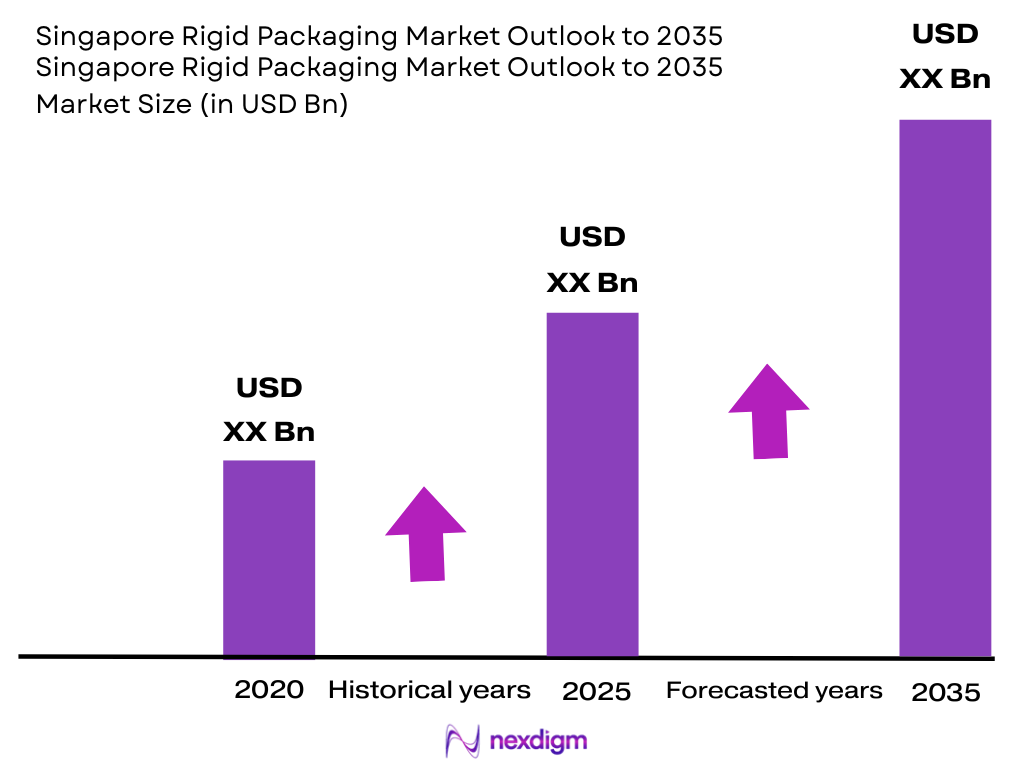
The Singapore rigid packaging market was valued at USD ~ Billion in 2024 and is expected to expand at a ~% CAGR during 2026–2035. The market is driven by strong demand from food & beverage, pharmaceuticals, personal care, chemicals, and electronics industries. Singapore’s advanced manufacturing ecosystem, strategic location as a regional trade hub, and stringent food safety standards continue to stimulate demand for premium rigid packaging solutions. Singapore’s total merchandise trade exceeded SGD 1.2 trillion in 2024, while manufacturing contributed approximately 20% to national GDP, creating sustained demand for industrial and consumer packaging.
Market Segmentation
By Material Type
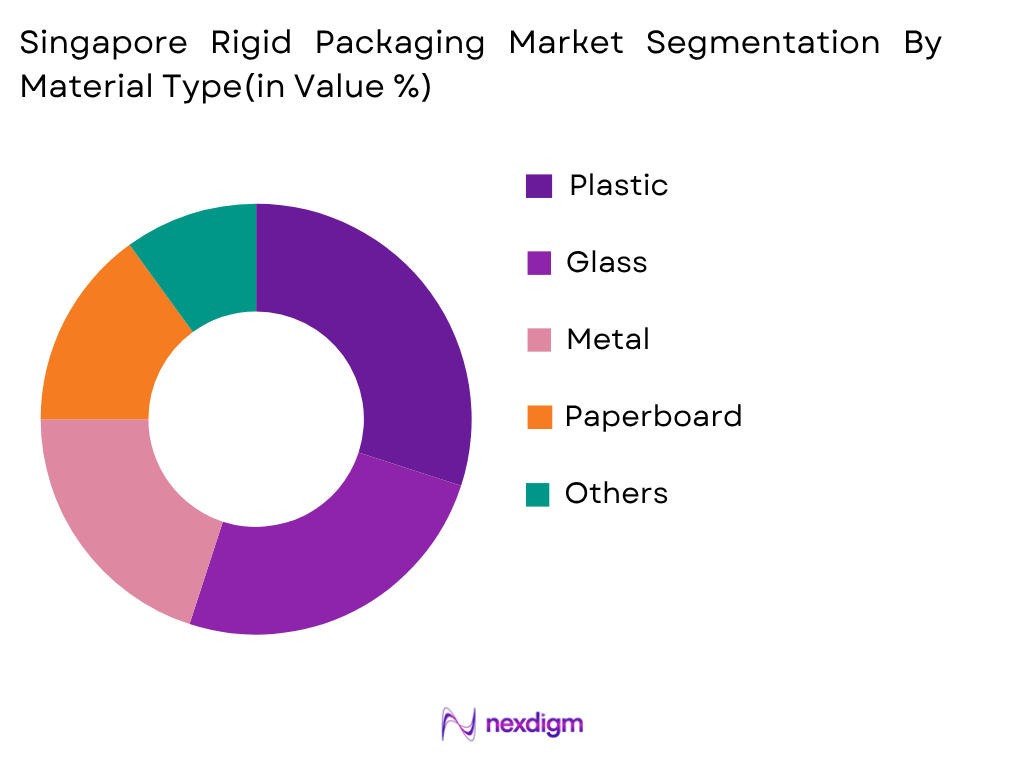
The Singapore rigid packaging market is segmented by material type into Plastic, Glass, Metal, Paperboard, and Wood. Plastic remains the dominant segment owing to its superior versatility, lightweight nature, durability, and compatibility with automated manufacturing systems. PET, HDPE, and polypropylene packaging materials are widely used across food, beverages, pharmaceuticals, cosmetics, and household products due to their excellent barrier properties and cost efficiency. Singapore’s strong emphasis on food safety, export-quality packaging, and sustainable manufacturing has also accelerated the adoption of recyclable plastics and food-grade recycled PET (rPET). Continuous investments in lightweight packaging technologies and circular economy initiatives further reinforce plastic’s leading position despite increasing environmental regulations.
By End-Use Industry
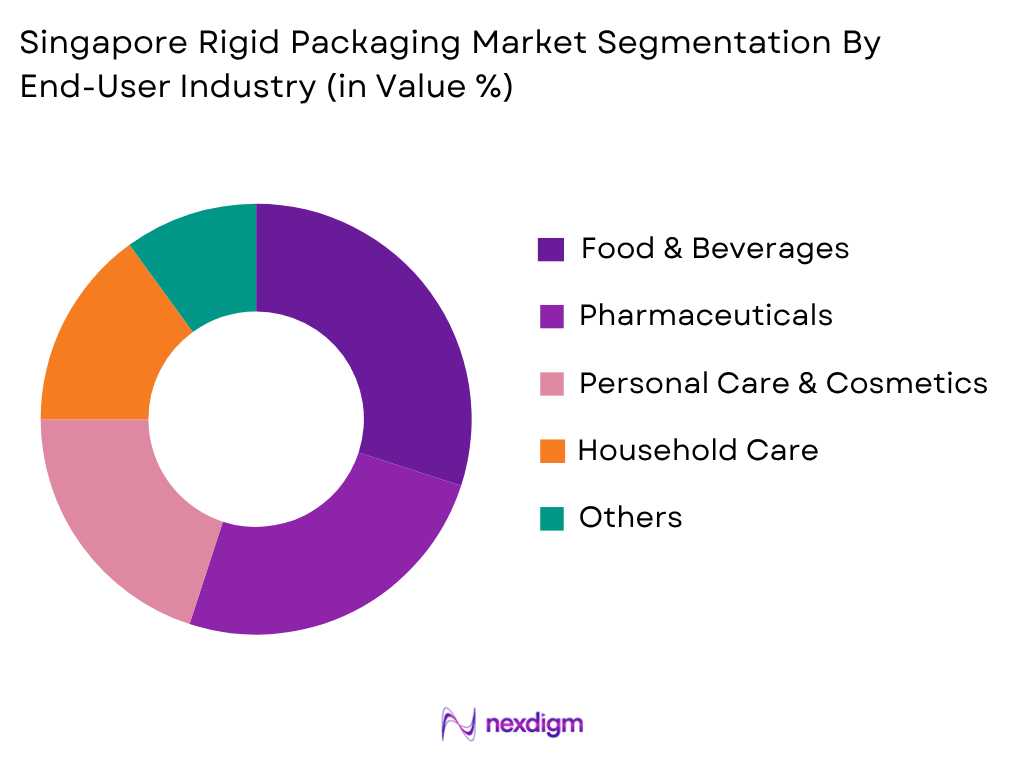
The Singapore rigid packaging market is segmented by end-use industry into Food & Beverages, Pharmaceuticals, Personal Care & Cosmetics, Household Care, Chemicals, Industrial Packaging, Healthcare, and Electronics. Food & Beverages represent the dominant segment due to Singapore’s highly developed food manufacturing sector, extensive beverage production, and substantial imports requiring repackaging and distribution. Strict food safety regulations and premium product positioning encourage the use of high-quality rigid bottles, jars, containers, and closures. The pharmaceutical industry also contributes significantly through demand for pharmaceutical-grade packaging, but food and beverage manufacturers continue to generate the highest consumption due to the volume of packaged food products distributed through retail, hospitality, and export channels.
Competitive Landscape
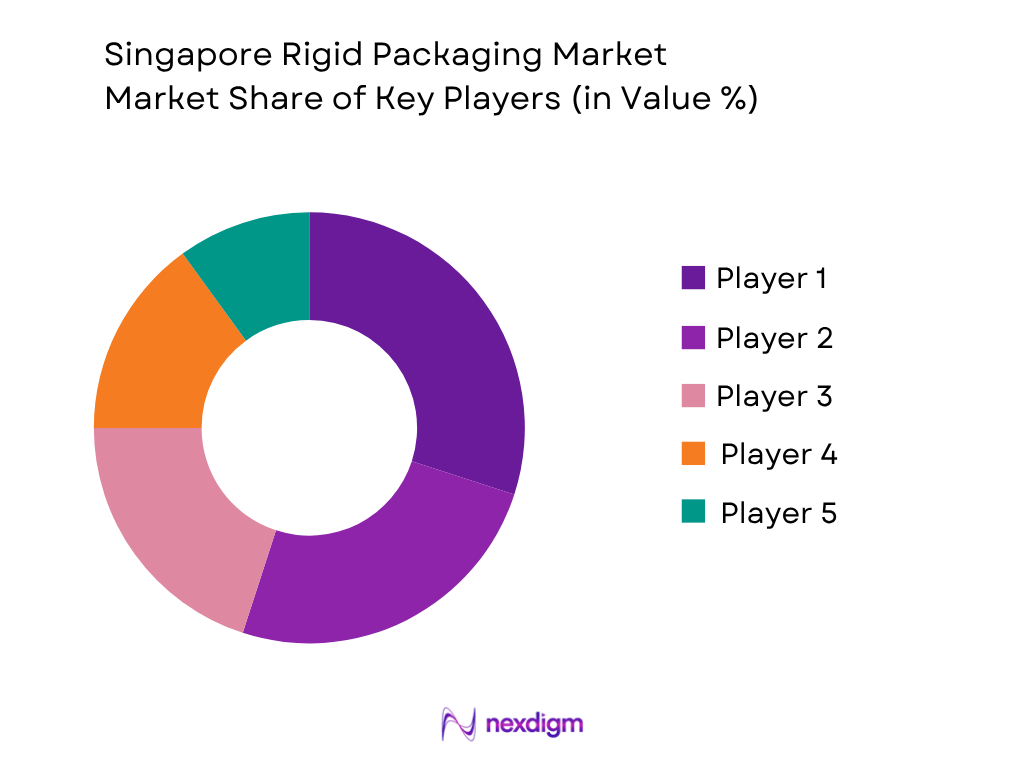
The Singapore rigid packaging market is moderately consolidated, with multinational packaging companies and regional manufacturers serving food, pharmaceutical, industrial, and consumer goods industries. Competition is based on manufacturing quality, sustainability initiatives, innovation, automation capabilities, and long-term supply agreements with multinational FMCG and pharmaceutical companies. Manufacturers continue investing in recycled materials, smart packaging solutions, lightweight designs, and advanced production technologies to strengthen their competitive positions within Singapore and the broader Southeast Asian region.
| Company | Established | Headquarters | Primary Product Portfolio | Rigid Packaging Portfolio | Manufacturing Presence | Major End-Use Industries | Key Strategic Focus | Certifications & Compliance |
| Amcor plc | 1860 | ~ | ~ | ~ | ~ | ~ | ~ | ~ |
| ALPLA Group | 1955 | ~ | ~ | ~ | ~ | ~ | ~ | ~ |
| Berry Global Inc. | 1967 | ~ | ~ | ~ | ~ | ~ | ~ | ~ |
| Silgan Holdings Inc. | 1987 | ~ | ~ | ~ | ~ | ~ | ~ | ~ |
| AptarGroup Inc. | 1940 | ~ | ~ | ~ | ~ | ~ | ~ | ~ |
Singapore Rigid Packaging Market Analysis
Growth Drivers
Expansion of Food & Beverage Manufacturing
Singapore’s rigid packaging market is significantly driven by the country’s highly developed food and beverage manufacturing industry, which requires large volumes of PET bottles, glass containers, metal cans, rigid tubs, and closures for domestic consumption and exports. The manufacturing sector contributed SGD 114.8 billion in nominal value added during 2024, remaining one of the country’s largest economic sectors. Singapore’s economy recorded a GDP of SGD 673.3 billion in 2024, while the country’s population reached 6.04 million. Government initiatives continue supporting food manufacturing modernization through automation and productivity enhancement schemes, encouraging manufacturers to adopt advanced packaging technologies. Singapore also remains one of Asia’s largest food trading hubs, handling billions of dollars in processed food imports and exports annually through its integrated logistics network. Increasing production of ready-to-eat meals, bottled beverages, dairy products, sauces, edible oils and premium packaged foods has strengthened demand for rigid packaging offering superior barrier protection, product integrity and shelf-life extension. Advanced automated filling lines used by multinational food manufacturers also favor rigid plastic and glass packaging because of their dimensional consistency and compatibility with high-speed production systems. These structural advantages continue supporting long-term demand for rigid packaging solutions across Singapore’s food manufacturing ecosystem.
Growth of Pharmaceutical and Biomedical Manufacturing
Singapore’s pharmaceutical and biomedical manufacturing industry remains one of the strongest demand generators for rigid packaging due to strict regulatory requirements for medicine safety, sterility and traceability. The biomedical manufacturing sector produced SGD 39.7 billion worth of manufacturing output during 2024, making it one of Singapore’s highest-value manufacturing industries. Total manufacturing value added reached SGD 114.8 billion, highlighting the significant contribution of pharmaceutical production to industrial activity. Singapore hosts manufacturing facilities for numerous multinational pharmaceutical companies producing vaccines, biologics, active pharmaceutical ingredients and finished dosage formulations that require HDPE bottles, pharmaceutical containers, rigid closures and specialty packaging. The country also recorded a GDP per capita exceeding USD 89,000 and a population of 6.04 million, supporting continued healthcare expenditure and pharmaceutical demand. Singapore’s internationally recognized regulatory framework and strong export capabilities encourage pharmaceutical manufacturers to adopt premium rigid packaging meeting global quality standards. Expansion of biologics manufacturing, precision medicine production and healthcare logistics continues creating demand for high-performance rigid packaging capable of maintaining product stability, tamper resistance and regulatory compliance throughout regional distribution networks.
Market Challenges
Dependence on Imported Raw Materials
Singapore’s rigid packaging industry depends heavily on imported polymer resins, glass raw materials, aluminum and steel because of limited domestic natural resources. Total merchandise imports exceeded SGD 660 billion during 2024, reflecting Singapore’s reliance on international supply chains for industrial raw materials. The economy generated GDP of SGD 673.3 billion, while manufacturing remained one of the largest contributors to economic output. Imported PET resin, HDPE, polypropylene, aluminum sheets and specialty packaging additives expose rigid packaging manufacturers to global logistics disruptions, shipping delays and raw material availability fluctuations. Singapore’s strategic position as a global trading hub partially offsets these risks through efficient port infrastructure, yet manufacturers remain vulnerable to international supply chain interruptions. Packaging producers supplying food, pharmaceutical and electronics industries must maintain larger inventories and diversified sourcing strategies to ensure uninterrupted production. The dependence on imported feedstock also increases procurement complexity and inventory management requirements for converters producing bottles, jars, industrial containers and pharmaceutical packaging. These structural characteristics continue influencing manufacturing efficiency and operational planning throughout Singapore’s rigid packaging value chain.
Stringent Environmental Regulations and Sustainability Compliance
Singapore’s ambitious environmental policies require rigid packaging manufacturers to continuously invest in recyclable materials, sustainable packaging design and waste reduction initiatives. Singapore generated approximately 6.97 million tonnes of solid waste during 2024, while packaging waste remained one of the country’s largest waste streams requiring improved recovery and recycling systems. Under the Mandatory Packaging Reporting framework, producers are required to report packaging supplied to the domestic market and develop waste reduction plans. The Singapore Green Plan 2030 further encourages resource efficiency, circular economy practices and sustainable manufacturing across industrial sectors. Packaging manufacturers therefore face increasing compliance requirements related to recycled content, material traceability, eco-design and reporting obligations. While these policies encourage innovation, they also require continuous investments in new production technologies, material testing and certification processes. Companies supplying multinational food, beverage and pharmaceutical manufacturers must additionally comply with stringent international packaging standards, increasing operational complexity while creating pressure to accelerate adoption of sustainable rigid packaging solutions.
Market Opportunities
Rising Adoption of Recycled and Circular Packaging Solutions
Singapore’s transition toward a circular economy presents substantial opportunities for rigid packaging manufacturers specializing in recyclable and food-grade packaging materials. Plastic waste generation reached approximately 982,000 tonnes during 2024, highlighting the growing need for recycled packaging solutions and improved material recovery systems. The Mandatory Packaging Reporting framework requires producers to evaluate packaging reduction opportunities and strengthen sustainability practices across supply chains. Singapore’s economy generated GDP of SGD 673.3 billion, and its advanced manufacturing ecosystem continues encouraging investments in recycled PET (rPET), closed-loop recycling technologies and lightweight packaging innovations. Food and beverage companies, pharmaceutical manufacturers and consumer goods producers increasingly prefer packaging incorporating recycled materials to meet corporate sustainability commitments and evolving consumer expectations. Local investments in advanced recycling infrastructure and polymer recovery technologies create additional opportunities for packaging converters to expand production of environmentally responsible rigid packaging products. These developments strengthen long-term demand for high-value packaging solutions while supporting Singapore’s broader resource efficiency and circular economy objectives.
Growth in Advanced Manufacturing and Export-Oriented Industries
Singapore’s position as one of Asia’s leading advanced manufacturing and export economies continues creating favorable opportunities for rigid packaging suppliers. Non-oil domestic exports exceeded SGD 200 billion during 2024, while total manufacturing value added reached SGD 114.8 billion, reflecting sustained industrial production across pharmaceuticals, specialty chemicals, electronics and food manufacturing. Continued investments into high-value manufacturing sectors require sophisticated packaging for export markets. Pharmaceutical products, specialty chemicals, consumer healthcare products and premium food exports require rigid packaging that complies with international transportation, safety and quality standards. Singapore’s world-class logistics infrastructure, including Tuas Port and Changi Air Cargo facilities, further supports export-oriented manufacturing requiring durable and lightweight packaging solutions. Continuous investment in Industry 4.0 technologies, automation and precision manufacturing strengthens demand for advanced rigid packaging products capable of supporting efficient production, product protection and international distribution. These industrial developments provide significant opportunities for packaging manufacturers to expand value-added product portfolios and strengthen long-term supply relationships with multinational manufacturers.
Future Outlook
The Singapore rigid packaging market is expected to witness healthy long-term growth driven by increasing demand for sustainable packaging, expanding pharmaceutical manufacturing, premium food packaging, and continued investments in circular economy initiatives. Government policies supporting green manufacturing and recycling, combined with rising exports of packaged consumer goods, are expected to accelerate innovation in lightweight and recyclable rigid packaging. Digital manufacturing, automation, and smart packaging technologies are also expected to improve production efficiency and enhance value-added packaging solutions across multiple industries.
Major Players
- Amcor plc
- Berry Global Inc.
- ALPLA Group
- Plastics Technology Pte Ltd
- Silgan Holdings Inc.
- Graham Packaging Company
- Mauser Packaging Solutions
- Dynapack Asia
- Toyo Seikan Group Holdings
- AptarGroup Inc.
- Ball Corporation
- Crown Holdings Inc.
- Visy Packaging Singapore
- Huhtamaki Singapore Pte Ltd
- Schütz GmbH & Co. KGaA
Key Target Audience
- Food & Beverage Manufacturers
- Pharmaceutical Manufacturers
- Personal Care & Cosmetics Companies
- Chemical Manufacturers
- Industrial Packaging Buyers
- Investment and Venture Capitalist Firms
- Government and Regulatory Bodies (National Environment Agency (NEA), Enterprise Singapore, Singapore Food Agency (SFA), Ministry of Sustainability and the Environment (MSE))
- Packaging Machinery and Automation Companies
Research Methodology
Step 1: Identification of Key Variables
The initial phase involves constructing an ecosystem map covering raw material suppliers, rigid packaging manufacturers, converters, distributors, food manufacturers, pharmaceutical companies, retailers, and regulatory authorities within the Singapore Rigid Packaging Market. Extensive secondary research is conducted using government databases, trade publications, customs statistics, company annual reports, and proprietary industry databases to identify the critical variables influencing market demand and supply.
Step 2: Market Analysis and Construction
Historical market information is compiled through detailed assessment of production volumes, packaging consumption, import-export trade statistics, manufacturing output, and end-user demand across major industries. Bottom-up market estimation is combined with top-down validation using macroeconomic indicators to ensure reliable market sizing while analyzing production capacity, material consumption, and industry utilization trends.
Step 3: Hypothesis Validation and Expert Consultation
Market assumptions are validated through computer-assisted telephone interviews (CATIs) and discussions with packaging manufacturers, raw material suppliers, FMCG companies, pharmaceutical manufacturers, distributors, and industry associations. Operational insights regarding production capacity, procurement strategies, technological developments, pricing trends, sustainability initiatives, and future investment plans are incorporated to refine and validate market estimates.
Step 4: Research Synthesis and Final Output
The final stage integrates quantitative market estimates with qualitative findings collected from industry stakeholders. Forecast models consider manufacturing investments, trade flows, sustainability regulations, consumer demand, technological advancements, and circular economy developments. The final report undergoes multiple validation stages to ensure consistency, accuracy, and actionable business intelligence for industry participants.

- Executive Summary
- Research Methodology (Market Definitions and Assumptions, Abbreviations, Market Sizing Approach, Top-Down Analysis, Bottom-Up Analysis, Demand-Side Assessment, Supply-Side Assessment, Primary Industry Interviews, Secondary Research Validation, Data Triangulation, Forecasting Framework, Limitations and Future Conclusions)

- Definition and Scope
- Market Evolution and Industry Genesis
- Timeline of Major Industry Developments
- Rigid Packaging Industry Value Chain Analysis
- Supply Chain Analysis

- Growth Drivers (Expansion of Food Processing Industry, Growth in Pharmaceutical Manufacturing, Rising Demand for Premium Consumer Packaging, Increase in Export-Oriented Manufacturing, Growth of E-commerce Logistics, Government Support for Sustainable Manufacturing)
- Market Challenges (Dependence on Imported Raw Materials, High Manufacturing and Labor Costs, Limited Land Availability for Industrial Expansion, Stringent Environmental Regulations, Recycling Infrastructure Challenges)
- Market Opportunities (Growth in Sustainable Packaging Solutions, Rising Adoption of Recycled PET (rPET), Smart Packaging Technologies, Expansion of Pharmaceutical Packaging, Premium Food Packaging Innovation, Circular Economy Investments)
- Market Trends (Lightweight Packaging Designs, High Adoption of Food-Grade Recycled Plastics, Smart Labels and QR-enabled Packaging, Automation in Packaging Production, Mono-material Packaging Development, Digital Printing Technologies)
- Government Regulations (Singapore Green Plan 2030, Mandatory Packaging Reporting (MPR), Extended Producer Responsibility (EPR), National Environment Agency Packaging Guidelines, Food Contact Material Regulations, SS Standards for Packaging Materials)
- Raw Material Price Trend Analysis
- Import Dependency Assessment
- Supply-Demand Gap Analysis
- Recycling Ecosystem Analysis
- SWOT Analysis
- Porter’s Five Forces Analysis
- PESTLE Analysis
- Stakeholder Ecosystem
- Competition Ecosystem

- By Market Value (2020-2025)
- By Volume Consumption (2020-2025)
- By Average Selling Price (2020-2025)

- By Material Type (In Value %)
Plastic
Glass
Metal
Paperboard
Wood - By Product Type (In Value %)
Bottles
Jars
Containers
Cans
Drums
Crates
Intermediate Bulk Containers (IBCs)
Caps & Closures - By Manufacturing Process (In Value %)
Injection Molding
Blow Molding
Stretch Blow Molding
Extrusion Blow Molding
Thermoforming
Compression Molding - By End-Use Industry (In Value %)
Food & Beverages
Pharmaceuticals
Personal Care & Cosmetics
Household Care
Chemicals
Industrial Packaging
Healthcare
Electronics - By Region (In Value %)
South West
South South
South East
North Central
North West
North East

- Market Share of Major Players (By Revenue, Production Capacity, Product Type, End-Use Industry)
- Cross Comparison Parameters (Production Capacity, Material Portfolio, Manufacturing Facilities, Product Portfolio Breadth, Sustainability & Recycled Packaging Capability, Food & Pharmaceutical Packaging Expertise, Regional Distribution Network, Innovation & Smart Packaging Portfolio)
- SWOT Analysis of Major Players
- Pricing Analysis by Product Type and Material
- Production Capacity Benchmarking
- Manufacturing Footprint Analysis
- Recent Expansions, Investments and Strategic Partnerships
- Detailed Profiles of Major Companies
Amcor plc
Berry Global Inc.
ALPLA Group
Plastics Technology Pte Ltd
Silgan Holdings Inc.
Graham Packaging Company
Mauser Packaging Solutions
Dynapack Asia
Toyo Seikan Group Holdings
AptarGroup Inc.
Ball Corporation
Crown Holdings Inc.
Visy Packaging Singapore
Huhtamaki Singapore Pte Ltd
Schütz GmbH & Co. KGaA

- Packaging Consumption Analysis by Industry
- Procurement and Supplier Selection Analysis
- Packaging Specification Requirements
- Purchasing Power and Budget Allocation
- Sustainability Preference Assessment
- Packaging Innovation Adoption
- Product Protection and Shelf-Life Requirements
- Consumer Packaging Preference Analysis (Convenience, Durability, Product Safety, Recyclability, Premium Appearance)
- Pain Point Analysis
- Purchase Decision-Making Process

- By Market Value (2026-2035)
- By Volume Consumption (2026-2035)
- By Average Selling Price (2026-2035)


 Request a Sample
 Ask for Customization
 Get a Quote
 Enquire Now