
 Download PDF
Market Overview
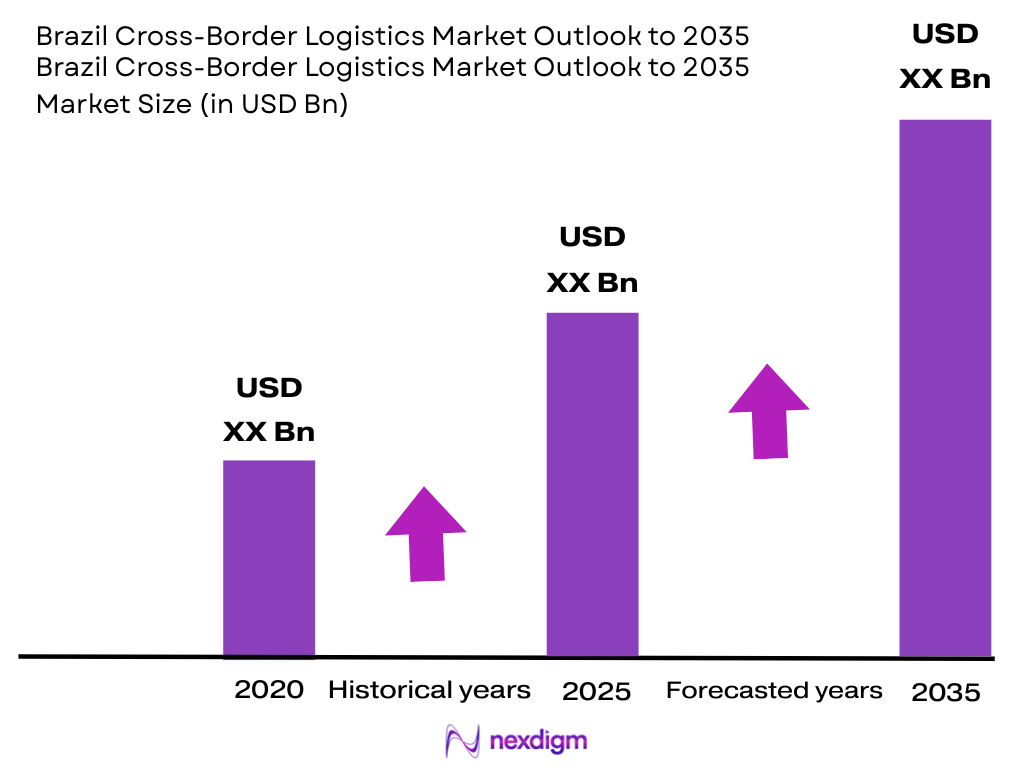
The Brazil Cross-Border Logistics Market was valued at USD ~ Billion in 2024 and is anticipated to expand at a CAGR of ~ % during 2026–2035. The market is primarily driven by Mercosur and EU-Mercosur trade agreement implementation, rising agricultural export volumes, and growth of e-commerce and cross-border parcel delivery. According to Mordor Intelligence, the Brazil Freight and Logistics Market was worth USD 116.42 billion in 2026 and is growing at a CAGR of 4.78 percent to reach USD 147.06 billion by 2031, while the Brazil Third-Party Logistics Market, a core enabler of cross-border freight movement, was estimated at USD 30.75 billion in 2023, with the International Transportation Management (ITM) segment holding the largest share at 36.68 percent, propelled by increasing global economic activities and cross-border trade liberalization under agreements such as Mercosur.
Market Segmentation
By Mode of Transport
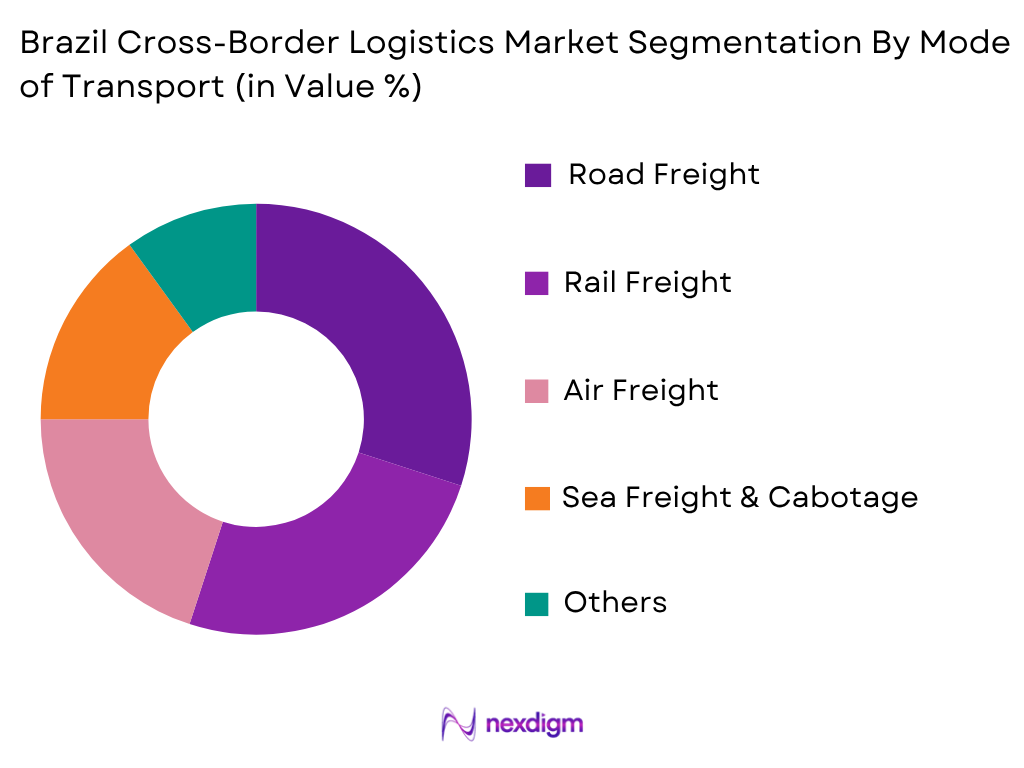
Among these, Road Freight holds a significant share of the Brazil Cross-Border Logistics Market, particularly across the Mercosur corridor connecting Brazil with Argentina, Uruguay, and Paraguay, supporting industries such as agriculture, mining, and manufacturing that require seamless cross-border logistics solutions, according to IMARC Group. However, cargo owners shipping perishable goods continue to favor road despite higher emissions, delaying the modal rebalance necessary for the market to hit sustainability targets, according to Mordor Intelligence. At the same time, Sea Freight & Cabotage represents a rapidly scaling segment, with cabotage volumes growing 20 percent to reach 1.55 million containers in 2024, even though cabotage remains costlier than trucking on many legs because terminal handling fees add up to 35 percent of total door-to-door transport costs. The BR do Mar law, which permits foreign vessel chartering, continues to reshape cabotage economics, though port congestion persists during soybean export peaks, eroding schedule reliability.
By Trade Corridor
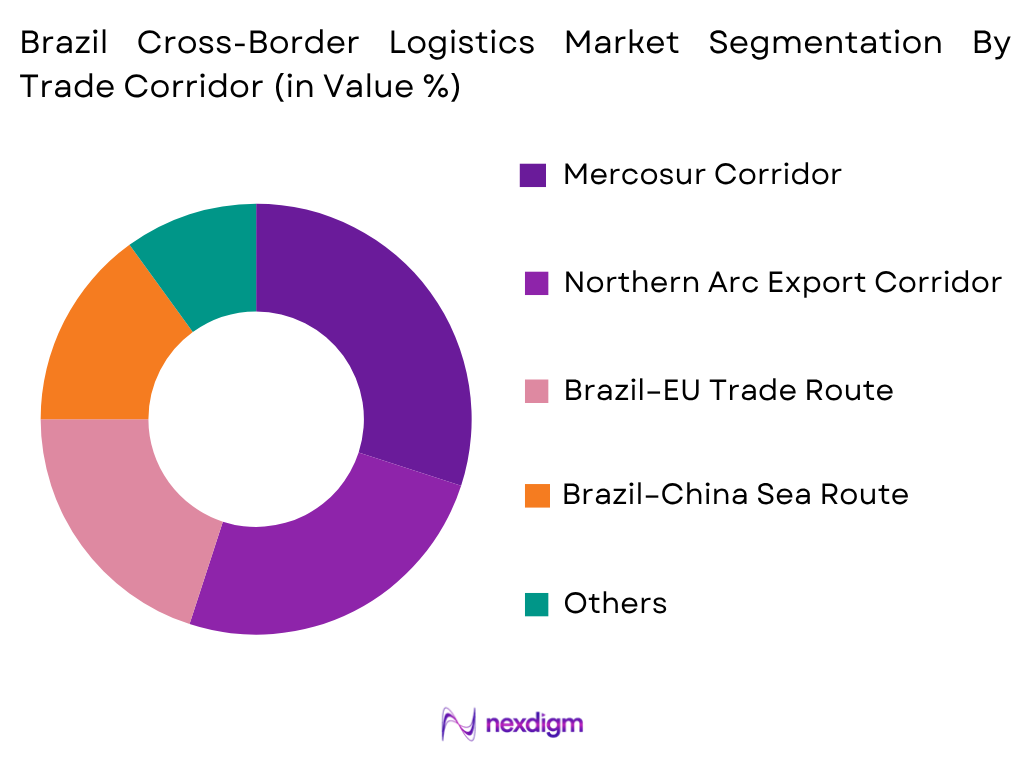
The Mercosur Corridor holds a leading share of the Brazil Cross-Border Logistics Market, with the Mercosur preferential trade agreement exemplifying the rising multilateral free-trade agreements propelling international transportation demand, according to Grand View Research. Free trade agreements such as MERCOSUR-Southern African Customs Union (SACU) and the EU-Mercosur Trade Agreement are further influencing demand for international transportation services. Meanwhile, the Northern Arc Export Corridor is emerging as a high-growth channel, with Northern Arc terminals shortening interior truck hauls by up to 1,000 kilometers compared with southern ports, lowering logistics costs for grain producers. Soybean exports are projected at 105.47 million tons and corn at 34 million tons in the 2024-25 season, catalyzing rail links such as VLI’s Ferrovia Norte-Sul expansion, while private concessions at the ports of Itaqui and Mirituba add berth capacity tailored to Panamax vessels, complementing berth deepening at Santos as southern ports respond competitively.
Competitive Landscape
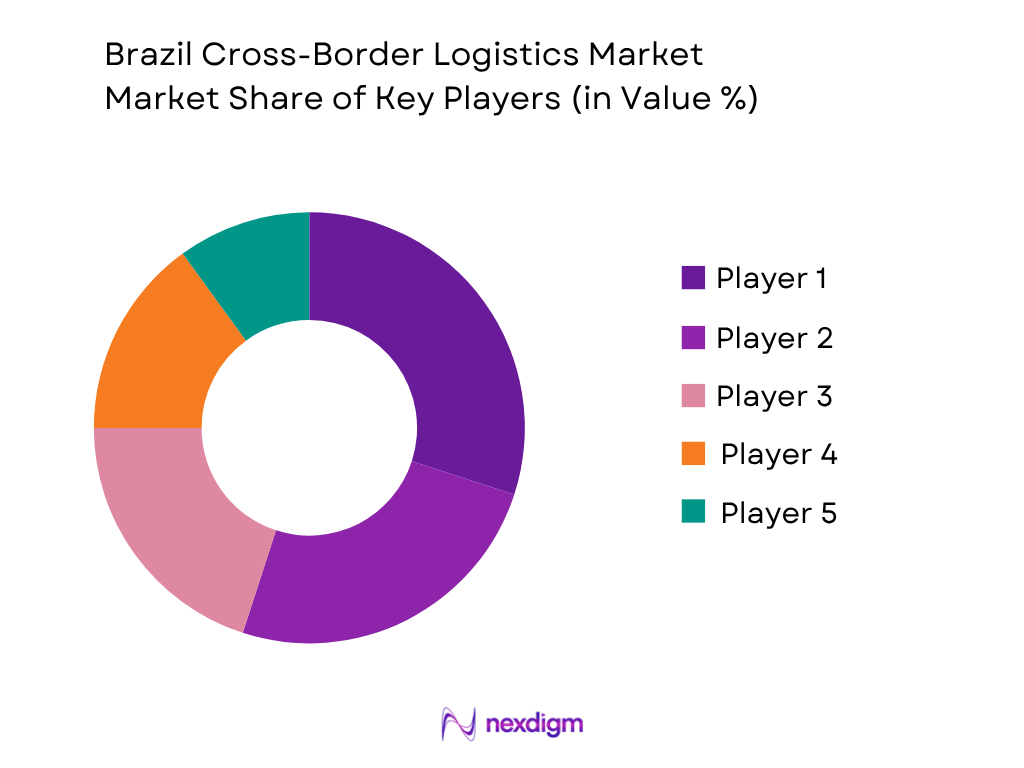
The Brazil Cross-Border Logistics Market is moderately consolidated, with A.P. Moller-Maersk, DHL Group, FedEx, JSL SA, and Kuehne+Nagel identified as the major companies operating in the market, according to Mordor Intelligence. Brazil’s participation in international trade agreements and its strategic geographic location position it as a potential hub for cross-border logistics services connecting South America with other regions, according to MarkWide Research. Correios’ blockchain prototype for traceability, alongside a dozen venture-backed startups, extends digital coverage from long-haul to last-mile delivery, while regulatory clarity from ANTT is accelerating technology adoption by fleet owners seeking back-haul loads and fuel rebates. Chinese investors, notably China Merchants Group, are evaluating stakes in Brazilian port infrastructure, reinforcing long-term capital inflows and reshaping the competitive dynamics of the country’s cross-border logistics sector.
| Company | Established | Headquarters | Primary Service | Cross-Border Network | Customs Brokerage | Digital Visibility Platform | Sustainability capability | Certifications & Complainces |
| A.P. Moller – Maersk | 1904 | ~ | ~ | ~ | ~ | ~ | ~ | ~ |
| DHL Group | 1969 | ~ | ~ | ~ | ~ | ~ | ~ | ~ |
| FedEx Corporation | 1971 | ~ | ~ | ~ | ~ | ~ | ~ | ~ |
| JSL SA | 1956 | ~ | ~ | ~ | ~ | ~ | ~ | ~ |
| Kuehne+Nagel | 1890 | ~ | ~ | ~ | ~ | ~ | ~ | ~ |
Brazil Cross-Border Logistics Market Analysis
Growth Drivers
Mercosur Trade Agreement Implementation and Agricultural Export Growth
Brazil’s cross-border logistics market is experiencing sustained growth due to Mercosur trade agreement implementation and rising agricultural export volumes. Increasing global economic activities and the growth of the e-commerce sector have led to an increase in demand for International Transportation Management services, with cross-border transport activities and trade liberalization policies increasing international trade, according to Grand View Research. Soybean exports are projected at 105.47 million tons and corn at 34 million tons in the 2024-25 season, according to Mordor Intelligence, catalyzing continued investment in rail links and port capacity. Brazil’s position as a major participant in international trade has attracted businesses seeking to tap into the South American market, intensifying the need for well-established logistics networks and positioning Brazil as a critical hub for cross-border goods movement, according to IMARC Group.
Government Investment in Port, Rail and Multimodal Infrastructure
Sustained government and private investment in Brazil’s port, rail, and multimodal infrastructure remains a major driver for cross-border logistics demand. Northern Arc terminals are shortening interior truck hauls by up to 1,000 kilometers compared with southern ports, lowering logistics costs for grain producers, according to Mordor Intelligence. Private concessions at the ports of Itaqui and Mirituba are adding berth capacity tailored to Panamax vessels, while berth deepening at Santos signals southern ports’ competitive response to rising cross-border trade volumes. VLI’s Ferrovia Norte-Sul expansion continues to catalyze rail-linked export capacity, and the BR do Mar law’s permission for foreign vessel chartering further expands cabotage shipping options, collectively strengthening Brazil’s cross-border logistics infrastructure across multiple transport modes.
Market Challenges
High Terminal Handling Fees and Port Congestion
Despite steady demand growth, the Brazil cross-border logistics market remains constrained by high terminal handling fees and recurring port congestion. Even after 20 percent growth to 1.55 million containers in 2024, cabotage remains costlier than trucking on many legs because terminal handling fees add up to 35 percent of total door-to-door transport costs, according to Mordor Intelligence. Although the BR do Mar law permits foreign vessel chartering, port congestion persists during soybean export peaks, eroding schedule reliability for cross-border shippers. These structural cost and congestion pressures continue to favor road transport despite its higher emissions profile, delaying the modal rebalance necessary for Brazil’s cross-border logistics market to meet Mercosur-EU sustainability requirements.
Poor Road Infrastructure and Regulatory Compliance Complexity
Brazil’s cross-border logistics market faces structural challenges from inconsistent road infrastructure quality outside major corridors and regulatory compliance complexity across customs jurisdictions. While Brazil benefits from an extensive road network connecting major industrial hubs to urban centers, infrastructure quality varies significantly outside the Southeast’s core corridors linking São Paulo and Rio de Janeiro, according to IMARC Group. Cross-border shippers must navigate customs requirements under Receita Federal, ANTT regulatory oversight, and Mercosur’s Common External Tariff framework simultaneously, creating documentation and compliance complexity that can extend transit times and increase operational costs for logistics providers serving multiple South American markets.
Market Opportunities
Rising Investment in Rail-Linked Multimodal Terminal Capacity
Brazil’s expanding agricultural export volumes and government-backed infrastructure investment create significant opportunities for investment in rail-linked multimodal terminal capacity. VLI’s Ferrovia Norte-Sul expansion and private port concessions at Itaqui and Mirituba illustrate the scale of capital flowing into Brazil’s Northern Arc export corridor, which shortens interior truck hauls by up to 1,000 kilometers compared with southern ports, according to Mordor Intelligence. As Chinese investors, notably China Merchants Group, evaluate stakes in Brazilian port infrastructure, logistics providers investing early in rail-linked, multimodal terminal capacity are positioned to capture growing demand from grain exporters and cross-border shippers seeking to reduce logistics costs and improve schedule reliability across Brazil’s expanding export infrastructure.
Expansion of Blockchain Traceability and Predictive Analytics
Brazil’s growing digitalization of logistics processes creates substantial long-term opportunities for technology-enabled cross-border logistics providers. Correios’ blockchain prototype for traceability, alongside a dozen venture-backed startups, extends digital coverage from long-haul to last-mile delivery, according to Mordor Intelligence. Predictive analytics that optimize empty-mile reduction improve carrier margins, bolster fleet utilization, and temper emissions, aligning with Mercosur-EU sustainability requirements. Regulatory clarity from ANTT is accelerating adoption by fleet owners seeking back-haul loads and fuel rebates, creating opportunities for logistics providers offering technology-enabled supply chain transparency and route optimization solutions across Brazil’s cross-border trade network.
Future Outlook
The Brazil Cross-Border Logistics Market is expected to witness sustained expansion over the forecast period, supported by continued Mercosur trade agreement implementation, expanding agricultural export volumes, and increasing government investment in port, rail, and multimodal infrastructure. Continued investment in Northern Arc port capacity, blockchain-enabled traceability, and predictive analytics for route optimization will further accelerate formalization across the industry. The market is also likely to benefit from Brazil’s position as South America’s largest economy and a critical hub for cross-border trade, enabling greater investment in advanced, sustainable, and cost-competitive logistics technologies capable of serving both regional Mercosur trade and broader international trade corridors.
Major Players
- A.P. Moller – Maersk
- DHL Group
- FedEx Corporation
- JSL SA
- Kuehne+Nagel
- CEVA Logistics
- XPO Logistics
- Atlasmex
- VLI Multimodal S.A.
- Localfrio
- Sequoia Logística
- Correios
- Tegma Gestão Logística S.A.
- Wilson Sons
- Rumo S.A.
Key Target Audience
- Freight Forwarders and Customs Brokers
- Agriculture and Agribusiness Exporters
- Manufacturing and Automotive Companies
- E-Commerce and Retail Platforms
- Port, Terminal and Rail Operators
- Investment and Venture Capitalist Firms
- Government and Regulatory Bodies (Receita Federal, Agência Nacional de Transportes Terrestres (ANTT), Ministério do Desenvolvimento, Indústria, Comércio e Serviços)
- Fleet, Trucking and Warehousing Infrastructure Providers
Research Methodology
Step 1: Identification of Key Variables
The research process begins with identifying the complete ecosystem of the Brazil Cross-Border Logistics Market, including freight forwarders, customs brokers, port and terminal operators, agricultural and manufacturing shippers, rail and trucking providers, and regulatory authorities. Extensive secondary research is conducted using company annual reports, government publications, trade associations, customs statistics, industry journals, and proprietary databases to determine the variables influencing market demand, pricing, corridor volumes, and technological developments.
Step 2: Market Analysis and Construction
Historical market information is collected and analyzed to estimate market size, freight volumes, corridor-level trade activity, and pricing trends. A combination of top-down and bottom-up approaches is used to estimate market revenues and validate segment-level performance. Consumption patterns across agriculture, manufacturing, e-commerce, and pharmaceutical cross-border corridors are evaluated to establish an accurate representation of the industry.
Step 3: Hypothesis Validation and Expert Consultation
The preliminary findings are validated through Computer-Assisted Telephone Interviews (CATIs) and structured discussions with freight forwarders, customs brokers, port operators, fleet managers, regulatory experts, and senior executives operating within the Brazilian cross-border logistics industry. These interviews help verify market assumptions, competitive developments, technology adoption trends, pricing dynamics, and future investment opportunities while refining the overall market estimates.
Step 4: Research Synthesis and Final Output
The final stage integrates insights obtained from primary interviews with quantitative information collected through secondary sources. Data triangulation techniques are applied to reconcile differences between supply-side and demand-side estimates, ensuring robust market forecasting. The report is then reviewed through multiple quality assurance checkpoints to deliver a comprehensive analysis covering market size, segmentation, competitive landscape, future outlook, and strategic recommendations for industry stakeholders.

- Executive Summary
- Research Methodology (Market Definitions and Assumptions, Abbreviations, Market Sizing Approach, Top-Down Analysis, Bottom-Up Analysis, Demand-Side Assessment, Supply-Side Assessment, Primary Industry Interviews, Trade Flow Assessment, Freight Intelligence Analysis, Data Triangulation, Forecasting Framework, Limitations and Future Conclusions)

- Definition and Scope
- Market Evolution and Industry Genesis
- Timeline of Major Industry Developments
- Cross-Border Trade Value Chain Analysis
- Cross-Border Logistics Supply Chain Analysis
- Trade Corridor Ecosystem Analysis

- Growth Drivers (Mercosur and EU-Mercosur Trade Agreement Implementation, Rising Agricultural Export Volumes, Growth of E-Commerce and Cross-Border Parcel Delivery, Government Investment in Port and Rail Infrastructure, Rising Adoption of Cabotage Shipping Under BR do Mar Law, Foreign Direct Investment in Multimodal Terminal Capacity)
- Market Challenges (High Terminal Handling Fees Compressing Cabotage Economics, Port Congestion During Soybean Export Peaks, Poor Road Infrastructure Outside Major Corridors, Regulatory Compliance Complexity Across Customs Jurisdictions, Currency Volatility Affecting Freight Cost Structures, Modal Imbalance Favoring Emissions-Intensive Road Transport)
- Market Opportunities (Investment in Rail-Linked Multimodal Terminal Capacity, Growth in Cold-Chain and Pharmaceutical Cross-Border Logistics, Expansion of Northern Arc Port Capacity for Grain Exports, Blockchain-Enabled Supply Chain Traceability, Predictive Analytics for Empty-Mile Reduction, Consolidation Through Strategic Investment and Partnerships)
- Market Trends (Rising Adoption of Blockchain Traceability Prototypes, Growth in Northern Arc Port Capacity Investment, Predictive Analytics for Backhaul and Fuel Rebate Optimization, Rail Expansion Along the Ferrovia Norte-Sul Corridor, Foreign Vessel Chartering Under BR do Mar, Chinese Strategic Investment in Port Infrastructure)
- Government Regulations (Receita Federal Customs Requirements, Agência Nacional de Transportes Terrestres (ANTT) Regulatory Oversight, BR do Mar Law for Cabotage and Foreign Vessel Chartering, Mercosur Common External Tariff, Siscomex Foreign Trade Integrated System, ANVISA Cross-Border Pharmaceutical Compliance)
- Import and Export Analysis (Trade Volume, Major Import Sources, Export Destinations, HS Code Analysis, Trade Balance)
- Raw Material and Infrastructure Availability Analysis (Port and Terminal Capacity, Rail Network Capacity, Trucking Fleet Availability, Warehousing Capacity)
- Technology Landscape (Blockchain-Enabled Traceability, Predictive Analytics for Route Optimization, IoT and Real-Time Fleet Monitoring, Automated Customs Documentation Systems, Cold-Chain Monitoring Systems)
- Sustainability Assessment (Modal Shift from Road to Rail and Cabotage, Electric and Hybrid Vehicle Adoption, Emissions Reduction Aligned with Mercosur-EU Sustainability Requirements, Empty-Mile Reduction Initiatives, Circular Economy Integration)
- PESTLE Analysis
- SWOT Analysis
- Porter’s Five Forces Analysis
- Stakeholder Ecosystem
- Competition Ecosystem

- By Market Value (2020-2025)
- By Freight Volume (2020-2025)
- By Average Logistics Cost per Shipment (2020-2025)

- By Service Type (In Value %)
International Transportation Management
Customs Brokerage & Clearance
Warehousing & Distribution
Freight Forwarding
Value-Added Logistics Services - By Mode of Transport (In Value %)
Road Freight
Sea Freight & Cabotage
Rail Freight
Air Freight - By Trade Corridor (In Value %)
Mercosur Corridor (Argentina, Uruguay, Paraguay)
Brazil–China Sea Route
Brazil–EU Trade Route
Northern Arc Export Corridor
Santos-Based Southern Corridor - By End-Use Industry (In Value %)
Agriculture & Agribusiness
Manufacturing & Automotive
Mining & Energy
E-Commerce & Retail
Pharmaceuticals & Healthcare - By Region (In Value %)
Southeast Brazil
South Brazil
Northeast Brazil
North Brazil (Amazon Region)

- Market Share of Major Players (By Value, Volume, Service Type, Corridor Coverage, End-Use Industry)
- Cross Comparison Parameters (Service Portfolio Breadth, Corridor and Network Coverage, Customs Brokerage Capability, Cold-Chain and Technical Support Capability, Fleet and Terminal Capacity, Regulatory Compliance & Certifications, Customer Base Across Industries, Innovation & Technology Adoption Frequency)
- SWOT Analysis of Major Players
- Pricing Analysis by Service Category and Corridor
- Fleet and Terminal Capacity Analysis
- Network and Corridor Footprint Analysis
- Distribution and Hub Network Analysis
- Innovation Benchmarking
- Detailed Profiles of Major Companies
A.P. Moller – Maersk
DHL Group
FedEx Corporation
JSL SA
Kuehne+Nagel
CEVA Logistics
XPO Logistics
Atlasmex
VLI Multimodal S.A.
Localfrio
Sequoia Logística
Correios
Tegma Gestão Logística S.A.
Wilson Sons
Rumo S.A.

- Consumption Pattern Analysis (Industrial Usage, Shipment Volume, Corridor Penetration, Seasonal Demand, Route Diversification Activity)
- Purchasing Criteria (Transit Time Reliability, Cost Efficiency, Customs Clearance Speed, Cargo Security, Regulatory Compliance, Real-Time Tracking Capability)
- Procurement and Provider Selection Analysis
- Sustainable Logistics Adoption Assessment
- Premium vs Standard Freight Service Demand
- Service Attribute Preference Analysis (Transit Reliability, Documentation Accuracy, Cold-Chain Integrity, Real-Time Visibility, Corridor Coverage, Cost Competitiveness)
- Trade Formalization and Digital Customs Influence on Provider Selection
- Pain Point Analysis
- Decision-Making Process

- By Market Value (2026-2035)
- By Freight Volume (2026-2035)
- By Average Logistics Cost per Shipment (2026-2035)


 Request a Sample
 Ask for Customization
 Get a Quote
 Enquire Now