
 Download PDF
Market Overview
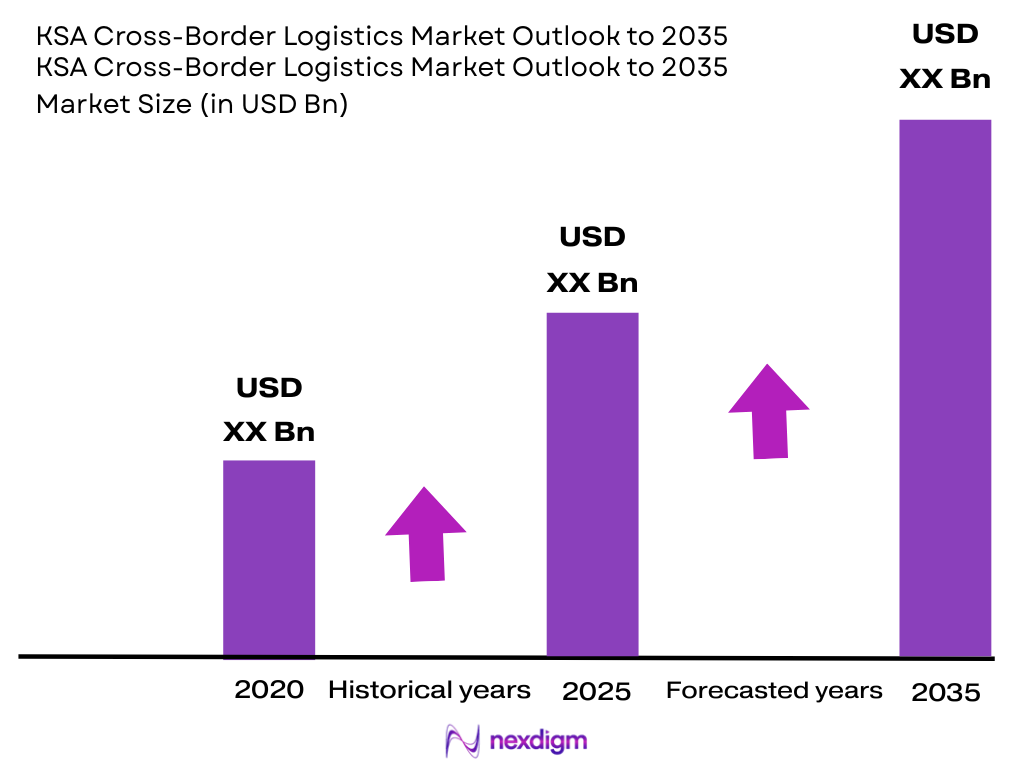
The KSA Cross Border Logistics Market was valued at approximately USD ~ Billion in 2025 and is estimated to grow to approximately USD ~ Billion in 2026 and reach approximately USD ~ Billion by 2031, reflecting a compound annual growth rate of approximately 5.96% during 2026-2031. The market continues to be shaped by Saudi Arabia’s diversification agenda under Vision 2030, the four-laning of the Batha-Al Ghuwaifat corridor, and near-universal two-hour electronic customs clearance through the Zakat, Tax and Customs Authority’s FASAH single-window system, which together continue to shrink transit times and spur volume gains across the Kingdom’s cross-border trade corridors. In a significant and highly current development, uncertainty surrounding the Strait of Hormuz has pushed cargo owners toward Gulf land bridges and Red Sea-facing ports that do not depend on a single maritime chokepoint, with customs declarations across affected corridors jumping from approximately 12,000 in March 2026 to approximately 100,000 in April 2026, positioning Saudi Arabia as the primary beneficiary of this diverted cargo flow within a GCC freight and logistics market valued at approximately USD 83 billion in 2025 and projected to reach approximately USD 120 billion by 2031.
Market Segmentation
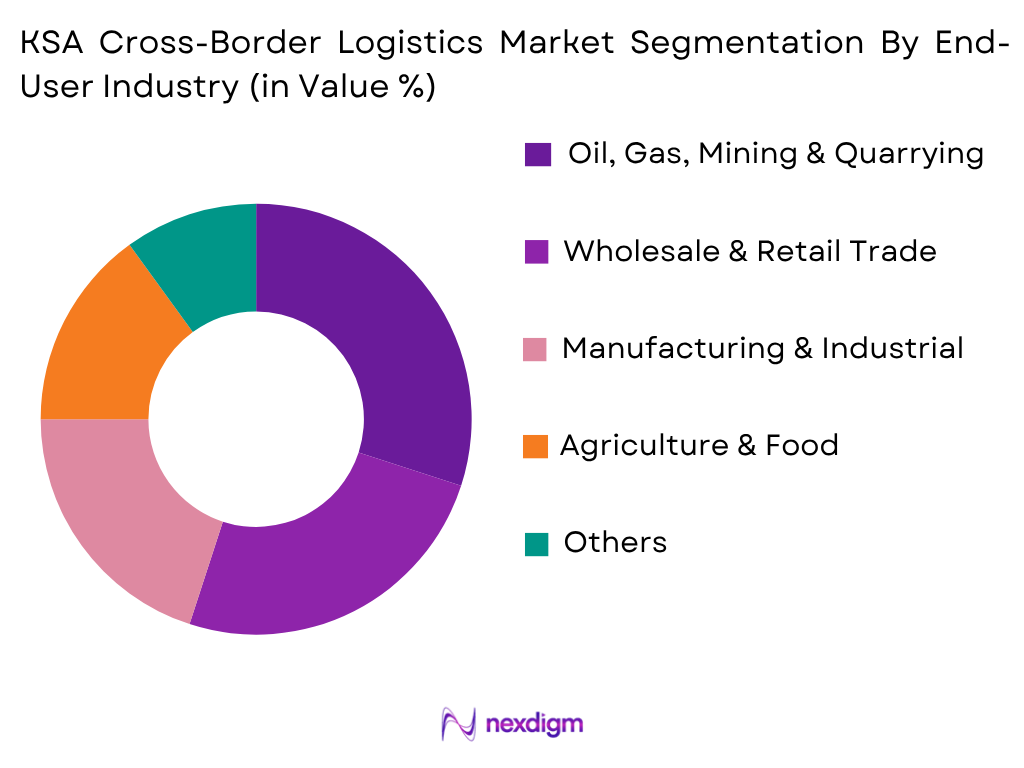
By End User Industry
Oil, Gas, Mining & Quarrying captured approximately 33.83% of the KSA Cross Border Logistics Market in 2025, reflecting the continued prevalence of petrochemical exports and inbound mining equipment moving across the Kingdom’s land borders. Wholesale & Retail Trade is forecast to expand at approximately 7.61% CAGR through 2031, the quickest growth rate among all end-user industries, fueled substantially by e-commerce parcels moving overnight from UAE fulfillment centers into the Kingdom. This structural pivot toward consumer goods is already visible in daily less-than-truckload consolidations at the Batha border crossing, where consumer goods now fill return legs that once ran empty toward Riyadh. Manufacturing localization continues to add steady, two-way flows of machinery parts and components, with machinery and electrical parts already comprising approximately 23.2% of Saudi Arabia’s non-oil exports, as automotive assembly clusters in King Abdullah Economic City and Jeddah increasingly require synchronized inbound parts flow and time-definite export logistics.
By Corridor
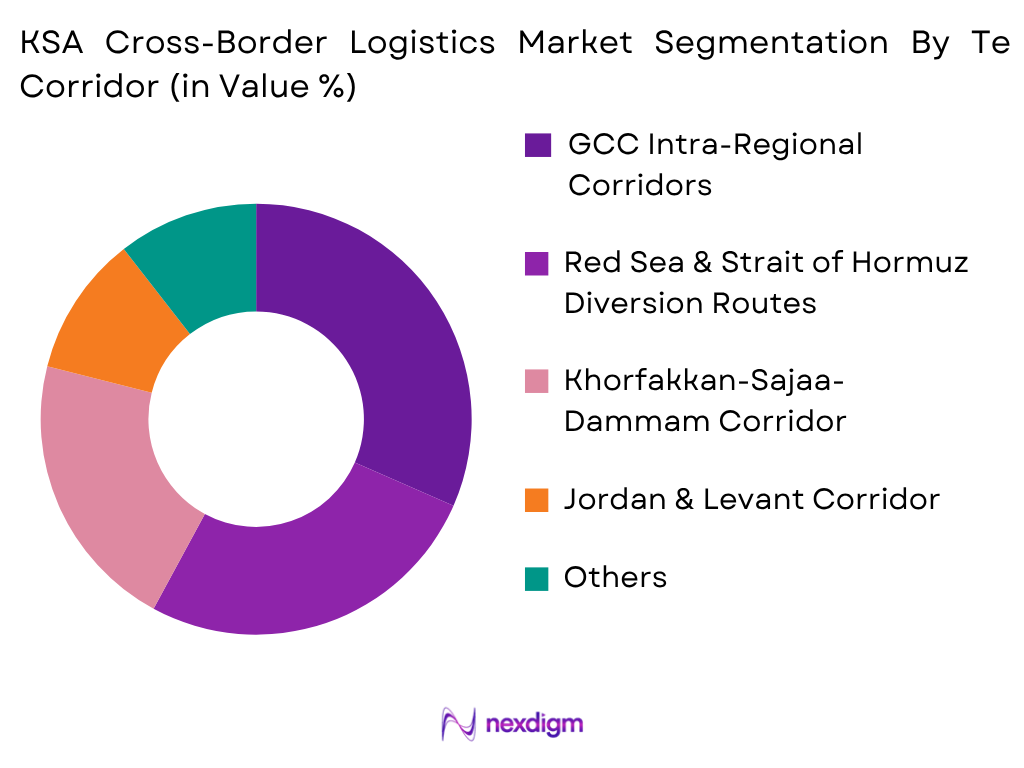
GCC Intra-Regional Corridors, anchored by the Batha-Al Ghuwaifat crossing connecting Saudi Arabia to the United Arab Emirates, represent the dominant corridor category within the KSA Cross Border Logistics Market, supported by continued four-laning investment and near-universal two-hour electronic customs clearance under the FASAH system. Red Sea & Strait of Hormuz Diversion Routes represent the fastest-growing corridor category, reflecting a highly current structural shift in regional cargo flows as shippers respond to uncertainty around the Strait of Hormuz by moving volume onto Gulf land bridges and Red Sea-facing ports; customs declarations across the affected corridor jumped from approximately 12,000 in March 2026 to roughly 100,000 in April 2026, illustrating the scale of diverted volume this arrangement has absorbed. The Khorfakkan-Sajaa-Dammam Corridor, which links Sharjah’s port and dry-port infrastructure with Saudi Arabia’s Eastern Province market, further ties Omani and Emirati gateways into the Dammam hub, reinforcing GCC ministers’ broader push toward multi-gateway optionality that reduces shippers’ dependence on any single strait or port to reach the Saudi east or Dubai markets.
Competitive Landscape
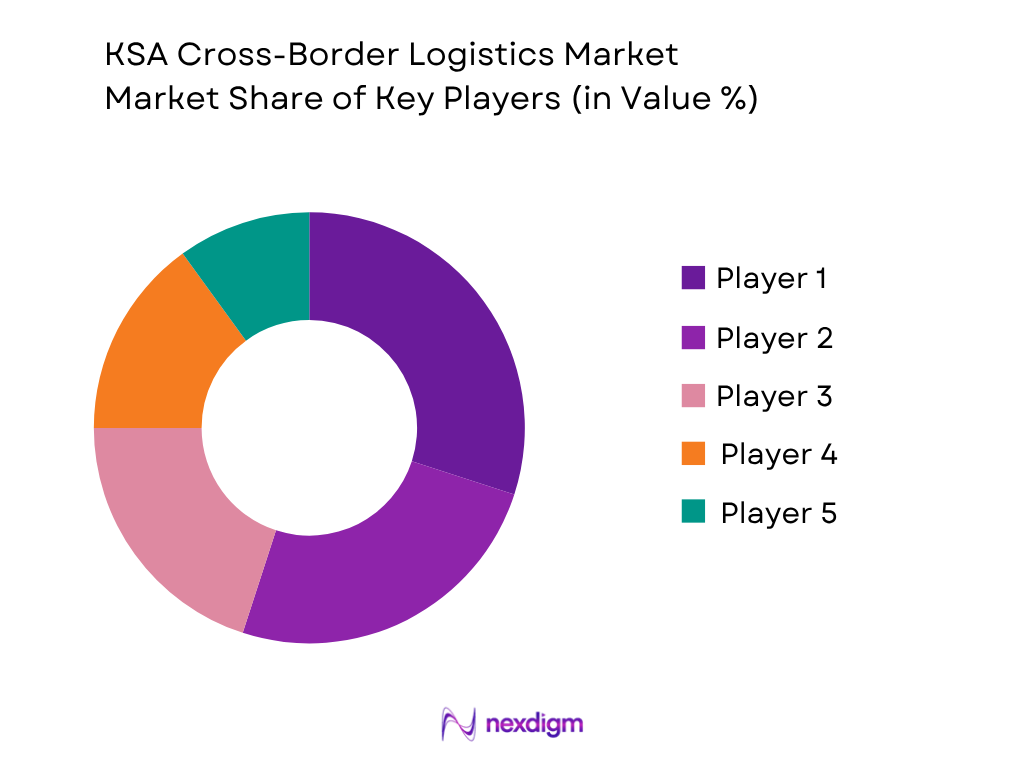
The KSA Cross Border Logistics Market features a mix of publicly listed Saudi logistics champions, regional and global freight forwarders, and specialized express and last-mile operators competing across the Kingdom’s road, sea-air, and emerging multimodal rail corridors. SAL Saudi Logistics Services Company has emerged as a leading domestic player benefiting directly from Vision 2030’s National Transport and Logistics Strategy, which is backed by approximately USD 133 billion in planned investment and a stated aim of positioning Saudi Arabia among the top ten global logistics hubs connecting three continents. Agility’s approximately USD 163 million logistics park near Jeddah, offering six multi-tenant warehouses located 11 kilometers from the port, illustrates the scale of investment global players are directing toward Saudi Arabia’s bonded logistics zone capacity. Almajdouie Logistics and Bahri maintain substantial domestic freight and shipping capability, while DSV, Kuehne+Nagel, and DHL Supply Chain continue to expand their Saudi presence to serve multinational manufacturers and e-commerce platforms navigating the Kingdom’s evolving customs digitalization requirements. Digital freight platforms and joint-venture consolidation among carriers continue to reshape competitive dynamics, as operators increasingly pursue multimodal rail links launched by Saudi Arabia Railways in 2026 to enhance capacity and reliability beyond conventional road freight.
| Company | Established | Headquarters | Primary Service Portfolio | Cross-Border Corridor Coverage | Fleet & Terminal Capacity | Major End-Use Industries | Key Strategic Focus | Certifications & Compliance |
| SAL Saudi Logistics Services Company | 2021 | ~ | ~ | ~ | ~ | ~ | ~ | ~ |
| Agility Public Warehousing Company | 1979 | ~ | ~ | ~ | ~ | ~ | ~ | ~ |
| Almajdouie Logistics | 1965 | ~ | ~ | ~ | ~ | ~ | ~ | ~ |
| Bahri (National Shipping Company of Saudi Arabia) | 1978 | ~ | ~ | ~ | ~ | ~ | ~ | ~ |
| DSV A/S | 1976 | ~ | ~ | ~ | ~ | ~ | ~ | ~ |
KSA Cross-Border Logistics Market Analysis
Growth Drivers
FASAH Digital Customs Modernization and Vision 2030 Infrastructure Investment
The KSA cross-border logistics market is experiencing sustained growth due to continued digitalization of customs clearance procedures under the Zakat, Tax and Customs Authority’s FASAH system, which now delivers near-universal two-hour electronic customs clearance and has fundamentally reshaped transit reliability across the Kingdom’s land border crossings. Since 2017, Saudi Customs has actively pursued digitalization of its clearance procedures, with the FASAH single-window platform connecting all organizations involved in trade regulation, including environment, commerce, agriculture, customs, and port authorities, while its integration with the blockchain-enabled TradeLens solution developed by Maersk and IBM enables real-time exchange of shipment events and documents. Vision 2030’s National Transport and Logistics Strategy, launched in June 2021 and backed by approximately USD 133 billion in planned investment, continues to underpin steady capacity additions and service upgrades across the Kingdom’s airport, rail, and port infrastructure, with a stated aim of positioning Saudi Arabia among the top ten global logistics hubs connecting Africa, Asia, and Europe. Customs interoperability initiatives with Bahrain and the UAE have further shrunk border dwell times to under two hours for pre-cleared loads, reinforcing the structural shift toward faster, more predictable cross-border transit across the Kingdom’s primary trade corridors.
Strait of Hormuz Diversion and Red Sea Corridor Growth
Heightened uncertainty surrounding the Strait of Hormuz has pushed cargo owners to actively seek gateways that do not depend on a single maritime chokepoint, directly benefiting Saudi Arabia’s Red Sea coast and Gulf land bridge corridors. Customs declarations across the affected corridor jumped from approximately 12,000 in March 2026 to roughly 100,000 in April 2026, illustrating the scale of cargo volume this diversion arrangement has absorbed within a remarkably short window. A second connectivity thread links Sharjah’s port and dry-port infrastructure with Saudi Arabia’s Eastern Province market through the Khorfakkan-Sajaa-Dammam corridor, tying Omani and Emirati gateways into the same Dammam hub that GCC ministers have reinforced as part of a broader regional resilience strategy. The GCC freight and logistics market, valued at approximately USD 83 billion in 2025 and forecast to reach approximately USD 120 billion by 2031, continues to expand at a mid-single-digit annual pace, with Saudi Arabia already holding the largest share of that spend and possessing strong strategic incentive to capture cargo that previously defaulted to routes elsewhere in the region.
Market Challenges
Geopolitical Chokepoint Risk and Route Volatility
The KSA cross-border logistics market remains exposed to significant geopolitical risk stemming from regional chokepoint vulnerability, particularly uncertainty surrounding the Strait of Hormuz, which continues to reshape cargo routing decisions in ways that create both opportunity and operational complexity for Saudi logistics operators. While diverted cargo volumes have benefited Saudi Arabia’s Red Sea and Gulf land bridge corridors substantially, with customs declarations across affected routes surging from approximately 12,000 to roughly 100,000 within a single month in early 2026, this volatility itself signals underlying regional risk that requires shippers and logistics operators to maintain contingency routing capability rather than relying on any single corridor configuration. Operators serving the Kingdom’s cross-border trade must continuously monitor and adapt to shifting geopolitical conditions that can rapidly alter optimal routing decisions, creating planning complexity for carriers seeking to commit long-term capacity investment to any single corridor or gateway. This chokepoint-driven volatility underscores the strategic importance of the multi-gateway optionality that GCC customs interoperability initiatives and corridor diversification strategies are designed to provide, even as the underlying geopolitical uncertainty driving this volatility remains outside the direct control of logistics market participants.
Logistics Zone Capacity Absorption Risk
Substantial new logistics infrastructure coming online across Saudi Arabia creates a meaningful execution risk around capacity absorption, as major projects including the approximately USD 1.14 billion SAL Logistics Zone north of Riyadh, spanning 1.5 million square meters of grade-A space and opening in phases from 2025, and Agility’s approximately USD 163 million Jeddah park must attract sufficient tenant demand to justify their scale of investment. While these hubs are designed to enable just-in-time cross-border sourcing and boost trucking frequency, the pace of demand growth from small and medium manufacturers being lured to zones near Dammam, Jubail, Arar, and Riyadh under Vision 2030 incentives will determine whether this substantial capacity investment translates into proportional freight volume growth or results in underutilized logistics real estate during the initial absorption period. Logistics operators and infrastructure investors must carefully calibrate expansion timing against realistic demand growth trajectories, particularly as multiple large-scale zones across different regions compete for the same pool of manufacturing tenants and cross-border freight volume.
Market Opportunities
Multimodal Rail Integration and Logistics Zone Development
Saudi Arabia Railways’ 2026 launch of multimodal rail links creates substantial opportunity for logistics operators seeking to diversify beyond conventional road freight and enhance both capacity and reliability across the Kingdom’s cross-border corridors. The approximately USD 1.14 billion SAL Logistics Zone north of Riyadh, opening in phases from 2025 across 1.5 million square meters of grade-A space, alongside Agility’s approximately USD 163 million Jeddah park offering six multi-tenant warehouses just 11 kilometers from the port, together illustrate the scale of infrastructure investment creating new opportunity for logistics operators, tenants, and technology providers positioned to serve just-in-time cross-border sourcing requirements. As Vision 2030 incentives continue luring small and medium manufacturers to zones near Dammam, Jubail, Arar, and Riyadh, cutting lead times for component imports, logistics providers capable of offering integrated multimodal, warehousing, and customs brokerage services across these emerging industrial clusters are well positioned to capture disproportionate share of the Kingdom’s growing manufacturing-linked cross-border freight volume.
GCC Customs Interoperability and Sea-Air Corridor Expansion
Continued expansion of GCC customs interoperability initiatives, which have already shrunk border dwell times to under two hours for pre-cleared loads moving between Saudi Arabia, Bahrain, and the UAE, creates substantial opportunity for logistics operators capable of navigating multi-country compliance frameworks efficiently. The 2025 launch of MSC’s Clanga shipping service at Jubail Commercial Port, connecting Saudi Arabia with major East Asian markets including Singapore, Shanghai, and Colombo, alongside new shipping services linking Saudi ports to similar destinations, illustrates the continued build-out of sea-air corridor connectivity that positions the Kingdom to capture growing intercontinental trade flows. As Saudi Arabia’s cabotage relaxation framework continues broadening domestic route access for foreign carriers, tilting competition toward digitally enabled, multimodal offerings, logistics operators that combine strong FASAH digital compliance capability with sea-air corridor expertise are increasingly well positioned to capture growing cross-border freight volume connecting the Kingdom to both GCC neighbors and broader intercontinental trade partners.
Future Outlook
The KSA Cross Border Logistics Market is expected to witness steady expansion over the forecast period, supported by continued FASAH-driven digital customs modernization, sustained Vision 2030 infrastructure investment approaching USD 133 billion across airport, rail, and port projects, and ongoing diversion of regional cargo volumes toward Saudi Arabia’s Red Sea and Gulf land bridge corridors amid continued Strait of Hormuz uncertainty. Continued investment in multimodal rail integration, logistics zone development, and GCC customs interoperability will further shape competitive positioning across the industry as Saudi Arabia works toward its stated ambition of becoming a top-ten global logistics hub connecting Africa, Asia, and Europe. The market’s growth trajectory will remain closely tied to the pace of logistics zone capacity absorption and the broader region’s geopolitical stability, even as Saudi Arabia continues capturing an increasing share of the growing GCC freight and logistics market.
Major Players
- SAL Saudi Logistics Services Company
- Agility Public Warehousing Company
- Almajdouie Logistics
- Bahri (National Shipping Company of Saudi Arabia)
- DSV A/S
- Kuehne+Nagel Saudi Arabia
- DHL Supply Chain Saudi Arabia
- Aramex Saudi Arabia
- Zajil Express
- Saudi Arabia Railways (SAR)
- Bin Dawood Logistics
- Naqel Express
- SMSA Express Transportation
- Trukkin Technologies
- Barwil Unitor Saudi Arabia
Key Target Audience
- Cross-Border Logistics & Freight Forwarding Companies
- Oil, Gas & Petrochemical Companies
- E-Commerce & Retail Platforms
- Manufacturing & Industrial Companies
- Logistics Zone Developers & Tenants
- Investment and Venture Capitalist Firms
- Government and Regulatory Bodies (Zakat, Tax and Customs Authority (ZATCA), Ministry of Transport and Logistics Services, Saudi Ports Authority (Mawani))
- Customs Brokerage Agents and Freight Technology Providers
Research Methodology
Step 1: Identification of Key Variables
The research process begins with identifying the complete ecosystem of the KSA Cross Border Logistics Market, including freight carriers, customs brokerage agents, freight forwarders, warehousing and logistics zone operators, shippers, and regulatory authorities. Extensive secondary research is conducted using company annual reports, government publications, trade associations, customs statistics, industry journals, and proprietary databases to determine the variables influencing market demand, pricing, freight volumes, and infrastructure developments.
Step 2: Market Analysis and Construction
Historical market information is collected and analyzed to estimate market size, freight volumes, corridor-wise transit activity, end-user industry demand, and pricing trends. A combination of top-down and bottom-up approaches is used to estimate market revenues and validate segment-level performance. Consumption patterns across oil and gas, wholesale and retail trade, manufacturing, and construction cargo categories are evaluated to establish an accurate representation of the industry.
Step 3: Hypothesis Validation and Expert Consultation
The preliminary findings are validated through Computer-Assisted Telephone Interviews (CATIs) and structured discussions with cross-border freight operators, customs brokerage specialists, procurement and logistics managers, regulatory experts, and senior executives operating within the Saudi Arabian and broader GCC logistics industry. These interviews help verify market assumptions, competitive developments, technology adoption trends, pricing dynamics, and future investment opportunities while refining the overall market estimates.
Step 4: Research Synthesis and Final Output
The final stage integrates insights obtained from primary interviews with quantitative information collected through secondary sources. Data triangulation techniques are applied to reconcile differences between supply-side and demand-side estimates, ensuring robust market forecasting. The report is then reviewed through multiple quality assurance checkpoints to deliver a comprehensive analysis covering market size, segmentation, competitive landscape, future outlook, and strategic recommendations for industry stakeholders.

- Executive Summary
- Research Methodology (Market Definitions and Assumptions, Abbreviations, Market Sizing Approach, Top-Down Analysis, Bottom-Up Analysis, Demand-Side Assessment, Supply-Side Assessment, Primary Industry Interviews, Secondary Research Validation, Data Triangulation, Forecasting Framework, Limitations and Future Conclusions)

- Definition and Scope
- Market Evolution and Industry Genesis
- Timeline of Major Industry Developments
- Cross-Border Logistics Industry Value Chain Analysis
- Supply Chain Analysis

- Growth Drivers (FASAH Digital Customs Modernization, Vision 2030 Infrastructure Investment, Strait of Hormuz Diversion & Red Sea Corridor Growth, Growth in E-Commerce & Wholesale Trade LTL Volumes, Logistics Zone & Bonded Warehouse Expansion, Manufacturing Localization & Non-Oil Export Growth)
- Market Challenges (Geopolitical Chokepoint Risk & Route Volatility, Logistics Zone Capacity Absorption Risk, Customs Documentation & HS Code Compliance Complexity, Driver & Fleet Capacity Constraints, Regional Corridor Competition, Infrastructure Execution Timeline Risk)
- Market Opportunities (Multimodal Rail Integration Growth, GCC Customs Interoperability Expansion, Cold Chain & Pharmaceutical Logistics Growth, Sea-Air Corridor Development, Cabotage-Enabled Foreign Carrier Entry, Bonded E-Commerce Hub Development)
- Market Trends (Growth in Digital Freight Platform Adoption, Two-Hour Electronic Customs Clearance Standardization, Sea-Air Corridor Diversification, Joint-Venture Consolidation Among Carriers, Just-In-Time Cross-Border Sourcing, Multimodal Rail-Road Integration)
- Government Regulations (Zakat, Tax and Customs Authority (ZATCA) Pre-Clearance Requirements, FASAH Single Window Compliance, National Transport and Logistics Strategy, Cabotage Relaxation Framework, GCC Customs Interoperability Agreements, Bonded Zone & Free Zone Regulations)
- Import and Export Analysis (Trade Volume, Major Destination Markets, Corridor-Wise Freight Distribution, HS Code Analysis, Trade Balance)
- Infrastructure Availability Analysis (Border Post Capacity & Dwell Times, Highway Network Quality, Rail Network Development, Bonded Warehouse & Logistics Zone Capacity, Port & Sea-Air Corridor Infrastructure)
- Technology Landscape (FASAH Digital Customs Platform, MASAR Shipment Tracking Application, Blockchain-Enabled Trade Documentation, Digital Freight Matching Platforms, Warehouse Management & Automation Systems)
- Sustainability Assessment (Fleet Emission Reduction, Modal Shift from Road to Rail Potential, Renewable Energy Warehouse Integration, Route Optimization & Idle-Time Reduction, Regional Corridor Resilience)
- PESTLE Analysis
- SWOT Analysis
- Porter’s Five Forces Analysis
- Stakeholder Ecosystem
- Competition Ecosystem

- By Market Value (2020-2025)
- By Volume Consumption (2020-2025)
- By Average Selling Price (2020-2025)

- By Service Type (In Value %)
Road Freight Transport
Customs Brokerage & Digital Clearance (FASAH)
Warehousing & Bonded Zones
Sea-Air & Multimodal Freight
Rail Freight (Saudi Arabia Railways) - By End User Industry (In Value %)
Oil, Gas, Mining & Quarrying
Wholesale & Retail Trade (E-Commerce)
Manufacturing & Industrial
Construction
Agriculture & Food - By Corridor (In Value %)
GCC Intra-Regional Corridors (Batha-Al Ghuwaifat)
Red Sea & Strait of Hormuz Diversion Routes
Khorfakkan-Sajaa-Dammam Corridor
Jordan & Levant Corridor
Other Corridors - By Region (In Value %)
Riyadh Region
Eastern Province (Dammam & Jubail)
Makkah Region (Jeddah)
Northern Borders (Batha)
Other Regions

- Market Share of Major Players (By Value, Freight Volume, Service Type, Corridor, End-User Industry)
- Cross Comparison Parameters (Service Portfolio Breadth, Customs Brokerage & FASAH Integration Capability, Corridor & Logistics Zone Access, Fleet & Technology Integration, Warehousing & Bonded Storage Capacity, Regulatory Compliance & Certifications, Petrochemical & E-Commerce Customer Base, Innovation & Digital Platform Adoption)
- SWOT Analysis of Major Players
- Pricing Analysis by Corridor and Cargo Type
- Fleet Capacity Analysis
- Corridor Footprint Analysis
- Distribution & Agent Network Analysis
- Innovation Benchmarking
- Detailed Profiles of Major Companies
SAL Saudi Logistics Services Company
Agility Public Warehousing Company
Almajdouie Logistics
Bahri (National Shipping Company of Saudi Arabia)
DSV A/S
Kuehne+Nagel Saudi Arabia
DHL Supply Chain Saudi Arabia
Aramex Saudi Arabia
Zajil Express
Saudi Arabia Railways (SAR)
Bin Dawood Logistics
Naqel Express
SMSA Express Transportation
Trukkin Technologies
Barwil Unitor Saudi Arabia

- Consumption Pattern Analysis (Freight Volume, Shipment Frequency, Corridor Preference, Seasonal Demand, Modal Split Activity)
- Purchasing Criteria (Transit Time Reliability, Customs Compliance Support, Cost per Shipment, Cargo Visibility & Tracking, Multimodal Capability, Corridor Access)
- Procurement and Carrier Selection Analysis
- Digital Customs Adoption Assessment
- Petrochemical vs E-Commerce Cross-Border Demand Comparison
- Service Attribute Preference Analysis (Dwell Time Performance, Documentation Accuracy, Fleet & Technology Compatibility, Corridor Coverage, Real-Time Tracking, Cost Efficiency)
- Regulatory Compliance Influence on Carrier Selection
- Pain Point Analysis
- Decision-Making Process

- By Market Value (2026-2035)
- By Volume Consumption (2026-2035)
- By Average Selling Price (2026-2035)


 Request a Sample
 Ask for Customization
 Get a Quote
 Enquire Now