

 Download PDF
Market Overview
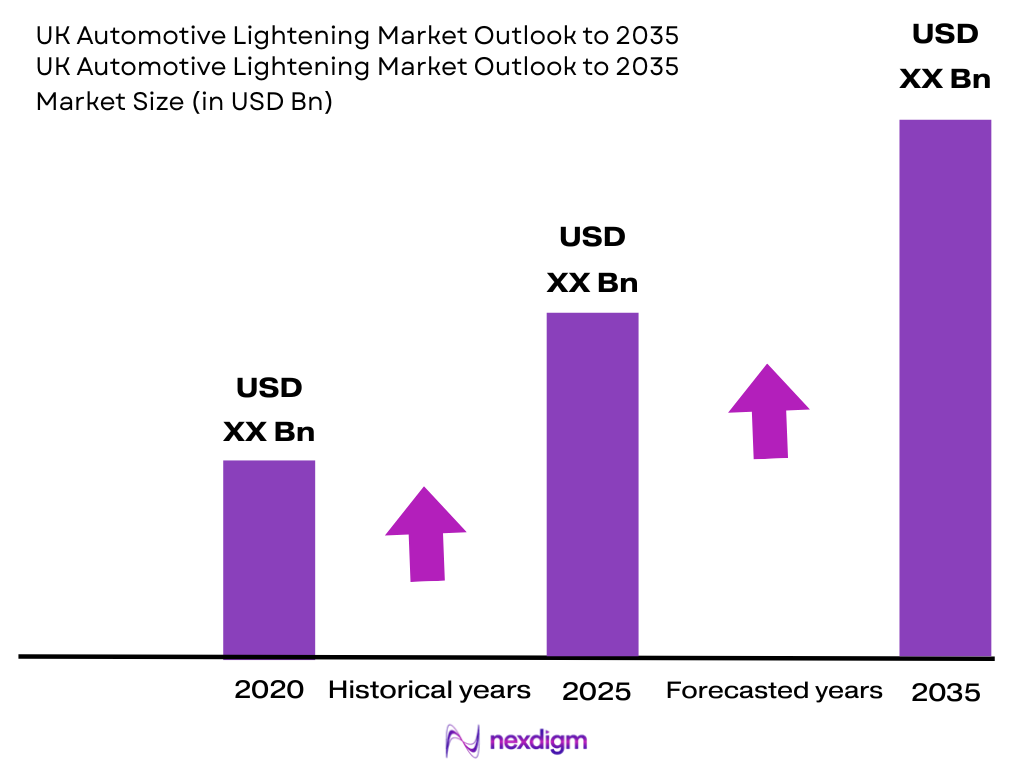
The UK Automotive Lightening Market is valued at approximately USD ~ Billion in 2025 based on a five-year historical assessment, driven by recovering new vehicle registrations, tightening UN ECE lighting regulations, and the continued shift from halogen to LED and adaptive lighting technology. The market is projected to grow steadily through 2035, supported by a maturing premium and SUV vehicle parc, rising electric vehicle penetration, and growing consumer demand for signature LED daytime running lights and adaptive driving beam headlamps. The West Midlands automotive cluster, together with manufacturing sites across North East and North West England, remain the largest OEM production and lighting-supplier demand centres, while the UK market continues to operate as a net importer of automotive lighting components, relying heavily on a concentrated supply base from European partners including the Czech Republic, Austria, and France. The Driver and Vehicle Standards Agency (DVSA) and the Vehicle Certification Agency (VCA) continue to enforce lighting and signalling requirements under UN ECE Regulation No. 48 and the Road Vehicle Lighting Regulations (RVLR) 1989, while the post-Brexit UK Conformity Assessed (UKCA) framework and adoption of UN ECE Regulation No. 149 on Adaptive Driving Beam headlamp systems are accelerating OEM adoption of matrix LED technology that improves nighttime visibility, reduces glare to oncoming traffic, and supports the country’s broader road safety and vehicle electrification objectives.
Market Segmentation
By Vehicle Type
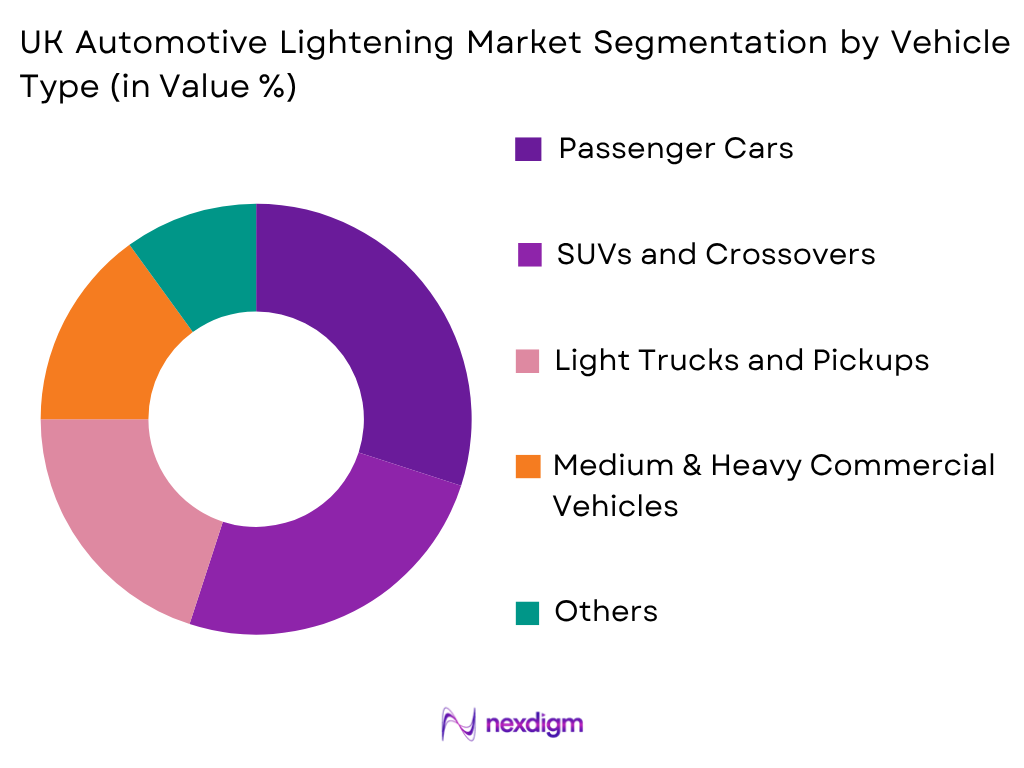
The Passenger Cars segment dominates the UK Automotive Lightening Market, supported by a large, continuously renewed vehicle parc concentrated around the West Midlands and North East England OEM manufacturing clusters. Rising consumer preference for SUVs and crossovers, sustained premium vehicle demand, and increasing electric vehicle adoption have accelerated OEM adoption of styled LED headlamp and tail lamp assemblies, while automakers increasingly equip vehicles sold in the United Kingdom with projector-LED headlamps and signature DRLs to meet both UN ECE Regulation No. 48 compliance and consumer styling expectations. The SUVs and Crossovers segment continues to gain share as UK new car buyers steadily shift away from traditional hatchbacks toward larger vehicle formats, while premium marques based in the UK continue to push adoption of matrix LED and Adaptive Driving Beam technology. Expanding electric vehicle availability across passenger and light commercial vehicle segments is further reinforcing demand for lightweight, energy-efficient lighting systems engineered to minimise battery drain and maximise driving range.
By Sales Channel
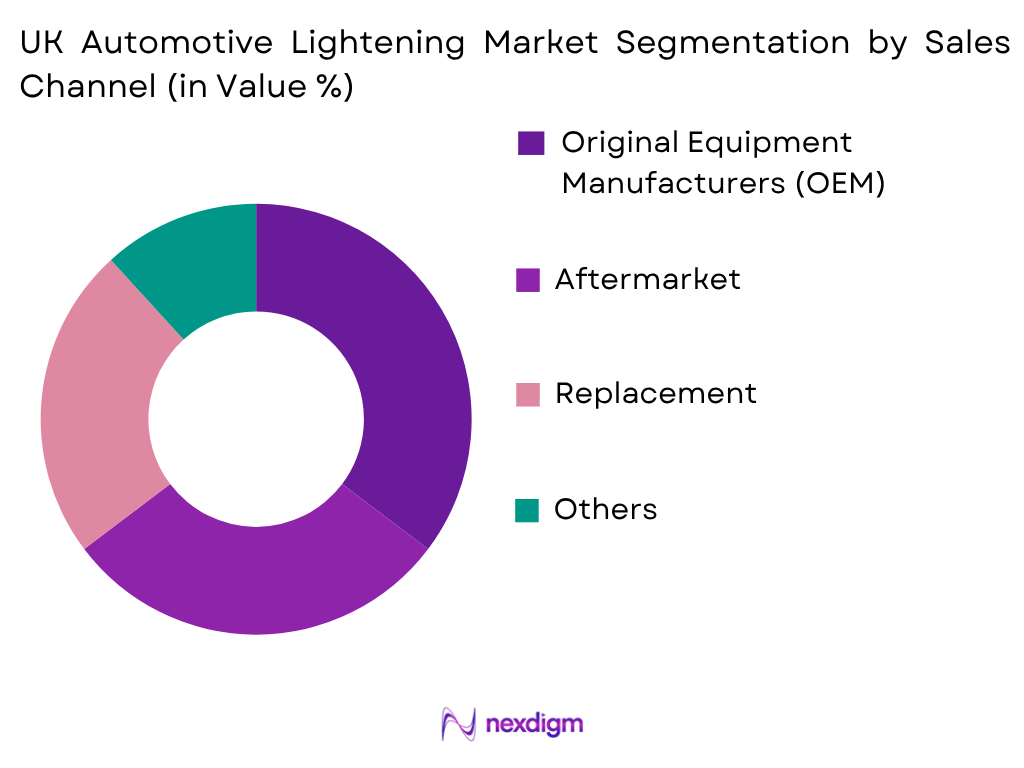
The Original Equipment Manufacturers (OEM) channel holds the largest share of the UK Automotive Lightening Market because lighting systems are increasingly integrated into vehicle design and styling programs from the platform development stage, requiring close, long-cycle collaboration between OEMs and Tier-1 lighting suppliers such as Forvia HELLA, Valeo, Koito Manufacturing, and Marelli. The country’s automotive manufacturing base, concentrated around the West Midlands and North East England, together with the UK’s continued reliance on a concentrated European lighting component supply base, have shaped long-term OEM sourcing relationships with both domestic and continental European lighting manufacturers. The Aftermarket segment, while smaller, is expanding steadily as vehicle owners increasingly retrofit halogen lighting systems with LED and projector kits, supported by growing awareness of energy efficiency and styling upgrades, alongside continued growth of organised automotive parts retail and MOT-driven lighting compliance checks under DVSA requirements.
Competitive Landscape
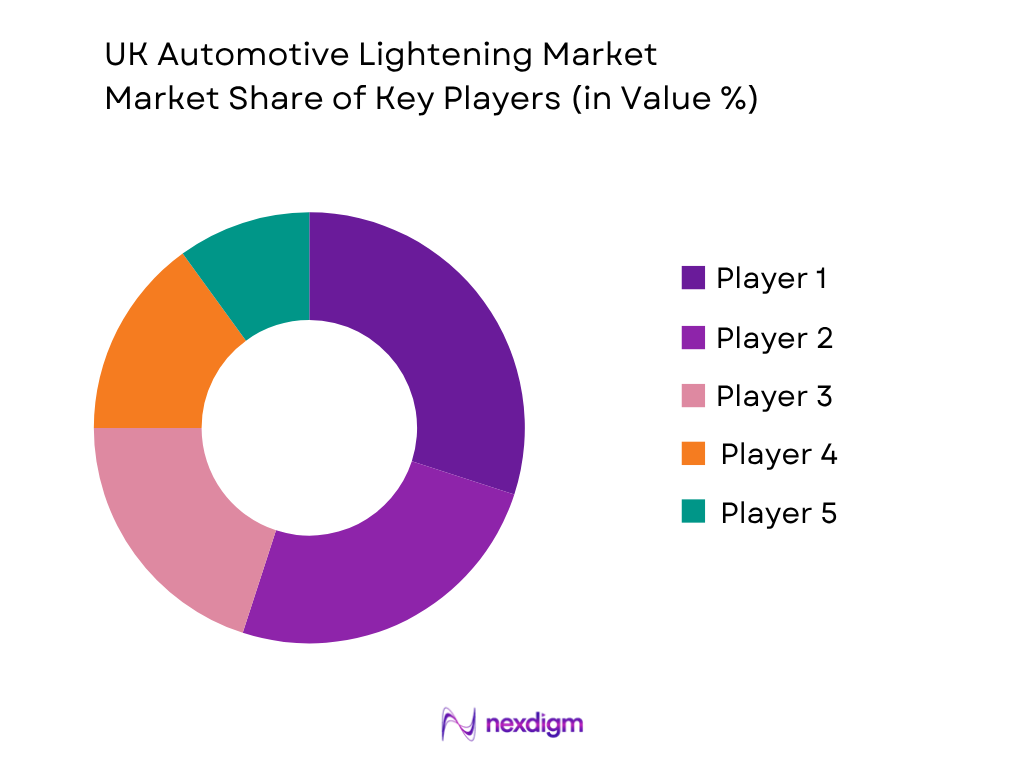
The UK Automotive Lightening Market is moderately consolidated, dominated by established global Tier-1 suppliers operating engineering and distribution footprints in the UK alongside a concentrated European import supply base. Forvia HELLA maintains a significant UK presence supplying adaptive lighting and electronic systems to premium and mainstream passenger vehicle platforms, and was recognised with the 2025 Road Safety Innovation Award for its EvenLED technology, which improves vehicle visibility through ultra-homogenous light diffusion across both light and heavy goods vehicles. Valeo supplies headlamp and rear-lamp assemblies to UK-based OEM platforms and continues to expand its matrix LED and Adaptive Driving Beam portfolio in line with UN ECE Regulation No. 149. Koito Manufacturing, the Japanese lighting major, supplies premium OEM programmes in the United Kingdom through its European operations and continues to expand adaptive and matrix LED capability for luxury vehicle platforms. Marelli Holdings supplies lighting systems to UK and European OEM platforms across passenger and commercial vehicle segments, with its h-Digi microLED head-lamp recognised by the 2024 CLEPA Top Innovator award, although the company’s June 2025 Chapter 11 filing has introduced counterparty risk for long-lead UK supply programmes. OSRAM and GE Lighting continue to supply LED light sources and bulb components across OEM and aftermarket channels, while Koninklijke Philips (Philips Electronics) maintains a strong presence in the LED lighting component and aftermarket retrofit segments. Grupo Antolin Irausa also supplies lighting and interior systems to UK OEM programmes. The market remains predominantly import-driven, with the Czech Republic, Austria, and France collectively supplying a significant share of UK automotive lighting imports, reflecting the country’s continued integration with the wider European automotive supply chain following Brexit. Competition is further shaped by UN ECE Regulation No. 48 and No. 149 compliance, DVSA and VCA approval requirements, the post-Brexit UKCA conformity framework, and growing investment in matrix LED and Adaptive Driving Beam technology suited to the UK’s premium vehicle segment, alongside emerging low-cost gallium-nitride LED entrants from Chinese suppliers facing hurdles meeting ECE and TISAX standards.
| Company | Establishment Year | Headquarters | OEM Partnerships | LED/Adaptive Lightening Portfolio
|
Manufacturing Presence in UK | Major End-Use Industries | Key Strategic Focus | Certifications & Compliance |
| Forvia HELLA GmbH & Co. KGaA | 1899 | ~ | ~ | ~ | ~ | ~ | ~ | ~ |
| Valeo SA | 1923 | ~ | ~ | ~ | ~ | ~ | ~ | ~ |
| Koito Manufacturing Co., Ltd. | 1915 | ~ | ~ | ~ | ~ | ~ | ~ | ~ |
| Marelli Holdings Co., Ltd. | 1919 | ~ | ~ | ~ | ~ | ~ | ~ | ~ |
| OSRAM GmbH | 1919 | ~ | ~ | ~ | ~ | ~ | ~ | ~ |
UK Automotive Lightening Market Analysis
Growth Drivers
Recovering New Vehicle Registrations and Premium/SUV Penetration
The United Kingdom’s position as one of Europe’s largest automotive production and consumption markets is among the strongest growth drivers for the Automotive Lightening Market, as recovering new vehicle registrations and sustained premium and SUV segment growth directly boost OEM lighting demand. New car registrations have continued to stabilise in recent years following pandemic-era disruption, supported by continued consumer preference for SUVs and crossovers, sustained demand from UK-based premium and luxury marques, and steady replacement demand across an ageing vehicle parc. Vehicle manufacturers are increasingly adopting LED and matrix LED lighting systems that reduce power draw, improve styling differentiation, and comply with tightening UN ECE lighting standards, particularly following the adoption of Adaptive Driving Beam headlighting technology under UN ECE Regulation No. 149. These structural developments continue to create sustained demand for advanced lighting technologies across both OEM and aftermarket channels.
UN ECE Regulatory Standards and Adaptive Lighting Technology Shift
The continued enforcement of UN ECE Regulation No. 48 on the installation of lighting and light-signalling devices, together with the phased adoption of UN ECE Regulation No. 149 permitting Adaptive Driving Beam headlamp systems, is generating steady demand for certified, energy-efficient, and glare-reducing lighting systems across the vehicle parc. The country’s expanding premium and SUV vehicle segments continue to drive adoption of styled projector-LED headlamps and signature tail lamps, while growing electric vehicle penetration is increasing demand for lightweight, low-power lighting systems engineered to preserve battery range. As UK-based OEM manufacturing sites and Tier-1 suppliers navigate the post-Brexit UKCA conformity framework, lighting suppliers are increasingly prioritising LED and matrix LED capacity investment to meet rising OEM specification requirements across premium and volume vehicle platforms.
Market Challenges
High Import Dependence and Post-Brexit Trade Complexity
The UK Automotive Lightening Market remains a net importer of automotive lighting components, with domestic manufacturing capacity concentrated among a limited number of Tier-1 suppliers operating UK facilities, while the country relies heavily on a concentrated European supply base, with the Czech Republic, Austria, and France collectively supplying a significant share of UK automotive lighting imports. This import dependence subjects manufacturers and distributors to post-Brexit customs and trade documentation complexity under the UK-EU Trade and Cooperation Agreement, international freight costs, and fluctuations in rare-earth and semiconductor component prices. The June 2025 Chapter 11 filing by Marelli Holdings has introduced counterparty risk for long-lead UK supply programmes, potentially diverting contracts to more solvent rivals, while the growing presence of low-cost Chinese gallium-nitride LED entrants facing hurdles meeting ECE and TISAX standards increases competitive and compliance-related pressure on certified OEM-grade offerings.
High Production Costs and Capital-Intensive Manufacturing Processes
The widespread adoption of automotive lightweighting technologies in the United Kingdom remains constrained by the significant investment required for advanced manufacturing equipment and specialized production processes. Lightweight vehicle structures require sophisticated technologies including hot stamping, laser welding, friction stir welding, hydroforming, precision casting and adhesive bonding, all of which involve substantial capital expenditure. Manufacturers must redesign production lines, validate structural integrity through crash testing and integrate multi-material joining techniques before commercial production can begin. Carbon fiber composites, advanced aluminum alloys, magnesium components and engineered polymers also require specialized processing expertise that increases production complexity. Smaller Tier-1 and Tier-2 suppliers may encounter difficulties financing these technological upgrades while remaining competitive within highly cost-sensitive global automotive supply chains. In addition, ongoing factory retooling for electric vehicle production increases operational complexity and requires continuous investment in workforce training, automation systems and quality assurance technologies, slowing the pace of lightweight material adoption across certain vehicle segments.
Market Opportunities
Growth of Electric Vehicle Lighting and Software-Updatable Systems
The United Kingdom’s expanding electric passenger vehicle segment continues creating strong opportunities for energy-efficient LED and smart lighting adoption among domestic and European OEMs. Ongoing investment in UK gigafactory capacity and the broader electric vehicle supply chain is accelerating opportunities for lighting technology localisation, while established suppliers such as Forvia HELLA continue to develop next-generation adaptive lighting systems in partnership with leading automotive manufacturers to support ADAS integration. Strategic focus across the industry is increasingly shifting toward software-updatable lighting that monetises over-the-air animations and personalisation features, creating new opportunities for Tier-1 suppliers and technology partnerships to expand reach through both OEM platform wins and aftermarket LED retrofit demand across the UK’s premium vehicle parc.
Increasing Adoption of Sustainable and Recyclable Lightweight Materials
The growing emphasis on circular manufacturing and sustainable automotive production creates significant opportunities for lightweight material suppliers throughout the United Kingdom. Vehicle manufacturers are increasingly incorporating recyclable aluminum, bio-based composites, recycled engineering plastics and low-carbon steel into new vehicle platforms to reduce environmental impact throughout the product lifecycle. Research institutions, automotive OEMs and advanced material manufacturers continue collaborating to develop lightweight materials offering improved structural performance together with enhanced recyclability and lower embodied carbon emissions. Digital engineering, artificial intelligence-assisted material optimization and additive manufacturing further support development of lightweight components requiring fewer raw materials while maintaining safety and durability. As manufacturers pursue carbon-neutral production strategies and sustainable vehicle design, demand for innovative lightweight materials capable of supporting both environmental objectives and high-performance automotive engineering is expected to continue expanding across the UK’s automotive manufacturing sector.
Future Outlook
The UK Automotive Lightening Market is expected to witness steady growth over the coming years, supported by continued recovery in new vehicle registrations, sustained regulatory emphasis on lighting-related road safety, gradual expansion of matrix LED and Adaptive Driving Beam capacity under UN ECE Regulation No. 149, and rising OEM prioritisation of styling-led product differentiation. Vehicle manufacturers and Tier-1 suppliers are increasingly investing in UN ECE Regulation No. 48-compliant, energy-efficient lighting systems to meet quality standards and consumer expectations, while growing electric vehicle penetration across passenger and light commercial vehicle segments continues to drive adoption of lightweight, low-power lighting systems across the country’s automotive manufacturing base.
Major Players
- Forvia HELLA GmbH & Co. KGaA
- Valeo SA
- Koito Manufacturing Co., Ltd.
- Marelli Holdings Co., Ltd.
- OSRAM GmbH
- Koninklijke Philips N.V. (Philips Electronics)
- GE Lighting
- Grupo Antolin Irausa, S.A.
- Varroc Group
- Magneti Marelli S.p.A.
- Robert Bosch GmbH
- Infineon Technologies AG
Key Target Audience
- Passenger Vehicle Manufacturers (OEMs)
- Light Commercial and Heavy Goods Vehicle Manufacturers
- Automotive Lighting and Electronic Component Manufacturers
- Tier-1 and Tier-2 Auto Component Suppliers
- Authorised Dealers and Aftermarket Distribution Networks
- Investment and Venture Capital Firms
- Government and Regulatory Bodies (Driver and Vehicle Standards Agency (DVSA), Vehicle Certification Agency (VCA), Department for Transport, Society of Motor Manufacturers and Traders (SMMT))
- Electric Vehicle Manufacturers and Mobility Solution Providers
Research Methodology
Step 1: Identification of Key Variables
The initial phase involves constructing a comprehensive ecosystem map covering all major stakeholders operating within the UK Automotive Lightening Market. Extensive desk research is undertaken using government publications, automotive industry databases, lighting manufacturing reports, company disclosures, trade associations, and proprietary industry sources. The primary objective is to identify and define the critical variables influencing market dynamics, including new vehicle registration volumes, OEM lighting fitment rates, LED technology adoption, raw material and component availability, Driver and Vehicle Standards Agency regulatory requirements, electric vehicle penetration, and OEM purchasing behaviour.
Step 2: Market Analysis and Construction
In this phase, historical market data relating to the UK Automotive Lightening Market are compiled and analysed to estimate market size and identify growth patterns. Both top-down and bottom-up approaches are employed to evaluate lighting demand across passenger vehicles, SUVs, light commercial vehicles, buses and coaches, and electric vehicles. Market segmentation is validated by analysing OEM procurement, aftermarket demand, component import and distribution volumes, vehicle parc, sales channel performance, and regional demand across the West Midlands, North East and North West England, Greater London and the South East, and Scotland. Revenue estimates are cross-verified through import volumes, supplier sales data, and end-user consumption patterns to ensure accuracy.
Step 3: Hypothesis Validation and Expert Consultation
Market hypotheses are developed using secondary research findings and subsequently validated through Computer-Assisted Telephone Interviews (CATI) and structured consultations with industry experts. Respondents include lighting component manufacturers, automobile OEMs, Tier-1 suppliers, aftermarket distributors, automotive engineers, and regulatory stakeholders. These discussions provide valuable commercial, operational, and technical insights that help validate market assumptions, assess technology adoption, understand purchasing trends, and refine future market projections across OEM and aftermarket channels.
Step 4: Research Synthesis and Final Output
The final phase integrates findings from secondary research, primary interviews, and quantitative analysis to develop a comprehensive assessment of the UK Automotive Lightening Market. Data obtained through the bottom-up methodology are cross-validated using top-down analysis and multiple independent information sources to ensure consistency and reliability. The report is further verified through consultations with leading lighting manufacturers, Tier-1 suppliers, and industry experts regarding product innovation, manufacturing capacity, competitive developments, OEM preferences, and regulatory trends before publication, ensuring a robust and accurate market assessment.

- Executive Summary
- Research Methodology (Market Definitions and Assumptions, Abbreviations, Market Sizing Approach, Top-Down Analysis, Bottom-Up Analysis, Demand-Side Assessment, Supply-Side Assessment, Primary Industry Interviews, Data Triangulation, Forecasting Framework, Limitations and Future Conclusions)

- Definition and Scope
- Market Evolution and Industry Genesis
- Timeline of Major Industry Developments
- Low Rolling Resistance Tire Value Chain Analysis
- Raw Material Supply Chain Analysis
- OEM and Replacement Tire Ecosystem Analysis
- Tire Manufacturing and Distribution Framework

- Growth Drivers (Recovering New Vehicle Registrations, UN ECE Regulation Compliance Requirements, Shift Toward LED and Adaptive Driving Beam Lighting, Growth of Electric Vehicle Segment, Consumer Preference for Styling and Signature Lighting, Rising ADAS and Autonomous Vehicle Integration, Aftermarket LED Retrofit Growth, Premium and SUV Segment Expansion)
- Market Challenges (High Import Dependence on European Supply Base, Post-Brexit Trade and Customs Complexity, Semiconductor and Raw Material Price Volatility, High Cost of Adaptive and Matrix LED Systems, Counterfeit and Non-Compliant Aftermarket Products, Long OEM Product Validation Cycles, Automotive Manufacturing Site Consolidation Risk)
- Market Opportunities (Expansion of Domestic LED Manufacturing Capacity, Growth of Electric Vehicle Fleets, Smart and Connected Lighting Systems, Matrix LED and ADB Adoption Under UN Regulation No. 149, Rising Aftermarket LED Retrofit Demand, Gigafactory and EV Supply Chain Investment, Vehicle-to-Infrastructure Communication Lighting)
- Market Trends (Adaptive Driving Beam (ADB) Systems, Signature DRL Styling, Matrix LED Headlamps, Ambient and Mood Interior Lighting, Miniaturized LED Modules, OLED Tail Lamp Development, Sensor-Integrated Smart Lighting, Sustainable and Energy-Efficient Lighting Design)
- Government Regulations (UN ECE Regulation No. 48 on Installation of Lighting and Light-Signalling Devices, UN ECE Regulation No. 149 on Adaptive Driving Beam Headlamp Systems, Road Vehicle Lighting Regulations (RVLR) 1989, Driver and Vehicle Standards Agency (DVSA) MOT Testing Requirements, UK Type Approval (UKCA) Post-Brexit Compliance Framework, Vehicle Certification Agency (VCA) Approval Processes, Retained EU Law on Vehicle Lighting Standards, Import Tariff Structure Under the UK-EU Trade and Cooperation Agreement)
- SWOT Analysis
- PESTLE Analysis
- Porter’s Five Forces Analysis
- Stakeholder Ecosystem
- Competition Ecosystem

- By Market Value (2020-2025)
- By Tire Volume (Units) (2020-2025)
- By Average Selling Price (2020-2025)

- By Vehicle Type (In Value %)
Passenger Cars
Sport Utility Vehicles (SUVs) and Crossovers
Light Commercial Vehicles (LCVs)
Medium & Heavy Commercial Vehicles
Electric Vehicles (EVs)
Buses and Coaches - By Product Type (In Value %)
Headlamps
Tail Lamps
Fog Lamps
Daytime Running Lights (DRLs)
Interior/Ambient Lighting
Indicator and Signal Lamps - By Technology (In Value %)
LED Lighting
Halogen Lighting
Xenon/HID Lighting
Laser and Matrix LED (Adaptive) Lighting - By Sales Channel (In Value %)
Original Equipment Manufacturers (OEM)
Aftermarket/Replacement - By Region (In Value %)
West Midlands Automotive Cluster
North East and North West England
Greater London and South East
Scotland and Other Regions

- Market Share of Major Players (By Revenue, Unit Shipments, Vehicle Type, Sales Channel, OEM Partnerships)
- Cross Comparison Parameters (OEM Supply Partnerships, LED/Adaptive Lighting Portfolio, Manufacturing/Assembly Capacity, R&D and Design Capability, EV Lighting Portfolio, Distribution and Aftermarket Network, Export Footprint, Certifications and Compliance)
- SWOT Analysis of Major Players
- Pricing Analysis (Passenger Car Lighting SKU, Truck/SUV Lighting SKU, EV Lighting Pricing, OEM Pricing, Aftermarket Pricing)
- Detailed Profiles of Major Companies
Forvia HELLA GmbH & Co. KGaA
Valeo SA
Koito Manufacturing Co., Ltd.
Marelli Holdings Co., Ltd.
ams-OSRAM AG
Koninklijke Philips N.V. (Signify)
Stanley Electric Co., Ltd.
Varroc Engineering Ltd.
Grote Industries, LLC
Truck-Lite Co., LLC (Dorman Products)
J.W. Speaker Corporation
Magna International Inc.
Texas Instruments Incorporated

- OEM Procurement Assessment (Platform Sourcing Strategy, Vendor Qualification Cycle, Cost Negotiation, Localization Targets)
- Consumer Purchase Behavior (Styling Preference, Brand Preference, Retrofit Frequency, Price Sensitivity)
- Technology Adoption Analysis (LED Penetration, Adaptive Lighting Awareness, EV Lighting Integration, Smart Lighting Adoption)
- Investment and Budget Allocation Analysis (OEM R&D Spend, Tooling Investment, Capacity Expansion Budgets, ROI Expectations)
- Needs, Desires and Pain Point Analysis (Energy Efficiency, Styling Differentiation, Durability, Nighttime Visibility, Cost Optimization)
- Vendor Selection Criteria (Technical Capability, OEM Approval History, Cost Competitiveness, Delivery Reliability, R&D Support)
- Decision-Making Process (Design Validation, Cost Analysis, Supplier Audit, Platform Sign-Off)

- By Market Value (2026-2035)
- By Tire Volume (Units) (2026-2035)
- By Average Selling Price (2026-2035)


 Request a Sample
 Ask for Customization
 Get a Quote
 Enquire Now