
 Download PDF
Market Overview
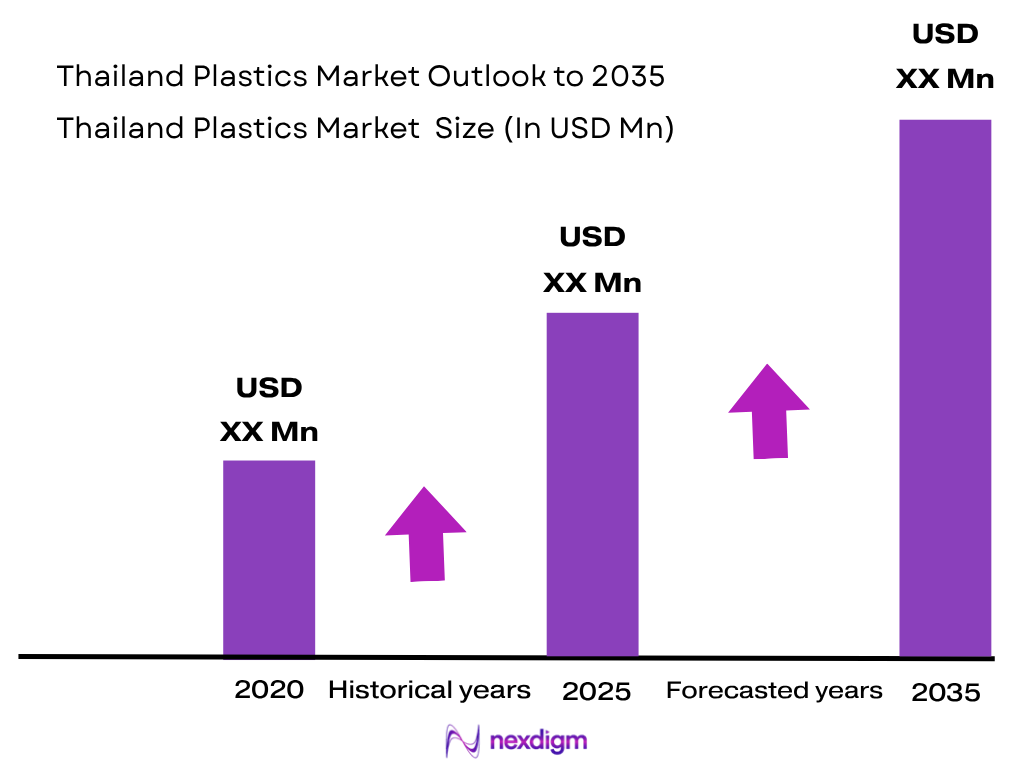
The Thailand Plastics Market is valued at approximately USD ~ billion, based on historical market assessment, compared with approximately USD ~XX billion in the preceding period. Thailand’s plastics industry is supported by its integrated petrochemical base, extensive converting capacity and demand from packaging, automotive, electronics, construction and consumer products. Official industrial data recorded the plastics Manufacturing Production Index at 93.17 in the preceding annual period, while the shipment index stood at 93.81, demonstrating the scale of Thailand’s established plastics manufacturing ecosystem.
Bangkok Metropolitan Region, Samut Prakan, Samut Sakhon and Thailand’s Eastern Economic Corridor are the dominant plastics manufacturing locations because they combine converters, industrial estates, petrochemical infrastructure and proximity to automotive, electronics and packaging customers. Rayong and Map Ta Phut are particularly important upstream locations, while Bangkok and neighboring provinces accommodate substantial downstream conversion activity. The Central region contains the majority of plastics enterprises, while the eastern region represents the second-largest production cluster, supported by integrated petrochemicals and export-oriented manufacturing.
Market Segmentation
By Polymer Type
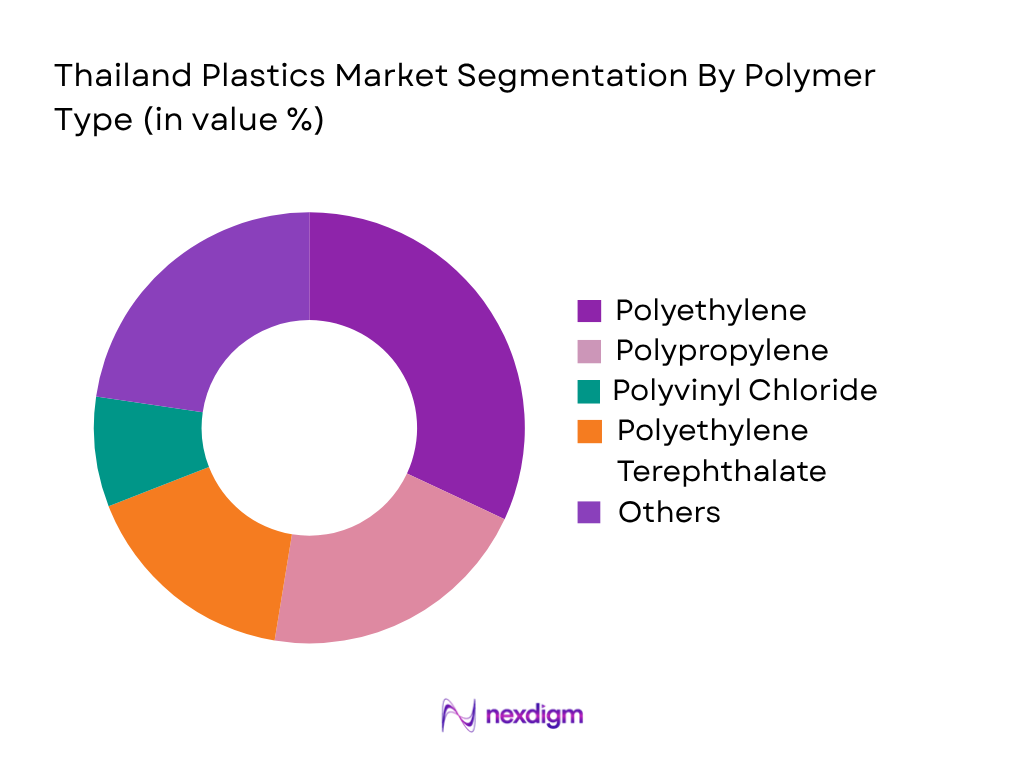
The Thailand Plastics Market is segmented by polymer type into polyethylene, polypropylene, polyvinyl chloride, polyethylene terephthalate, polystyrene, ABS and other engineering and specialty plastics. Polyethylene represents the dominant sub-segment, supported by Thailand’s large integrated petrochemical production base and extensive downstream applications in films, bags, bottles, containers, industrial packaging and household products. Thailand hosts established domestic producers of HDPE, LDPE and LLDPE, enabling converters to access multiple resin grades for film extrusion, blow molding and injection molding. Polyethylene demand is particularly connected to Thailand’s substantial packaging industry, which accounts for the largest concentration of plastics manufacturers. PP is another major material because of its widespread use in automotive components, food containers, household products and industrial applications. PVC maintains an established position in construction products such as pipes, profiles and fittings, while PET benefits from Thailand’s beverage-packaging and polyester value chain. Engineering plastics have a smaller but increasingly strategic role in automotive, electronics and electrical components.
By End-Use Industry
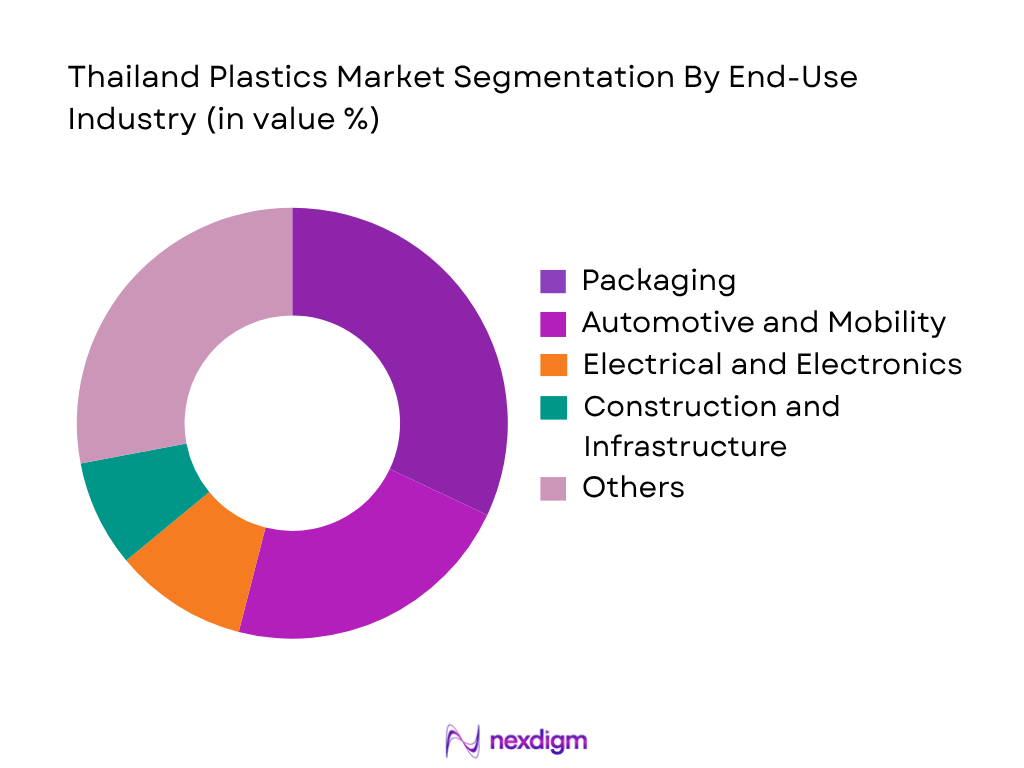
The Thailand Plastics Market is segmented into packaging, automotive and mobility, electrical and electronics, construction and infrastructure, consumer and household products, healthcare and other industrial applications. Packaging represents the dominant end-use segment, supported by Thailand’s substantial food processing, beverage, consumer-goods, retail, tourism and export industries. The concentration of converters reinforces this position, with packaging accounting for the largest group of plastics manufacturers, ahead of household products and electrical and electronics applications. Flexible films, rigid containers, bottles, caps, closures, pouches and protective packaging create broad demand for PE, PP and PET. Automotive represents another strategically important application because Thailand hosts an extensive vehicle and component manufacturing ecosystem requiring PP compounds, ABS, polyamide and engineering thermoplastics. Electronics and electrical manufacturing similarly supports higher-specification materials used in appliance housings, connectors, insulation and precision components. Construction demand is concentrated in PVC pipes, fittings, profiles, sheets and insulation-related plastic products.
Competitive Landscape
The Thailand Plastics Market has an integrated competitive structure extending from petrochemical feedstocks and polymerization to compounding, recycling and downstream conversion. PTT Global Chemical, SCG Chemicals and IRPC possess extensive domestic production footprints, while Indorama Ventures has a major position in PET, polyester and recycling. HMC Polymers specializes in polypropylene applications. Competition increasingly extends beyond production scale toward specialty grades, high-value-added polymers, automotive compounds, sustainable packaging materials, recycled polymers and circular feedstock solutions.
| Major Player | Establishment Year | Headquarters | Core Polymer Portfolio | Thailand Production Position | Major Applications | Downstream Integration | Export Orientation | Circular/Sustainable Plastics Capability |
| PTT Global Chemical | 2011 | Bangkok, Thailand | ~ | ~ | ~ | ~ | ~ | ~ |
| SCG Chemicals | 1983 | Bangkok, Thailand | ~ | ~ | ~ | ~ | ~ | ~ |
| IRPC | 1978 | Bangkok, Thailand | ~ | ~ | ~ | ~ | ~ | ~ |
| Indorama Ventures | 1994 | Bangkok, Thailand | ~ | ~ | ~ | ~ | ~ | ~ |
| HMC Polymers | 1983 | Bangkok, Thailand | ~ | ~ | ~ | ~ | ~ | ~ |
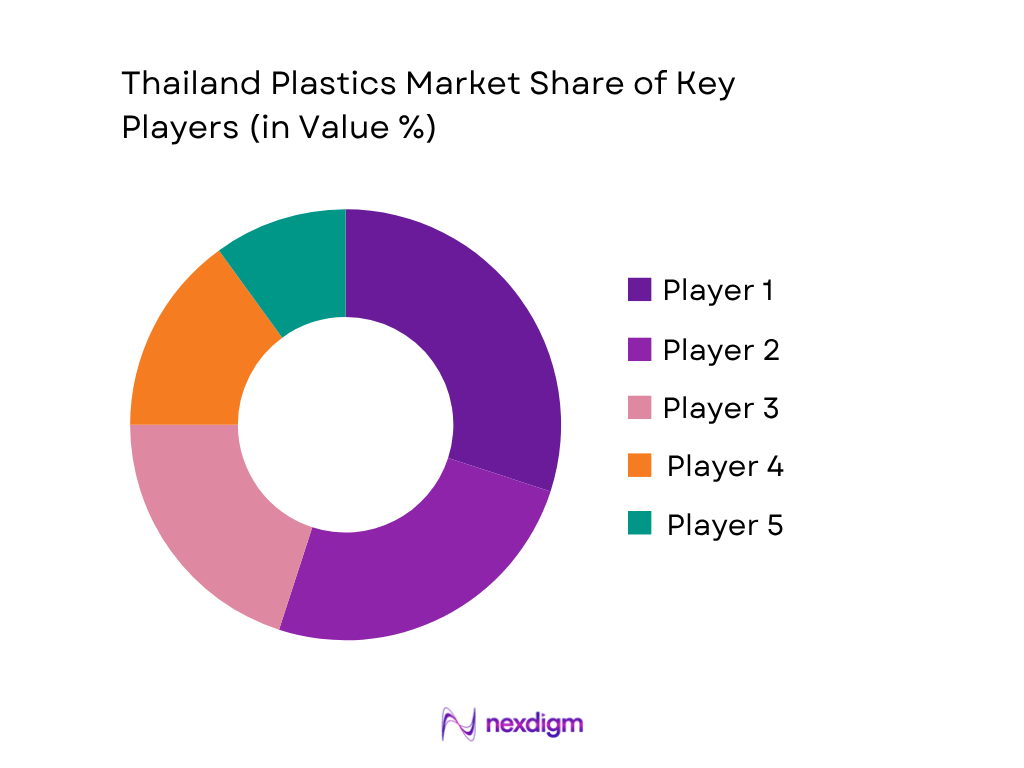
Thailand Plastics Market Analysis
Growth Drivers
Strong Packaging and Downstream Manufacturing Demand
Thailand’s plastics market is supported by sustained demand from packaging, food and beverage, household products and other downstream manufacturing industries that rely heavily on polyethylene, polypropylene, PET and flexible plastic films. The Office of Industrial Economics recorded Thailand’s plastics Manufacturing Production Index at 96.97 in 2024, while the industry Shipment Index reached 98.38, reflecting substantial domestic conversion and product movement across the plastics value chain. In the first quarter of 2025, exports of plastic products reached USD 1,154 million, while imports totaled USD 1,441.99 million, demonstrating significant material and finished-product flows through the domestic economy. Food, beverage and packaging demand remained among the principal factors supporting plastics production during the period. The wider macroeconomic environment provides additional scale: the IMF recorded Thailand’s nominal GDP at USD 526.5 billion in 2024, GDP per capita at USD 7,347, and population at 71.67 million. This large manufacturing and consumer base supports continuous requirements for films, pouches, bottles, closures, containers, trays, industrial packaging and transport packaging, strengthening demand for extrusion, blow-molding, thermoforming and injection-molding capacity throughout Thailand’s plastics conversion ecosystem.
Automotive and Electric Vehicle Manufacturing Expanding Technical Polymer Applications
Thailand’s established automotive and rapidly developing electric-vehicle manufacturing ecosystem is expanding opportunities for polypropylene compounds, ABS, polyamide, polycarbonate and other engineering plastics used in interiors, exterior assemblies, connectors, battery systems and electrical components. Thailand’s Board of Investment recorded 309 automotive and parts investment applications worth THB 102.4 billion in 2024, demonstrating continued capital deployment into vehicle manufacturing and component localization. The country also registered 70,582 battery-electric passenger cars in 2024, while 57,289 additional BEV passenger cars were registered during the first half of 2025. By that period, Thailand had approximately 203,000 BEV passenger cars, 71,900 electric motorcycles, 3,800 electric buses and trucks, and 1,000 electric three-wheelers operating domestically. This installed vehicle base requires plastic components for battery protection, electrical insulation, connectors, housings, dashboards, trims and lightweight structural systems. Supporting macroeconomic capacity remains substantial, with IMF data placing Thailand’s 2024 nominal GDP at USD 526.5 billion, GDP per capita at USD 7,347, and population at 71.67 million. Automotive localization therefore creates a direct route for Thailand’s plastics producers to move toward higher-specification compounds and precision-molded components.
Thailand Plastics Market Challenges
Large Plastic Waste Volumes and Limited Circular Feedstock Recovery
Thailand’s plastics industry faces a significant material-recovery challenge because large quantities of post-consumer plastics continue to leave the productive polymer cycle instead of returning as usable recycled feedstock. Thailand’s Pollution Control Department recorded approximately 2.88 million tonnes of single-use plastic waste in 2024. Around 0.72 million tonnes were reused, while approximately 2.16 million tonnes were transported to disposal facilities or remained in the environment. Total municipal solid waste reached 27.20 million tonnes, equivalent to approximately 74,529 tonnes per day, further demonstrating the scale of waste-management infrastructure required nationally. The challenge is particularly relevant for packaging converters seeking dependable recycled PE, PP and PET because mixed collection can introduce food residues, colors and other contamination that reduce material quality. Thailand’s broader economic scale intensifies the importance of improving recovery: IMF statistics place nominal GDP at USD 526.5 billion in 2024, GDP per capita at USD 7,347, and population at 71.67 million. Converters therefore operate within a large industrial and consumer economy, but the 2.16 million tonnes of unrecovered single-use plastics indicate that domestic collection, sorting, cleaning and recycling systems still require substantial strengthening to support high-quality circular resin supply.
Import Competition and Pressure on Domestic Plastic Conversion
Thailand’s plastics manufacturers face increasing competitive pressure from imported plastic products, particularly in standardized applications where local converters have limited scope to differentiate through formulation, precision or engineering performance. The Office of Industrial Economics recorded USD 1,441.99 million of plastic-product imports during the first quarter of 2025, compared with USD 1,154 million of exports during the same period. Thailand’s plastics Manufacturing Production Index stood at 96.57 during that quarter, while the Shipment Index was 95.70, demonstrating that domestic manufacturers were operating in an environment combining substantial production activity with significant inbound product competition. The Office of Industrial Economics also identified increasing competition from China as a material pressure on domestic plastic manufacturers, particularly for commodity-oriented products. Thailand’s macroeconomic scale makes the issue strategically important: IMF data record USD 526.5 billion in nominal GDP for 2024, a population of 71.67 million, and GDP per capita of USD 7,347. Domestic plastics producers therefore need to protect participation in a sizeable industrial economy while simultaneously upgrading into engineered compounds, specialized packaging, automotive components and application-specific products where technical certification, local customer integration and shorter supply chains can provide stronger competitive differentiation than commodity production alone.
Thailand Plastics Market Opportunities
Advanced Recycling and High-Quality Recycled Polypropylene Development
Advanced recycling represents a significant future opportunity for Thailand’s plastics market because the country combines a large domestic plastic-waste stream with an established petrochemical, conversion and consumer-products ecosystem. Thailand’s Board of Investment approved a recycled polypropylene project in 2026 involving investment exceeding THB 8.1 billion in Rayong. The planned facility has production capacity of approximately 59,000 tonnes per year and is designed to consume around 65,600 tonnes of domestically generated polypropylene waste annually, creating a direct industrial pathway from post-consumer waste into higher-quality recycled resin. The investment is particularly relevant against Pollution Control Department data showing 2.88 million tonnes of single-use plastic waste in 2024, of which approximately 2.16 million tonnes were ultimately disposed of or remained outside productive reuse channels. Thailand also has the macroeconomic base required to support circular-material investment, with IMF data recording nominal GDP of USD 526.5 billion in 2024, GDP per capita of USD 7,347, and population of 71.67 million. These conditions create future opportunities in PP purification, recycled compound production, sorting technologies, traceability, packaging-grade recycled materials and circular feedstock partnerships between recyclers, converters and consumer-product manufacturers.
Engineering Plastics and Specialty Materials for EV and Advanced Manufacturing
Thailand’s plastics market has an opportunity to increase value creation through engineering polymers and specialty compounds serving electric vehicles, electronics, medical products and precision manufacturing rather than relying primarily on commodity plastic applications. The Board of Investment recorded 309 automotive and parts investment applications valued at THB 102.4 billion in 2024, while total investment-promotion applications across Thailand reached THB 1.14 trillion. The country registered 70,582 BEV passenger cars during 2024, and an additional 57,289 units were registered in the first half of 2025. Thailand also had 3,720 charging stations and 11,622 installed chargers operating as of March 2025, supporting a broader electric-mobility ecosystem. These developments create downstream requirements for polyamide, PBT, polycarbonate, ABS, reinforced polypropylene and specialty compounds used in connectors, cable systems, battery housings, thermal-management parts and electrical enclosures. The IMF recorded Thailand’s 2024 nominal GDP at USD 526.5 billion, GDP per capita at USD 7,347, and population at 71.67 million. This combination of manufacturing investment and domestic economic scale provides a strong current foundation for future expansion of technical compounding, precision injection molding and application-specific polymer development.
Future Outlook
The Thailand Plastics Market is projected to expand at approximately ~X.X% CAGR during 2026–2035, supported by the evolution of the country’s automotive, electronics, packaging and advanced manufacturing sectors. Future development is expected to become less dependent on undifferentiated commodity plastics and increasingly focused on high-value-added polymers, lightweight automotive compounds, engineering plastics, recycled resins and circular packaging solutions.
Thailand’s established downstream manufacturing ecosystem provides an important platform for this transition. Packaging is deeply embedded in the domestic plastics conversion industry, while automotive and electronics applications require increasingly sophisticated material properties. Suppliers capable of developing heat-resistant, lightweight, flame-retardant, impact-resistant and electrically insulating compounds are consequently positioned to expand their participation in higher-value applications. Electric mobility provides another opportunity for polymer producers and compounders. Electric vehicles require plastics in battery housings, cable insulation, connectors, charging components, thermal-management systems, interior assemblies and lightweight structural applications. Thailand’s automotive manufacturing base allows resin producers, compounders and component manufacturers to align new polymer grades with evolving OEM requirements.
Major Players
- PTT Global Chemical Public Company Limited
- SCG Chemicals Public Company Limited
- IRPC Public Company Limited
- HMC Polymers Company Limited
- Thai Polyethylene Company Limited
- Thai Polypropylene Company Limited
- Thai Plastic and Chemicals Public Company Limited
- Indorama Ventures Public Company Limited
- AGC Vinythai Public Company Limited
- INEOS Styrolution Thailand
- GC Styrenics Company Limited
- Siam Polystyrene Company Limited
- Srithai Superware Public Company Limited
- TPBI Public Company Limited
- Thantawan Industry Public Company Limited
Key Target Audience
- Petrochemical and Polymer Resin Producers
- Plastic Converters and Injection Molding Manufacturers
- Flexible and Rigid Plastic Packaging Manufacturers
- Automotive, Electric Vehicle and Electronics Component Manufacturers
- Polymer Distributors, Compounders and Masterbatch Suppliers
- Plastic Recycling and Circular Polymer Companies
- Investments and Venture Capitalist Firms
- Government and Regulatory Bodies (Ministry of Industry, Office of Industrial Economics, Pollution Control Department, Thailand Board of Investment, Industrial Estate Authority of Thailand)
Research Methodology
Step 1: Identification of Key Variables
The initial phase involves developing a comprehensive Thailand Plastics Market ecosystem covering petrochemical companies, polymer manufacturers, resin distributors, compounders, masterbatch suppliers, converters, recyclers and end-use industries. Extensive secondary research is conducted to identify critical variables such as domestic resin production, polymer consumption, imports, exports, conversion activity, processing technologies, recycling and application-specific demand.
Step 2: Market Analysis and Construction
Historical information is evaluated through integrated top-down and bottom-up approaches. The top-down assessment examines Thailand’s petrochemical output and plastics-consuming industries, including packaging, automotive, electronics, construction and healthcare. The bottom-up analysis evaluates producer output, converter activity, polymer flows, trade volumes and individual application requirements to construct and reconcile the overall Thailand Plastics Market.
Step 3: Hypothesis Validation and Expert Consultation
Market hypotheses are validated through computer-assisted telephone interviews and structured discussions with polymer producers, compounders, resin distributors, packaging converters, injection molders, automotive component suppliers and recyclers. These discussions are designed to validate resin demand, utilization patterns, grade preferences, domestic-versus-imported supply, customer qualification requirements, recycling adoption and structural changes occurring across Thailand’s plastics value chain.
Step 4: Research Synthesis and Final Output
The final stage triangulates information obtained from government databases, industry associations, company disclosures, customs data and primary interviews. Supply-side polymer production is reconciled with demand-side conversion and end-use consumption to minimize double counting. The resulting model establishes market size, segmentation, competitive positioning and forecasts while identifying high-value opportunities across specialty polymers, automotive plastics, packaging, engineering resins and circular materials.

- Executive Summary
- Research Methodology (Market Definition and Scope, Thailand Plastics Market Classification, Polymer Resin Demand Assessment, Petrochemical Feedstock Integration Mapping, Plastic Conversion Industry Assessment, Engineering Plastics Application Analysis, Circular Plastics Ecosystem Evaluation, Plastic Waste Recovery Framework Assessment, Import-Export and Re-Export Analysis, End-Use Industry Demand Mapping, Polymer Processing Technology Assessment)

- Definition and Scope
- Thailand Plastics Industry Evolution and Development of Integrated Petrochemical and Downstream Conversion Ecosystem
- Petrochemical Feedstock, Polymer Resin and Plastic Processing Industry Structure
- Thailand Plastics Value Chain Analysis
- Thailand Plastics Supply Chain Analysis
- Polymer Producer, Compounder, Masterbatch Supplier, Plastic Converter, Distributor, OEM and Recycler Ecosystem Analysis
- Plastic Manufacturing and Conversion Integration Assessment Across Packaging, Automotive, Electronics, Construction and Industrial Applications

- Growth Drivers (Integrated Rayong and Map Ta Phut Petrochemical Base, Large Automotive Manufacturing Ecosystem, Expansion of Electric Vehicle Production, Electrical and Electronics Manufacturing Demand, Food and Beverage Packaging Consumption, Domestic Polyolefin Production Capacity, ASEAN Export Connectivity, High-Value-Added Polymer Applications)
- Market Challenges (Regional Petrochemical Overcapacity, Competition from Imported Plastic Resins, Feedstock Supply Volatility, Plastic Waste Recovery Constraints, Recycled Feedstock Quality Variability, Commodity Converter Margin Pressure, Carbon Reduction Requirements, High Technology Investment Requirements)
- Market Opportunities (High-Value-Added Polymers, Electric Vehicle Plastic Components, Medical-Grade Polymer Applications, Recycled Polyolefins, Food-Grade Recycled PET, Mono-Material Packaging, Chemical Recycling, Bio-Based Polymers, Precision Plastic Components)
- Market Trends (Green Polymer Development, Post-Consumer Recycled Resin Adoption, Lightweight Automotive Components, High-Barrier Packaging, Mono-Material Packaging Structures, Engineering Plastics Localization, Smart Manufacturing, Plastic Conversion Automation, Circular Feedstock Integration)
- Regulatory and Standards Landscape (Thailand Plastic Waste Management Roadmap, Bio-Circular-Green Economy Framework, Extended Producer Responsibility Development, Industrial Waste Regulations, Food-Contact Plastic Requirements, Recycled Plastic Standards, Packaging Circularity Requirements, Plastic Waste Import Controls)
- SWOT Analysis
- Porter’s Five Forces Analysis
- PESTLE Analysis
- Stakeholder Ecosystem
- Competition Ecosystem

- By Market Value (2020-2025)
- By Polymer Consumption Volume (2020-2025)
- By Domestic Resin Production Volume (2020-2025)
- By Plastic Conversion Volume (2020-2025)
- By Virgin Polymer Consumption Volume (2020-2025)
- By Recycled Polymer Consumption Volume (2020-2025)
- By Plastic Resin Import Volume (2020-2025)
- By Plastic Resin Export Volume (2020-2025)

- By Polymer Type (In Value %)
Polyethylene (PE)
High-Density Polyethylene (HDPE)
Low-Density Polyethylene (LDPE)
Linear Low-Density Polyethylene (LLDPE)
Polypropylene (PP)
Polyvinyl Chloride (PVC)
Polyethylene Terephthalate (PET)
Polystyrene (PS)
Expanded Polystyrene (EPS)
Acrylonitrile Butadiene Styrene (ABS)
Polycarbonate (PC)
Polyamide (PA)
Engineering and High-Performance Plastics - By Product Type (In Value %)
Flexible Plastic Films and Sheets
Rigid Plastic Packaging
Plastic Bottles, Preforms, Caps and Closures
Plastic Bags and Pouches
Injection-Molded Plastic Components
Blow-Molded Plastic Products
Plastic Pipes and Fittings
Automotive Plastic Components
Electrical and Electronics Plastic Components
Industrial Plastic Components
Medical Plastic Products
Agricultural Plastic Products - By Application Type (In Value %)
Food and Beverage Packaging
Consumer and Industrial Packaging
Automotive Components
Electric Vehicle Components
Electrical and Electronics Components
Construction and Infrastructure Applications
Healthcare and Medical Applications
Agricultural Applications
Industrial and Precision Engineering Applications - By End-Use Industry (In Value %)
Packaging
Food and Beverage
Automotive and Mobility
Electrical and Electronics
Construction and Infrastructure
Consumer and Household Products
Healthcare and Medical Devices
Agriculture
Industrial Manufacturing
Home Appliances
Logistics and Protective Packaging - By Region (In Value %)
Bangkok Metropolitan Region
Eastern Economic Corridor (EEC)
Rayong
Chonburi
Chachoengsao
Central Thailand
Northern Thailand
Northeastern Thailand
Southern Thailand

- Market Share of Major Players (By Revenue, Polymer Production Volume, Polymer Type, Product Portfolio, End-Use Industry, Manufacturing Footprint, Export Presence, Customer Segment Distribution)
- Cross Comparison Parameters (Thailand Plastics Revenue, Installed Polymer Production Capacity, Polymer and Resin Portfolio Breadth, Plastic Conversion and Processing Capability, Automotive and Electronics Application Exposure, Thailand Manufacturing Footprint and EEC Presence, Export and ASEAN Distribution Reach, Recycled and Circular Polymer Capability)
- SWOT Analysis of Major Players
- Competitive Positioning Matrix
- Polymer and Product Portfolio Benchmarking
- Pricing and Resin Category Benchmarking
- Manufacturing and Processing Technology Assessment
- OEM Partnership and End-Use Industry Assessment
- Detailed Profiles of Major Companies
PTT Global Chemical Public Company Limited
SCG Chemicals Public Company Limited
IRPC Public Company Limited
HMC Polymers Company Limited
Thai Polyethylene Company Limited
Thai Polypropylene Company Limited
Thai Plastic and Chemicals Public Company Limited
Indorama Ventures Public Company Limited
AGC Vinythai Public Company Limited
INEOS Styrolution Thailand
GC Styrenics Company Limited
Siam Polystyrene Company Limited
Srithai Superware Public Company Limited
TPBI Public Company Limited
Thantawan Industry Public Company Limited

- Packaging Converter Polymer Procurement Assessment
- Automotive OEM Plastic Material Requirement Analysis
- Electric Vehicle Manufacturer Polymer Application Assessment
- Electrical and Electronics Manufacturer Resin Requirement Analysis
- Food and Beverage Manufacturer Packaging Material Assessment
- Construction Plastic Product Buyer Analysis
- Healthcare and Medical Device Polymer Requirement Assessment
- Industrial OEM Plastic Component Procurement Assessment
- Recycled Resin Buyer Acceptance Analysis

- By Market Value (2026-2035)
- By Polymer Consumption Volume (2026-2035)
- By Domestic Resin Production Volume (2026-2035)
- By Plastic Conversion Volume (2026-2035)
- By Virgin Polymer Consumption Volume (2026-2035)
- By Recycled Polymer Consumption Volume (2026-2035)
- By Plastic Resin Import Volume (2026-2035)
- By Plastic Resin Export Volume (2026-2035)


 Request a Sample
 Ask for Customization
 Get a Quote
 Enquire Now