
 Download PDF
Market Overview
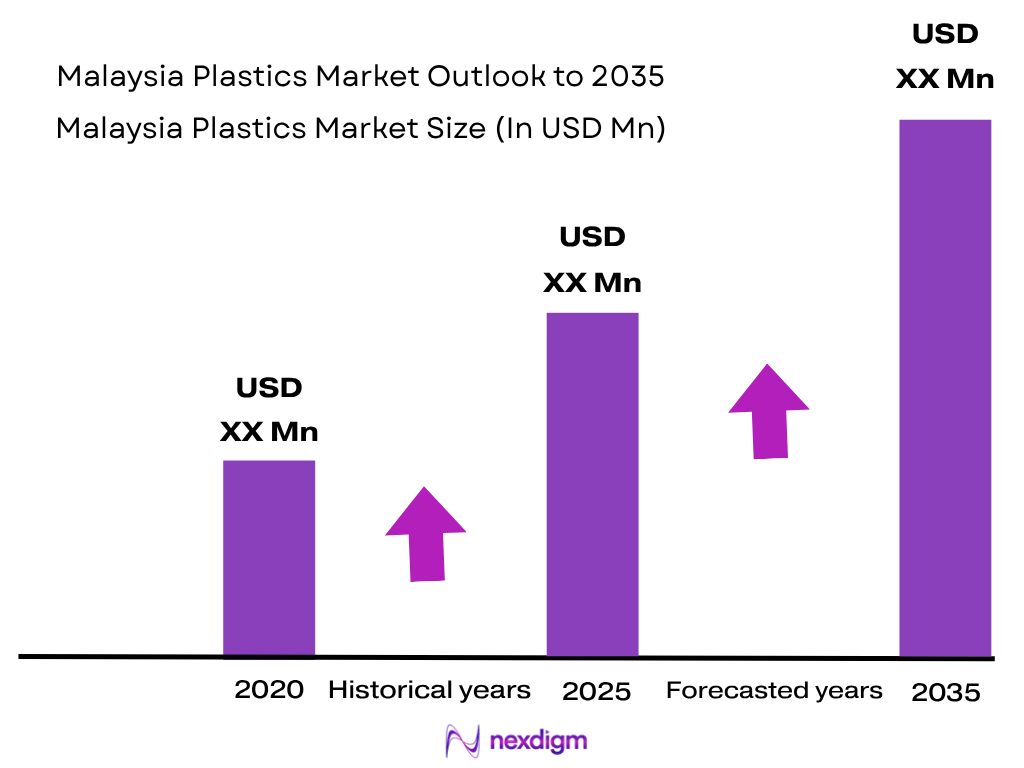
The Malaysia Plastics Market recorded an industry sales value of RM64.78 billion, compared with RM61.44 billion in the preceding period, while resin processed increased from 2.7 million metric tonnes to 2.8 million metric tonnes. The industry comprises approximately 1,400 companies employing 167,000 people. Demand is anchored by packaging, electrical and electronics, automotive, construction, agriculture and household applications, making plastics an integral intermediate-material industry within Malaysia’s manufacturing economy.
Johor, Selangor, Penang and Kedah are among Malaysia’s strategically important plastics and downstream-manufacturing locations. Johor hosts major petrochemical facilities in Pasir Gudang and Tanjung Langsat, while Selangor contains major corporate, converting and packaging operations. Penang’s export-oriented electrical and electronics ecosystem creates demand for precision plastic components, and Kedah supports major flexible-packaging manufacturing. Malaysia processed 2.8 million metric tonnes of resin, while national plastic-product exports reached RM17.3 billion, illustrating the importance of these interconnected industrial clusters.
Market Segmentation
By End-Use Industry
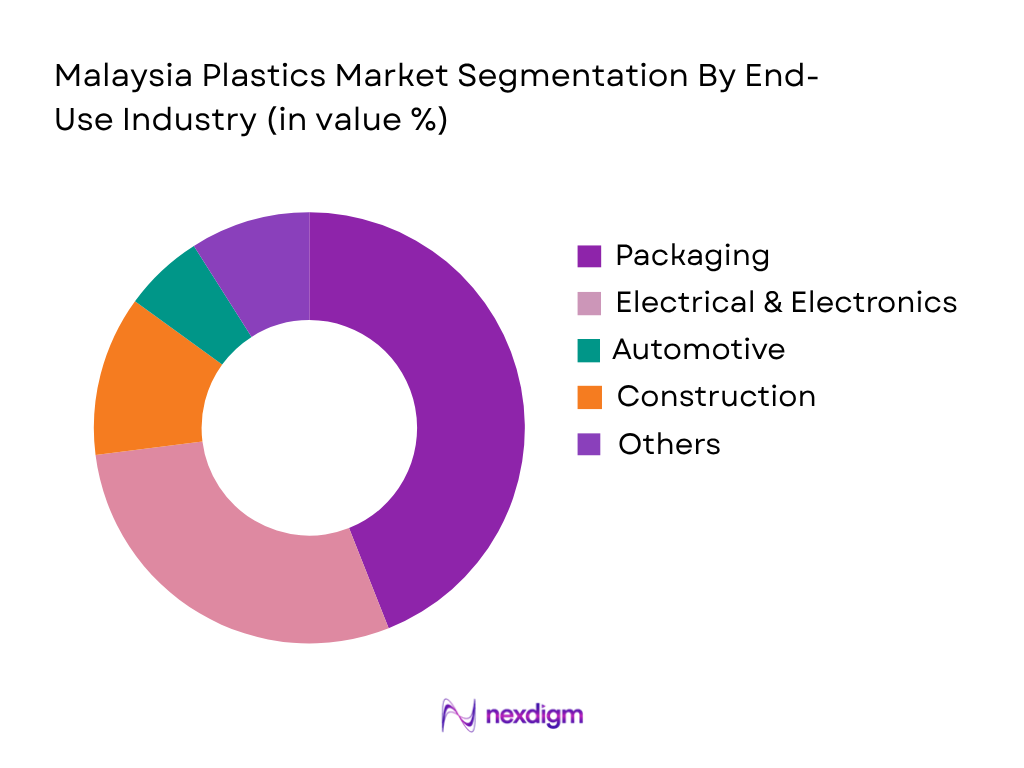
The Malaysia Plastics Market is segmented into packaging, electrical and electronics, automotive, construction, household, agriculture and other applications. Packaging dominates the market, accounting for the largest portion of plastics-industry sales. Its position reflects Malaysia’s substantial food and beverage processing, FMCG, industrial manufacturing and export-oriented supply chains, which require stretch films, flexible laminates, bags, bottles, containers and protective packaging. Malaysia also has established manufacturers of high-performance flexible and industrial packaging serving overseas customers. Electrical and electronics represents the second-largest application because Malaysia’s semiconductor and electronics manufacturing ecosystem requires engineering plastics for housings, connectors, insulation, precision molded components and related applications. Automotive demand is supported by interior components, under-the-hood parts and lightweight polymer applications. Construction generates PVC and PE demand through pipes, fittings and profiles, while agriculture and household applications create additional demand for films, containers and molded products.
By Market Orientation
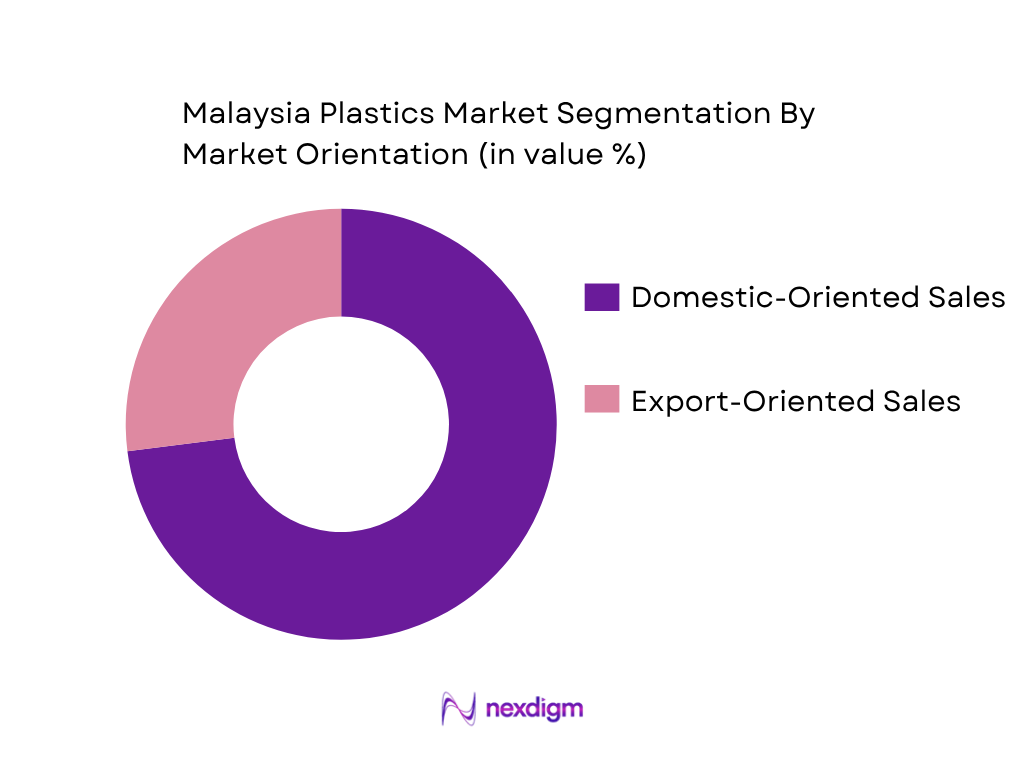
The Malaysia Plastics Market can also be segmented into domestic-oriented sales and export-oriented sales. Domestic-oriented demand dominates, reflecting extensive consumption from packaging, electrical and electronics, automotive, construction, medical-device, household and industrial manufacturing customers operating inside Malaysia. At the same time, exports are structurally important to the industry because Malaysian converters supply flexible films, industrial packaging and precision plastic products to international customers. Plastic-product exports reached RM17.3 billion, compared with total industry sales of RM64.8 billion, with the United States becoming an increasingly important destination. Malaysia’s established ports, petrochemical infrastructure and integration into ASEAN and wider Asian manufacturing networks reinforce this export orientation. Export-focused producers also benefit from Malaysia’s strong E&E supply chain and established quality-control, converting and manufacturing capabilities, while domestic customers provide a diversified demand base that reduces dependence on any single overseas destination.
Competitive Landscape
The Malaysia Plastics Market has a fragmented downstream converter base alongside several large petrochemical, flexible-packaging and industrial-film producers. LOTTE Chemical Titan and PETRONAS Chemicals Group have strategically important upstream positions, while Scientex, Thong Guan Industries and BP Plastics are established downstream packaging and film manufacturers. Competition is increasingly shaped by resin security, manufacturing scale, multilayer-film capability, export networks, automation, recycled-content integration and the ability to supply technically demanding E&E, automotive, food-packaging and industrial customers. Malaysia has approximately 1,400 plastics companies, illustrating the substantial converter ecosystem operating alongside these major participants.
| Company | Establishment Year | Headquarters | Core Market Position | Polymer/Product Coverage | Manufacturing Capability | Key End-Use Industries | Export/Market Reach | Sustainability & Technology Position |
| LOTTE Chemical Titan Holding Berhad | 1989 | Petaling Jaya, Selangor | ~ | ~ | ~ | ~ | ~ | ~ |
| PETRONAS Chemicals Group Berhad | 1998 | Kuala Lumpur | ~ | ~ | ~ | ~ | ~ | ~ |
| Scientex Berhad | 1968 | Shah Alam, Selangor | ~ | ~ | ~ | ~ | ~ | ~ |
| Thong Guan Industries Berhad | 1942 | Sungai Petani, Kedah | ~ | ~ | ~ | ~ | ~ | ~ |
| BP Plastics Holding Bhd | 1990 | Batu Pahat, Johor | ~ | ~ | ~ | ~ | ~ | ~ |
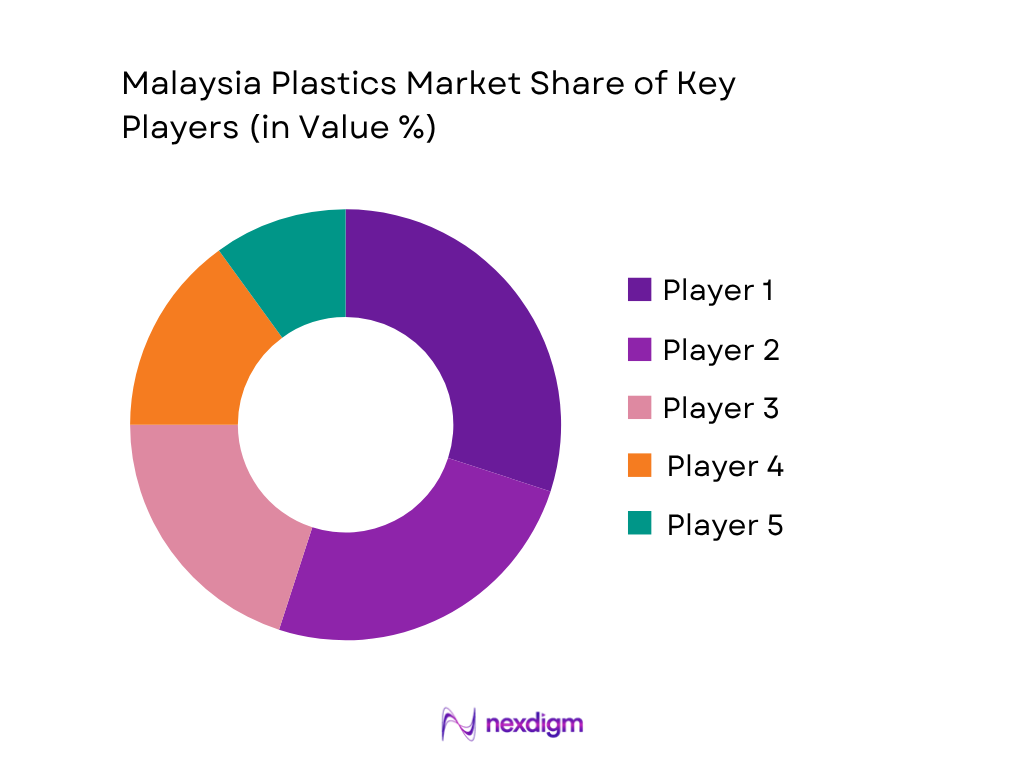
Malaysia Plastics Market Analysis
Growth Drivers
Expansion of Electrical, Electronics and Advanced Manufacturing Applications
Malaysia’s expanding electrical and electronics manufacturing ecosystem is a major demand driver for engineering plastics, thermoplastic compounds, protective films, trays, semiconductor packaging, connectors, housings and precision injection-moulded components. Electrical and electronics exports reached RM601.18 billion in 2024, including RM313.10 billion of electronic integrated circuits, RM32.31 billion of computers, RM15.43 billion of data-processing equipment and RM10.68 billion of computer parts and accessories. The country additionally approved 153 electrical and electronics manufacturing projects involving RM55.81 billion of investment and 30,888 potential jobs in 2024. These downstream investments create addressable demand for high-performance polymers requiring heat resistance, dimensional stability, flame retardancy and electrical insulation. Malaysia’s broader manufacturing sector recorded approximately RM1.9 trillion in sales during 2024, demonstrating the industrial scale supporting plastic converters. The macroeconomic environment also remained supportive, with nominal GDP reaching approximately USD422.23 billion and GDP per capita reaching USD11,874.4 in 2024. Together, semiconductor expansion, electronics exports and industrial investment provide a strong foundation for Malaysian plastic processors supplying precision and technical applications.
Strong Packaging Demand from Manufacturing, Food Processing and Export Supply Chains
Malaysia’s large export-oriented manufacturing and food-processing base creates sustained demand for flexible films, stretch films, shrink packaging, industrial sacks, PET containers, protective plastic packaging and multilayer structures. Manufactured-goods exports reached RM1.289 trillion in 2024, while processed-food exports reached RM35.37 billion. Machinery, equipment and parts exports reached RM69.04 billion, and optical and scientific equipment exports stood at RM59.17 billion, creating additional requirements for industrial, protective and transit packaging. Malaysia’s total merchandise exports reached RM1.508 trillion, supported by exports of RM437.92 billion to ASEAN markets, demonstrating the scale of goods moving through domestic packaging and logistics systems. The manufacturing sector generated approximately RM1.9 trillion in sales during 2024, reinforcing the demand base available to film extruders, rigid-packaging manufacturers and industrial converters. Malaysia also had a population of approximately 35.56 million and nominal GDP of approximately USD422.23 billion in 2024. These manufacturing, consumption and international trade volumes create a substantial underlying demand base for high-throughput plastic packaging serving domestic manufacturers and export-oriented supply chains.
Market Challenges
Exposure to Imported Intermediate Materials and International Supply Chains
Malaysia’s plastics industry operates within a highly import-intensive manufacturing economy, exposing resin producers and converters to international feedstock availability, currency movements and supply-chain disruptions. Total Malaysian imports reached RM1.371 trillion in 2024. Imports from China alone amounted to RM296.45 billion, while imports from the United States reached RM126.26 billion and imports from Taiwan reached RM109.12 billion. Imports from ASEAN markets were also substantial, reflecting Malaysia’s integration with regional manufacturing networks. Chemicals and chemical products represented approximately RM104.14 billion of imports, while petroleum-product imports reached approximately RM128.57 billion, highlighting significant cross-border movement of industrial and petrochemical inputs. This matters directly for plastic processors dependent on polymer resins, additives, masterbatches, specialty chemicals, machinery and technical components sourced internationally. Malaysia’s nominal GDP stood at approximately USD422.23 billion and its population reached approximately 35.56 million in 2024, illustrating the scale of the domestic economy exposed to global trade conditions. Malaysian plastic converters consequently need stronger local sourcing, inventory resilience and supplier diversification while retaining access to specialized polymer grades required by electronics, automotive, medical and packaging applications.
Recycling Feedstock Quality and Transition to Circular Plastic Manufacturing
Malaysia’s transition toward circular plastics creates operational challenges because converters must simultaneously maintain product quality, secure consistent recycled feedstock and redesign products for recyclability. The industrial scale involved is substantial, with Malaysia’s manufacturing sector generating approximately RM1.9 trillion in sales during 2024. The country approved 1,108 manufacturing projects involving approximately RM120.48 billion of investment, while plastic-products manufacturing itself recorded approvals for 91 projects. These plastic-product projects included approximately RM864.0 million of domestic investment and RM900.9 million of foreign investment. This expanding processing base increases requirements for reliable waste collection, sorting, washing, pelletisation, traceability and recycled-resin quality systems. Malaysia’s extensive trade economy further increases packaging-material flows, with total merchandise trade reaching approximately RM2.879 trillion, comprising RM1.508 trillion of exports and RM1.371 trillion of imports in 2024. The country also had approximately 35.56 million residents, creating a substantial consumer-material stream requiring effective recovery systems. The central challenge for the plastics industry is converting post-industrial and post-consumer waste into consistent recycled feedstock capable of satisfying demanding specifications across packaging, electronics, automotive and other technical applications.
Market Opportunities
Higher-Value Engineering Plastics for Electronics and Automotive Manufacturing
Malaysia has a significant opportunity to expand higher-value plastic conversion for semiconductor, electrical, electronics and automotive applications rather than relying predominantly on commodity plastic products. The country approved 153 electrical and electronics projects representing approximately RM55.81 billion of investment and 30,888 potential jobs in 2024. Transport-equipment manufacturing recorded another 110 projects, approximately RM15.83 billion of approved investment and 9,675 potential jobs. Chemicals and chemical products accounted for 92 projects, approximately RM10.63 billion of investment and 4,476 potential jobs, creating an increasingly sophisticated downstream manufacturing ecosystem requiring engineered polymer solutions. Electrical and electronics exports reached RM601.18 billion, including approximately RM313.10 billion of integrated circuits and RM5.54 billion of electro-diagnostic, medical and radiological apparatus exports in 2024. These current industrial volumes create opportunities for polycarbonate, ABS, polyamide, PBT and other specialized polymer compounds used in connectors, housings, electrical insulation and precision components. Malaysia’s nominal GDP of approximately USD422.23 billion further provides macroeconomic depth for investment in higher-specification domestic plastic-processing capabilities serving advanced manufacturing supply chains.
Expansion of Export-Oriented Plastic Manufacturing and Regional Supply Integration
Malaysia’s extensive international trade network creates an opportunity for plastic converters to expand export-oriented films, packaging, precision components and industrial plastic products across ASEAN and other global markets. Total Malaysian merchandise trade reached approximately RM2.879 trillion in 2024, comprising RM1.508 trillion of exports and RM1.371 trillion of imports. ASEAN absorbed approximately RM437.92 billion of Malaysian exports, including RM230.86 billion shipped to Singapore, RM58.98 billion to Thailand, RM54.40 billion to Indonesia and RM53.86 billion to Vietnam. This regional trade infrastructure provides Malaysian converters with established channels into nearby manufacturing and consumer markets. Investment activity also demonstrates continuing interest in the industry, with 91 approved plastic-products manufacturing projects involving approximately RM1.76 billion of investment during 2024. Malaysia’s wider macroeconomic base included nominal GDP of approximately USD422.23 billion, while the country’s extensive free-trade network connects manufacturers with major regional and international markets. These conditions provide Malaysian plastic converters with an opportunity to deepen regional supply relationships, diversify export destinations and move into higher-value flexible films, precision components, sustainable packaging and specialized industrial plastic products.
Future Outlook
The Malaysia Plastics Market is forecast to expand at an indicative ~4.5% CAGR during 2026-2035, supported by Malaysia’s E&E manufacturing ecosystem, food and consumer packaging requirements, automotive applications and continued demand for high-performance industrial plastics. Future growth is expected to become progressively more value-driven as converters move toward engineering plastics, advanced flexible packaging, recycled materials, lightweight components and automated manufacturing.
Circularity will become increasingly important as Malaysia develops its Extended Producer Responsibility and solid-waste circular-economy frameworks. Producers are likely to place greater emphasis on mono-material structures, PCR-compatible products, downgauging, recycling and improved material traceability.cElectrical and electronics applications represent another structural opportunity. Malaysia’s established semiconductor ecosystem requires precision components, housings, connectors and high-performance engineering polymers. This should encourage converters to move beyond commodity applications toward higher-specification materials and technically demanding molding.
Major Players
- LOTTE Chemical Titan Holding Berhad
- PETRONAS Chemicals Group Berhad
- Scientex Berhad
- Thong Guan Industries Berhad
- Daibochi Berhad
- Tomypak Holdings Berhad
- BP Plastics Holding Bhd
- SCGM Bhd
- Respack Manufacturing Sdn Bhd
- Great Wall Plastic Industries Berhad
- Scientex Packaging (Ayer Keroh) Berhad
- Kaneka (Malaysia) Sdn Bhd
- Idemitsu SM (Malaysia) Sdn Bhd
- Toray Plastics (Malaysia) Sdn Bhd
- Dynapack Asia Malaysia
Key Target Audience
- Petrochemical and Thermoplastic Resin Producers
- Plastic Packaging and Conversion Companies
- Electrical and Electronics Component Manufacturers
- Automotive and Engineering Plastic Component Manufacturers
- Plastic Recycling and Circular-Material Companies
- Polymer Distributors, Importers and Industrial Raw-Material Suppliers
- Investments and Venture Capitalist Firms
- Government and Regulatory Bodies (Ministry of Investment, Trade and Industry, Malaysian Investment Development Authority, Ministry of Natural Resources and Environmental Sustainability, Ministry of Housing and Local Government, Department of Environment Malaysia, National Solid Waste Management Department)
Research Methodology
Step 1: Identification of Key Variables
The initial phase involves constructing a comprehensive ecosystem map of the Malaysia Plastics Market covering petrochemical companies, resin producers, compounders, converters, recyclers, distributors and downstream industries. Secondary research identifies critical variables including resin throughput, converter sales, exports, end-use consumption, manufacturing capacity, processing technologies and circular-material adoption. These variables establish the boundaries and analytical structure of the market.
Step 2: Market Analysis and Construction
Historical industry information is compiled using both top-down and bottom-up methodologies. The top-down assessment evaluates plastics-industry sales, resin processed, exports and downstream manufacturing activity, while the bottom-up analysis examines packaging, E&E, automotive, construction and other application categories. Supply-side information is reconciled with downstream resin requirements to construct a consistent market framework and identify major demand pools.
Step 3: Hypothesis Validation and Expert Consultation
Market hypotheses are validated through computer-assisted telephone interviews and discussions with resin suppliers, flexible-packaging companies, injection molders, film manufacturers, recyclers, distributors and industrial procurement teams. Interviews assess production utilization, material preferences, customer requirements, import competition, sustainability priorities and technology adoption. Primary findings are triangulated with official statistics, industry-association information and corporate disclosures to identify inconsistencies and refine assumptions.
Step 4: Research Synthesis and Final Output
The final phase integrates supply-side, demand-side and competitive intelligence into a consolidated Malaysia Plastics Market model. Industry sales and resin throughput are reconciled with packaging, E&E, automotive, construction and other downstream applications. Company manufacturing footprints, export capabilities, polymer portfolios and circularity strategies are then evaluated to establish competitive positioning and support the long-term forecast and strategic recommendations.

- Executive Summary
- Research Methodology (Market Definition and Scope, Malaysia Plastics Market Classification, Thermoplastic Resin Classification, Plastic Processing Technology Mapping, Petrochemical Feedstock Assessment, Plastic Converter Capacity Assessment, End-Use Industry Demand Mapping, Virgin and Recycled Resin Assessment, Top-Down Market Sizing, Bottom-Up Converter Demand Assessment, Domestic Production Analysis, Import and Export Assessment, Primary Industry Interviews, Data Triangulation, Forecasting Framework, Circular Economy Assessment, Limitations and Future Conclusions)

- Definition and Scope
- Malaysia Plastics Industry Evolution and Development of Petrochemical and Plastic Conversion Ecosystem
- Plastic Resin Production, Polymer Conversion and End-Use Application Structure
- Malaysia Plastics Industry Value Chain Analysis
- Malaysia Plastics Supply Chain Analysis
- Petrochemical Feedstock, Polymer Resin, Compounder, Plastic Converter, Recycler and End-Use Industry Ecosystem Analysis
- Plastic Resin Integration Assessment Across Packaging, Electrical and Electronics, Automotive, Construction, Healthcare, Agriculture and Consumer Applications

- Growth Drivers (Expansion of Electrical and Electronics Manufacturing, Growth of Flexible Packaging Production, Strong Export-Oriented Plastic Conversion Industry, Expansion of Semiconductor and Medical Device Manufacturing, Automotive Component Localization, Construction and Infrastructure Plastic Demand)
- Market Challenges (Dependence on Imported Engineering Plastic Resins, Plastic Waste Collection and Sorting Constraints, Limited Chemical Recycling Infrastructure, Volatility in Petrochemical Feedstock Availability, Rising Manufacturing Compliance Requirements, Skilled Labour and Automation Requirements)
- Market Opportunities (Expansion of High-Performance Engineering Plastics, Growth of Recycled Resin Production, Development of Mono-Material Flexible Packaging, Expansion of Medical-Grade Plastic Components, Electrical and Electronics Polymer Applications, Automotive Lightweighting Solutions, Circular Plastic Packaging Development)
- Market Trends (Post-Consumer Recycled Content Adoption, Design-for-Recycling Packaging, Lightweight Flexible Packaging, High-Barrier Multilayer Films, Engineering Plastic Compounding, Automation of Plastic Conversion Plants, Closed-Loop Plastic Recycling, Sustainable Polymer Innovation)
- Government Regulations (Malaysia Plastics Sustainability Roadmap 2021-2030, Circular Economy Blueprint for Solid Waste, Extended Producer Responsibility Framework Development, Solid Waste and Public Cleansing Management Act, Environmental Quality Act, Scheduled Waste Requirements, Food-Contact Packaging Requirements, Eco-Design for Recycling Standards)
- SWOT Analysis
- Porter’s Five Forces Analysis
- PESTLE Analysis
- Stakeholder Ecosystem
- Competition Ecosystem

- By Market Value (2020-2025)
- By Plastic Resin Consumption Volume (2020-2025)
- By Domestic Plastic Resin Production Volume (2020-2025)
- By Plastic Conversion Output Volume (2020-2025)
- By Virgin Plastic Resin Consumption Volume (2020-2025)
- By Recycled Plastic Resin Consumption Volume (2020-2025)
- By Plastic Product Export Volume (2020-2025)

- By Resin Type (In Value %)
Polyethylene
High-Density Polyethylene (HDPE)
Low-Density Polyethylene (LDPE)
Linear Low-Density Polyethylene (LLDPE)
Polypropylene
Polyvinyl Chloride
Polyethylene Terephthalate
Polystyrene and Expanded Polystyrene
ABS and Engineering Plastics
Recycled Plastic Resins - By Product Type (In Value %)
Flexible Plastic Films and Sheets
Plastic Bags and Sacks
Rigid Plastic Packaging
Plastic Bottles and Containers
Plastic Pipes and Fittings
Electrical and Electronics Plastic Components
Automotive Plastic Components
Household and Consumer Plastic Products
Industrial Plastic Components
Construction Plastic Products - By Processing Technology (In Value %)
Film Extrusion
Sheet Extrusion
Pipe and Profile Extrusion
Injection Molding
Extrusion Blow Molding
Injection Stretch Blow Molding
Thermoforming
Rotational Molding
Compression Molding
Foam Processing - By End-Use Industry (In Value %)
Packaging
Food and Beverage Packaging
Industrial and Export Packaging
Electrical and Electronics
Automotive and Transportation
Building and Construction
Healthcare and Medical Devices
Agriculture
Household and Consumer Goods
Industrial and Manufacturing Applications - By Material Origin (In Value %)
Virgin Fossil-Based Plastics
Domestic Virgin Plastic Resins
Imported Virgin Plastic Resins
Post-Industrial Recycled Plastics
Post-Consumer Recycled Plastics
Recycled Polyethylene
Recycled Polypropylene
Recycled PET
Bio-Based Plastics
Biodegradable and Compostable Plastics - By Sales Channel (In Value %)
Direct Resin Producer Sales
Polymer Distributors
Resin Traders and Importers
Plastic Compounders
Plastic Converters
OEM Procurement Networks
Packaging Manufacturers
Electrical and Electronics Component Manufacturers
Automotive Tier Suppliers - By Region (In Value %)
Selangor and Kuala Lumpur
Johor
Penang
Perak
Negeri Sembilan and Melaka
Pahang and East Coast Malaysia
Sabah
Sarawak

- Market Share of Major Players (By Revenue, Production Volume, Plastic Conversion Capacity, Polymer/Product Category, End-Use Industry, Processing Technology, Export Network, Customer Segment)
- Cross Comparison Parameters (Polymer and Plastic Product Portfolio Breadth, Installed Resin/Conversion Capacity, Malaysia Manufacturing Footprint, Flexible and Rigid Packaging Capability, Post-Consumer Recycled Resin Integration, Electrical-Electronics and Automotive Application Exposure, Export Market and Distribution Reach, Circularity and Sustainable Plastics Capability)
- SWOT Analysis of Major Players
- Competitive Positioning Matrix
- Product and Polymer Portfolio Benchmarking
- Production Capacity and Manufacturing Footprint Assessment
- Plastic Processing Technology Benchmarking
- Detailed Profiles of Major Companies
LOTTE Chemical Titan Holding Berhad
PETRONAS Chemicals Group Berhad
Scientex Berhad
Thong Guan Industries Berhad
Daibochi Berhad
Tomypak Holdings Berhad
BP Plastics Holding Bhd
SCGM Bhd
Respack Manufacturing Sdn Bhd
Great Wall Plastic Industries Berhad
Scientex Packaging (Ayer Keroh) Berhad
Kaneka (Malaysia) Sdn Bhd
Idemitsu SM (Malaysia) Sdn Bhd
Toray Plastics (Malaysia) Sdn Bhd
Dynapack Asia Malaysia

- Plastic Converter Resin Procurement Assessment
- Flexible Packaging Manufacturer Demand Assessment
- Electrical and Electronics Manufacturer Polymer Requirement Analysis
- Automotive Component Manufacturer Polymer Requirement Analysis
- Medical and Healthcare Plastic Buyer Assessment
- Construction Plastic Product Manufacturer Analysis
- Virgin versus Recycled Plastic Resin Preference Analysis
- Plastic Converter Supplier Selection Analysis
- End-Use Manufacturer Sustainability Requirement Analysis

- By Market Value (2026-2035)
- By Plastic Resin Consumption Volume (2026-2035)
- By Domestic Plastic Resin Production Volume (2026-2035)
- By Plastic Conversion Output Volume (2026-2035)
- By Virgin Plastic Resin Consumption Volume (2026-2035)
- By Recycled Plastic Resin Consumption Volume (2026-2035)
- By Plastic Product Export Volume (2026-2035)


 Request a Sample
 Ask for Customization
 Get a Quote
 Enquire Now