
 Download PDF
Market Overview
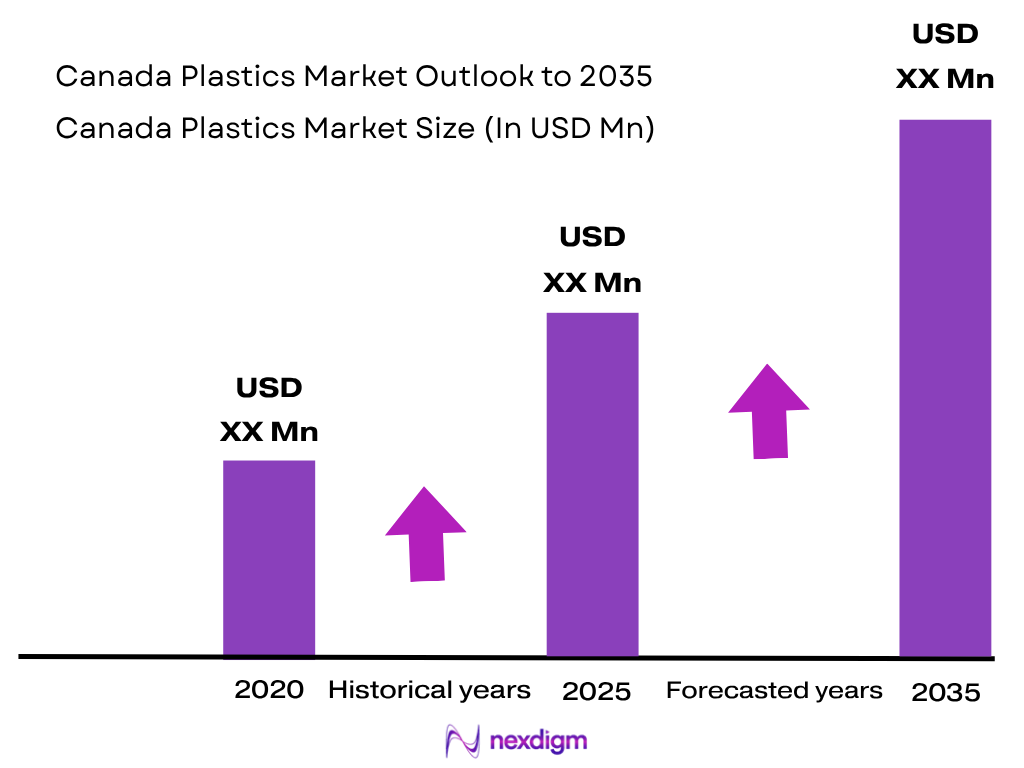
The Canada Plastics Market is estimated at ~USD XX billion in 2024, compared with ~USD XX billion in 2023, with demand supported by packaging, construction, transportation, electrical and electronics, healthcare, and consumer applications. Statistics Canada’s plastics-flow framework identifies packaging, construction materials and transportation vehicles as the three largest application groups, collectively accounting for nearly two-thirds of plastic produced for Canadian consumption. Canada’s plastics industry also spans nearly 2,000 businesses and employs close to 100,000 people.
Ontario, Quebec, Alberta and British Columbia represent the principal plastics manufacturing and conversion centres because of their concentration of automotive, packaging, construction, petrochemical, food-processing and industrial customers. Ontario benefits from its large automotive and manufacturing ecosystem, while Alberta provides proximity to petrochemical feedstocks and polymer production. Quebec has an established manufacturing and packaging base, and British Columbia benefits from Pacific trade connectivity. Statistics Canada recorded C$9.29 billion in monthly GDP at basic prices for plastics and rubber products manufacturing in the latest reported series, demonstrating the industry’s substantial industrial footprint.
Market Segmentation
By Polymer Type
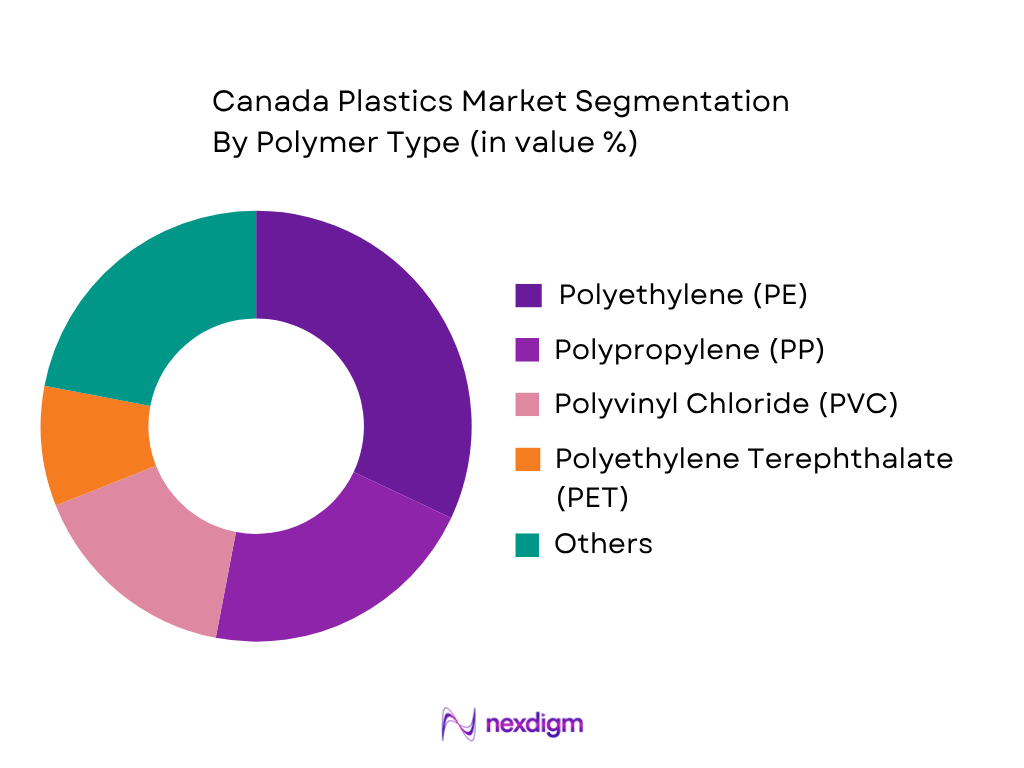
The Canada Plastics Market is segmented by polymer type into polyethylene, polypropylene, polyvinyl chloride, polyethylene terephthalate, polystyrene, polyurethane, engineering plastics and specialty polymers. Polyethylene is expected to represent the dominant segment, supported by its extensive use in flexible packaging, films, containers, pipes, agricultural products and industrial applications. Its processing flexibility, chemical resistance, lightweight characteristics and suitability for both rigid and flexible products make it particularly important to Canadian converters. Polyethylene also benefits from established North American resin supply chains and its compatibility with recycled-content applications. Statistics Canada identifies packaging as the largest individual category of plastic produced for Canadian consumption, accounting for 27.6% in its latest physical-flow assessment, while construction materials accounted for 21.2%. These applications provide a broad downstream base for PE consumption.
By End-Use Industry
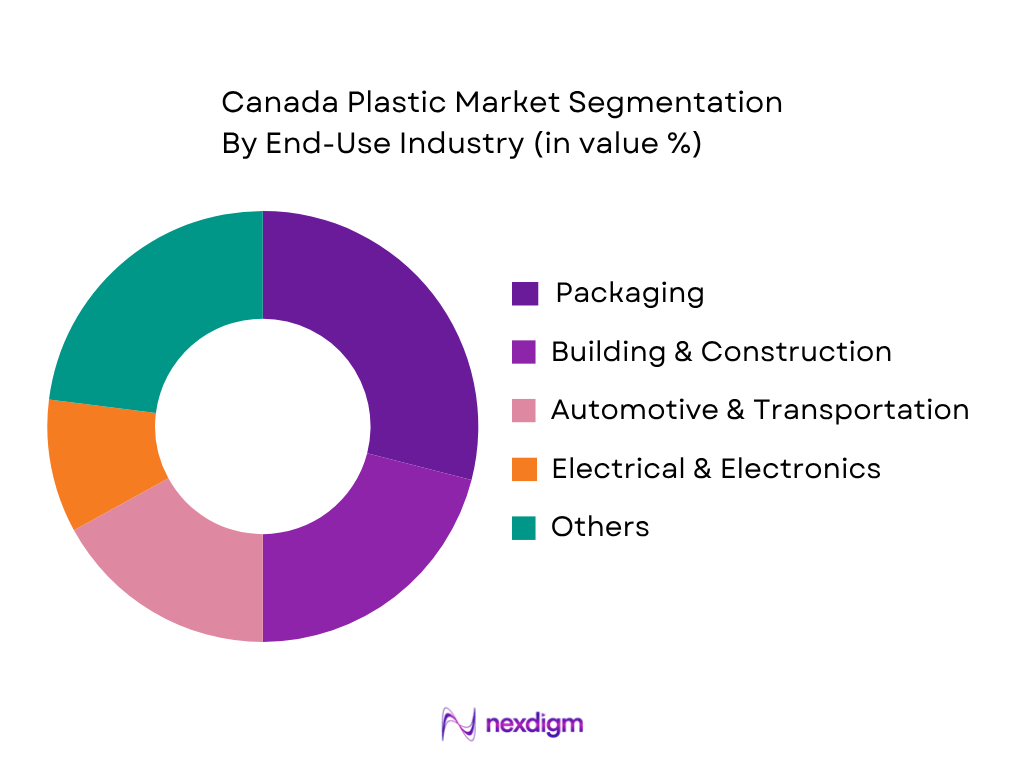
The Canada Plastics Market is segmented by end-use industry into packaging, building and construction, automotive and transportation, electrical and electronics, healthcare and medical, consumer goods, agriculture and industrial applications. Packaging is expected to remain the dominant end-use segment, reflecting the extensive requirement for flexible films, rigid containers, food packaging, beverage packaging, household packaging and industrial packaging. Statistics Canada’s physical-flow account shows packaging as the largest identified application for plastics produced for Canadian consumption, followed by construction materials and transportation vehicles. Packaging also provides significant opportunities for recycled polymers because Canada is pursuing greater circularity and producer responsibility across the plastics lifecycle. The federal government reported that Canadians discard nearly 5 million tonnes of plastic waste annually, creating an increasingly important requirement for recyclable packaging designs and recycled resin integration.
Competitive Landscape
The Canada Plastics Market is characterized by a combination of domestic polymer producers, global chemical companies, plastics processors, packaging manufacturers, recycling companies and specialized technology suppliers. Competition is differentiated by polymer-grade breadth, domestic manufacturing footprint, access to feedstocks, downstream conversion capabilities, recycled-resin availability and relationships with packaging, automotive, construction and industrial customers. Major participants also increasingly compete on circularity, recycled content, lightweighting and advanced polymer technologies as Canadian regulatory initiatives accelerate the transition toward a circular plastics economy.
| Company | Establishment | Headquarters | Polymer Portfolio | Canadian Manufacturing | Recycling/Circularity | Key Applications | Technology Focus | Distribution Reach |
| NOVA Chemicals | 1954 | Calgary, Canada | ~ | ~ | ~ | ~ | ~ | ~ |
| Dow | 1897 | Midland, USA | ~ | ~ | ~ | ~ | ~ | ~ |
| BASF | 1865 | Ludwigshafen, Germany | ~ | ~ | ~ | ~ | ~ | ~ |
| LyondellBasell | 2000 | Houston, USA | ~ | ~ | ~ | ~ | ~ | ~ |
| Berry Global | 1967 | Evansville, USA | ~ | ~ | ~ | ~ | ~ | ~ |
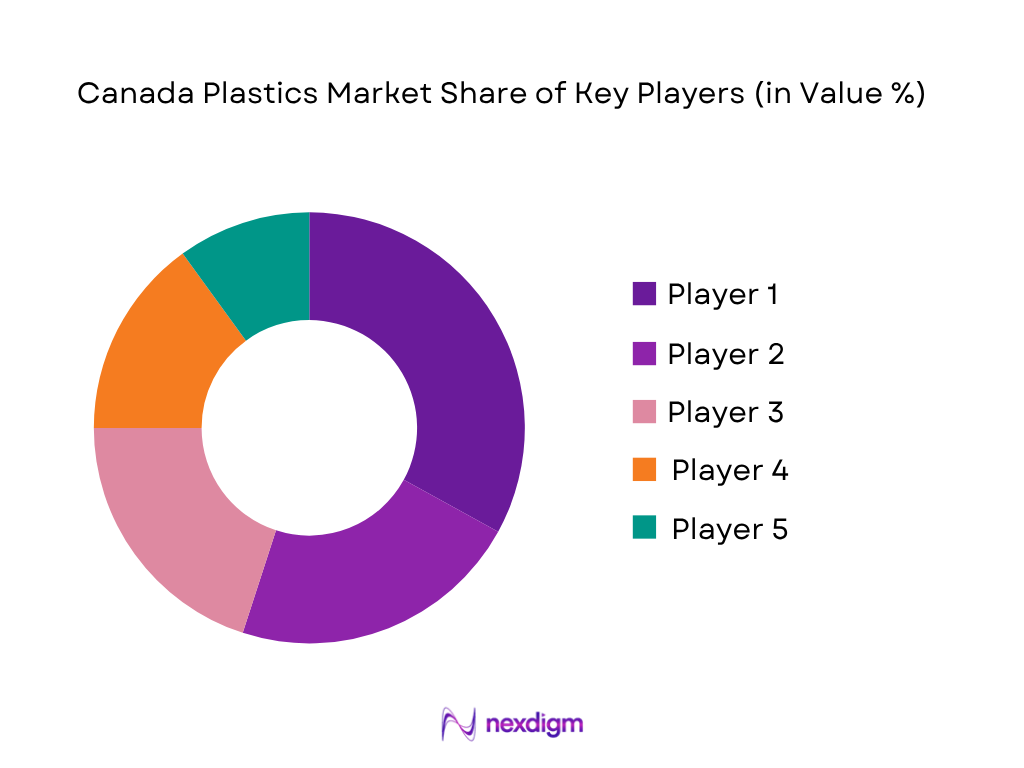
Canada Plastics Market Analysis
Growth Drivers
Expansion of Packaging Applications
The Canada Plastics Market is supported by the continued scale of packaging, food processing, beverage distribution and consumer-goods manufacturing, where plastics provide lightweight, barrier, sealing and durability characteristics. Statistics Canada reported C$36.29 billion of Canadian domestic exports to the United States for the combined basic and industrial chemical, plastic and rubber products category in 2024, while exports to other countries added C$5.159 billion, demonstrating the importance of plastics-linked manufacturing to Canada’s merchandise trade. Statistics Canada also reported C$40.046 billion in revenue from goods manufactured by the plastics and rubber products manufacturing subsector in the latest industry-revenue release available during the period. Packaging demand is further supported by Canada’s broad manufacturing base and cross-border supply chains. Federal policy is simultaneously increasing attention toward plastic-product design, collection and recycling, creating demand for recyclable packaging formats, recycled polymers and material-efficient structures. The Government of Canada introduced the Federal Plastics Registry in 2024 to improve tracking of plastic through production, use and end-of-life stages. These developments strengthen the commercial case for packaging manufacturers to redesign products around recyclability, recycled content and resource efficiency while maintaining required barrier and performance characteristics.
Growth of Construction and Infrastructure Activity
Construction represents a major structural outlet for plastics through pipes, insulation, membranes, flooring, roofing components, sealants, wiring systems and other building products. Statistics Canada reported C$253.8 billion in total investment in building construction in 2024, including C$102.4 billion in residential construction and C$51.7 billion in non-residential construction. Industrial construction investment reached C$10.5 billion, while institutional construction investment reached C$15.3 billion, creating multiple downstream requirements for polymer-based building components. Manufacturing investment also remained substantial, with revised 2024 manufacturing capital expenditures reaching approximately C$35 billion, according to Statistics Canada. The connection between these activities and plastics is particularly relevant for durable polymer applications because construction products require corrosion resistance, low weight, moisture resistance and long service lives. Canada’s infrastructure renewal, housing requirements and industrial development therefore provide a broad demand base for PVC pipes, polyethylene products, polymer insulation, protective films and engineered plastic components. Expansion of manufacturing facilities additionally increases requirements for industrial polymer products used in electrical systems, fluid handling and equipment protection.
Market Challenges
Plastic Waste Management Constraints
Plastic waste management remains a structural challenge for the Canada Plastics Market because significant quantities of used plastic require collection, sorting, processing and end-of-life treatment. The Government of Canada’s 2025 progress reporting, using Statistics Canada physical-flow data, identifies 4.6 million tonnes of disposed plastic and 0.37 million tonnes of recycled plastic in the latest available physical-flow observation. The federal government has consequently established a long-term objective of keeping plastic in use and out of the environment while developing infrastructure and policies supporting circular material flows. The 2024 Federal Plastics Registry represents another major development, requiring information from producers and other participants across the plastics value chain to improve tracking of plastics from production through end of life. For manufacturers, these requirements increase the importance of design-for-recycling, material identification, traceability and producer-responsibility compliance. The challenge is particularly significant for multi-layer packaging, contaminated materials and products containing multiple polymer types, where recovery can be technically difficult. Companies therefore face pressure to preserve product performance while simplifying material structures and increasing compatibility with established recycling systems.
Recycling Infrastructure Gaps
Recycling infrastructure limitations constrain the ability of the Canada Plastics Market to convert growing quantities of discarded material into reliable secondary feedstock. Government of Canada reporting indicates that only a limited quantity of plastic entering the waste stream is ultimately recycled, while the country’s circular-plastics initiative has identified recycling performance across individual resins as an important policy metric. The federal circular-plastics program received C$200.1 million in new funding, with C$40.5 million planned spending and C$38.2 million in actual spending for the reported fiscal period. The 2024 Federal Plastics Registry further reinforces the need for improved information regarding plastics placed on the Canadian market and their end-of-life pathways. For producers and converters, inconsistent access to sorted post-consumer material can complicate procurement planning, quality control and product certification. Differences in collection systems and processing capacity across provinces can also make national product strategies more complex. Consequently, manufacturers seeking higher recycled content must manage feedstock consistency, contamination, polymer separation and logistics alongside conventional production requirements. The infrastructure challenge is therefore not simply a waste issue; it directly affects material availability, product design and the scalability of circular plastics manufacturing.
Market Opportunities
Advanced Recycling Expansion
Advanced recycling provides an opportunity for the Canada Plastics Market to recover value from plastic streams that are difficult to process through conventional mechanical recycling. Canada’s policy framework is increasingly focused on keeping plastics within productive economic use, while the Federal Plastics Registry introduced in 2024 strengthens information availability across the plastics lifecycle. The opportunity is supported by the scale of Canada’s plastics-related trade: Statistics Canada recorded C$41.449 billion in 2024 domestic exports for the combined basic and industrial chemical, plastic and rubber products category, comprising C$36.29 billion exported to the United States and C$5.159 billion to other markets. At the same time, federal reporting identifies recycling of individual resins such as PET, LDPE, HDPE and PP as a specific performance area, highlighting the importance of improving recovery systems. Advanced recycling can potentially complement mechanical systems by processing selected mixed, contaminated or difficult-to-recycle streams into feedstock suitable for new polymer production. This creates opportunities for technology providers, resin producers, waste processors and packaging manufacturers to establish integrated collection, processing and offtake arrangements. Development of domestic recycling capacity can also reduce dependence on external secondary-material supply and improve traceability for manufacturers seeking circular-material inputs.
Post-Consumer Recycled Resin Adoption
Increasing adoption of post-consumer recycled resin presents a significant opportunity for Canadian polymer producers, converters and packaging manufacturers as businesses respond to circular-economy requirements and growing demand for lower-impact materials. Government of Canada reporting identifies recycled PET, LDPE, HDPE and PP as priority resin categories within Canada’s plastics circularity framework, while the Federal Plastics Registry introduced in 2024 creates a mechanism for improving information on plastic flows across the value chain. Canada’s manufacturing ecosystem provides a substantial downstream customer base: Statistics Canada reported approximately C$35 billion in manufacturing capital investment in 2024, alongside C$253.8 billion in building-construction investment. These industrial activities create potential applications for recycled polymers in packaging, construction products, consumer goods and industrial components where technical specifications permit recycled content. Greater domestic availability of consistent recycled resin can enable converters to incorporate secondary material without relying exclusively on imported feedstock. It can also encourage long-term procurement relationships between recyclers, resin producers and major users. The opportunity therefore extends beyond recycling itself, encompassing resin purification, pelletization, quality certification, traceability, product redesign and circular procurement agreements that can support broader commercialization of recycled plastics across Canadian manufacturing.
Future Outlook
The Canada Plastics Market is expected to experience continued structural development as packaging requirements, construction activity, automotive lightweighting, healthcare applications and advanced manufacturing sustain polymer consumption. At the same time, the market is shifting from a conventional virgin-resin model toward recycled and circular material systems. Federal policy is increasingly focused on keeping plastics in the economy and out of landfills and the environment. The government’s circular-plastics initiative runs through 2027 and includes investment in innovation, waste reduction, recycling and market transformation.
The strongest opportunities are expected to emerge around recycled-content polymers, advanced recycling, sustainable packaging, engineering plastics and lightweight automotive components. Canada’s plastics ecosystem is therefore likely to evolve through simultaneous expansion of conventional polymer applications and investment in circular material infrastructure.
Major Players
- NOVA Chemicals
- Dow
- BASF Canada
- LyondellBasell Industries
- INEOS
- Imperial Oil
- Shell Chemicals
- ExxonMobil
- DuPont
- Berry Global
- Amcor
- Cascades
- Winpak
- Husky Technologies
- Merlin Plastics
Key Target Audience
- Plastic resin manufacturers and polymer producers
- Plastic converters, compounders and injection-molding companies
- Packaging manufacturers and sustainable packaging producers
- Automotive OEMs and automotive component manufacturers
- Construction-material and plastic-pipe manufacturers
- Investments and venture capitalist firms
- Government and regulatory bodies (Environment and Climate Change Canada, Innovation, Science and Economic Development Canada, Natural Resources Canada, provincial environment ministries)
- Recycling, waste-management and circular-material companies
Research Methodology
Step 1: Identification of Key Variables
The initial phase involves constructing a Canada Plastics Market ecosystem covering resin producers, polymer distributors, compounders, plastics converters, packaging manufacturers, automotive suppliers, construction-material producers, recyclers and end users. The study identifies polymer types, conversion technologies, application categories, trade flows, recycled-content utilization and regional manufacturing concentrations as core market variables.
Step 2: Market Analysis and Construction
Historical market information is compiled through production, consumption, trade, industrial-output and end-use assessments. Bottom-up calculations examine polymer consumption across packaging, construction, transportation, healthcare, electrical and electronics, consumer products and industrial applications, while top-down analysis reconciles industry production and downstream demand.
Step 3: Hypothesis Validation and Expert Consultation
Market hypotheses are validated through discussions with plastics manufacturers, polymer producers, converters, packaging companies, recycling operators and automotive and construction stakeholders. Industry inputs are used to assess polymer utilization, capacity deployment, technology adoption, recycled-resin penetration, procurement structures and changes in end-use demand.
Step 4: Research Synthesis and Final Output
The final stage integrates primary findings with government statistics, industrial production data, plastics-flow information, trade records and company disclosures. Data are triangulated across supply-side and demand-side calculations to establish market estimates, segmentation structures, competitive positioning and the strategic outlook for Canada’s plastics industry.

- Executive Summary
- Research Methodology (Market Definitions and Scope, Polymer Classification Framework, Plastics Conversion Mapping, Top-Down Market Sizing, Bottom-Up Market Sizing, Demand-Side Assessment, Supply-Side Assessment, Primary Industry Interviews, Import-Export Validation, Production and Consumption Reconciliation, Data Triangulation, Forecasting Framework, Assumptions and Limitations)

- Definition and Scope
- Canadian Plastics Industry Evolution and Industrial Development Timeline
- Plastics Manufacturing Ecosystem Mapping
- Plastics Value Chain Analysis
- Plastics Supply Chain Analysis
- Polymer Production and Conversion Landscape
- Circular Plastics Ecosystem Assessment

- Growth Drivers (Expansion of Packaging Applications, Growth of Construction and Infrastructure Activity, Increasing Automotive Plastic Content, Expansion of Domestic Polymer Production, Growth of Healthcare and Medical Plastics, Demand for Lightweight Materials, Advanced Manufacturing Adoption, Rising Demand for Recycled Resin)
- Market Challenges (Feedstock Price Volatility, Plastic Waste Management Constraints, Recycling Infrastructure Gaps, Environmental Compliance Requirements, Resin Supply Chain Disruptions, Dependence on Petrochemical Feedstocks, Skilled Labor Availability, Provincial Regulatory Differences)
- Market Opportunities (Advanced Recycling Expansion, Post-Consumer Recycled Resin Adoption, Bio-Based Polymer Applications, Lightweight Automotive Component Substitution, Sustainable Flexible Packaging, High-Performance Engineering Plastics, Domestic Recycling Infrastructure Expansion, Circular Polymer Supply Agreements)
- Market Trends (Circular Plastics Adoption, Recycled Content Integration, Lightweighting, Sustainable Packaging Conversion, Chemical Recycling Development, Bio-Based Polymer Innovation, Advanced Compounding, Digital Plastics Manufacturing, Electrification-Driven Polymer Demand)
- Government Regulations and Standards (Federal Plastics Registry, Extended Producer Responsibility Frameworks, Single-Use Plastics Regulations, Canadian Environmental Protection Act Requirements, Provincial EPR Programs, Recycled Content Requirements, Packaging Labelling Requirements, Waste Diversion Standards)
- SWOT Analysis
- Porter’s Five Forces Analysis
- PESTLE Analysis

- By Market Value (2020-2025)
- By Production Volume (2020-2025)
- By Plastics Consumption Volume (2020-2025)
- By Plastics Import Volume (2020-2025)
- By Plastics Export Volume (2020-2025)
- By Average Selling Price (2020-2025)
- By Resin Conversion Volume (2020-2025)

- By Polymer Type (In Value %)
Polyethylene (PE)
Polypropylene (PP)
Polyvinyl Chloride (PVC)
Polyethylene Terephthalate (PET)
Polystyrene (PS)
Polyurethane (PU)
Acrylonitrile Butadiene Styrene (ABS)
Engineering Plastics
Specialty and High-Performance Polymers
Recycled Polymer Resins - By Product Form (In Value %)
Films and Sheets
Rigid Packaging
Pipes and Tubes
Plastic Profiles
Plastic Containers
Plastic Components and Parts
Foams
Compounded Plastics
Masterbatch and Additives - By Processing Technology (In Value %)
Injection Molding
Blow Molding
Extrusion
Thermoforming
Rotational Molding
Compression Molding
Calendering
3D Printing and Additive Polymer Manufacturing - By End-Use Industry (In Value %)
Packaging
Building and Construction
Automotive and Transportation
Electrical and Electronics
Healthcare and Medical
Consumer Goods
Industrial Machinery and Equipment
Agriculture
Aerospace and Defense - By Recycled Content (In Value %)
Virgin Plastics
Post-Industrial Recycled Plastics
Post-Consumer Recycled Plastics
Mechanically Recycled Resins
Chemically Recycled Resins
Bio-Based and Alternative Feedstock Plastics - By Distribution Channel (In Value %)
Direct Polymer Producer Sales
Plastics Distributors
Specialty Chemical Distributors
Compounder and Processor Networks
Industrial Packaging Suppliers
Online B2B Polymer Platforms

- Market Share of Major Players (By Polymer Type, Product Form, Processing Technology, End-Use Industry, Region, Recycled Resin Presence)
- Cross Comparison Parameters (Polymer Portfolio Breadth, Domestic Production and Conversion Capacity, Resin Grade Diversity, Recycling and Circularity Capability, Processing Technology Portfolio, End-Use Industry Coverage, North American Distribution Network, Sustainable Polymer and Recycled Resin Capability)
- SWOT Analysis of Major Players
- Detailed Profiles of Major Companies
NOVA Chemicals
Dow Canada
BASF Canada
Imperial Oil Chemicals
INEOS Canada
Shell Chemicals Canada
LyondellBasell Canada
DuPont Canada
Berry Global
Amcor
Cascades
Husky Technologies
Winpak
Merlin Plastics
Transcontinental

- Packaging Industry Demand Assessment
- Construction Industry Plastics Demand Assessment
- Automotive Industry Plastics Demand Assessment
- Healthcare Plastics Demand Assessment
- Electrical and Electronics Plastics Demand Assessment
- Consumer Goods Plastics Demand Assessment
- Industrial Plastics Demand Assessment
- Agricultural Plastics Demand Assessment
- Recycled Polymer Buyer Analysis

- By Market Value (2026-2035)
- By Production Volume (2026-2035)
- By Plastics Consumption Volume (2026-2035)
- By Plastics Import Volume (2026-2035)
- By Plastics Export Volume (2026-2035)
- By Average Selling Price (2026-2035)
- By Resin Conversion Volume (2026-2035)


 Request a Sample
 Ask for Customization
 Get a Quote
 Enquire Now