

3D printing is moving beyond prototyping as manufacturers evaluate where additive manufacturing can deliver repeatable value at production scale. The latest industry data shows global additive manufacturing revenues reached $24.2 billion in 2025, growing 10.9% year over year, while printing services represented 48% of total market revenue. Yet adoption is not uniform across manufacturing applications.
Automotive, aerospace, healthcare, industrial equipment, and electronics are exploring production use cases where complex geometries, customization, lightweighting, shorter lead times, or lower-volume economics provide an advantage. The key question is no longer whether 3D printing works, but which applications can justify its economics, quality requirements, and scalability for sustained production.
What Makes an Application Suitable for 3D Printing
Not every manufacturing application benefits equally from additive manufacturing. The strongest opportunities typically emerge where traditional production methods face limitations. Manufacturers are therefore evaluating 3D-printing opportunities based on:
- Design Complexity: 3D printing becomes attractive when components require complex geometries, internal channels, lattice structures, or designs that are difficult to manufacture conventionally.
- Production Volume: Low-to-medium production volumes can make additive manufacturing more competitive by reducing tooling requirements and enabling economical production without dedicated molds.
- Economic Viability: Production costs, post-processing, equipment utilization, material consumption, and lead-time benefits must collectively justify the shift from conventional manufacturing.
Assessing these factors helps manufacturers distinguish applications where 3D printing offers a genuine production advantage from those where conventional methods remain more economical.
Nexdigm’s Approach in 3D Printing Application Assessment
Determining where 3D printing can deliver production value requires more than evaluating the technology itself. Nexdigm combines market research, industry analysis, application intelligence, and competitive benchmarking to help manufacturers identify commercially attractive additive manufacturing opportunities. This is done by:
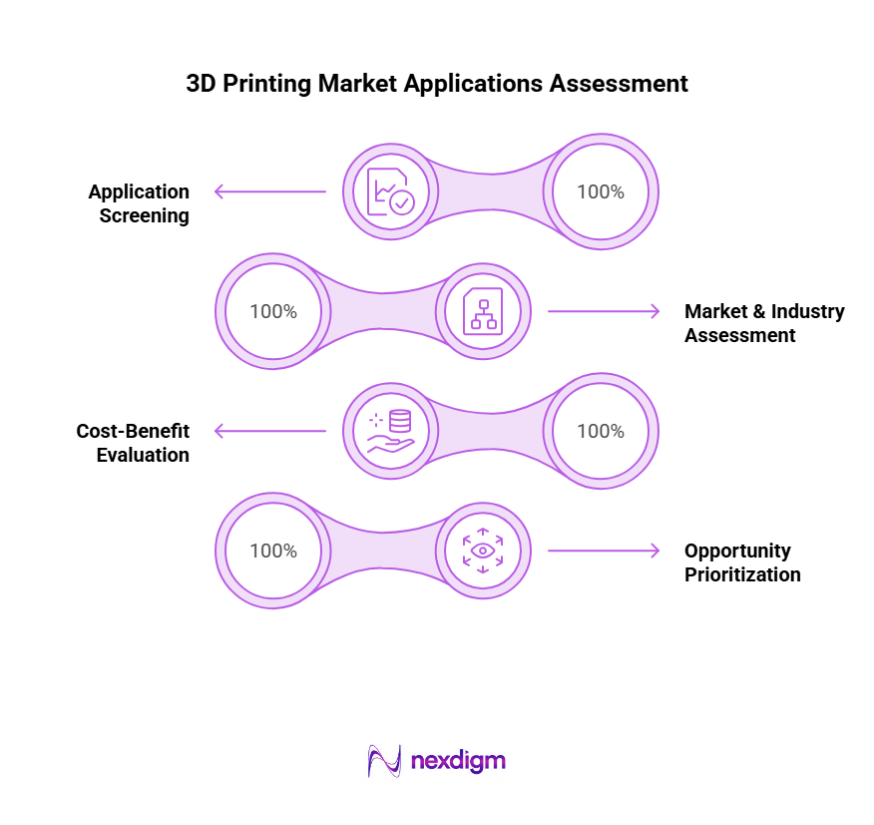
- Application Screening: Assessing manufacturing applications based on production volumes, design complexity, customization requirements, material needs, and technical feasibility.
- Market & Industry Assessment: Analyzing adoption trends, end-use industries, technology developments, competitive activity, and demand patterns to identify high potential applications.
- Cost-Benefit Evaluation: Comparing additive and conventional manufacturing across tooling, materials, production costs, lead times, scalability, and operational requirements.
- Opportunity Prioritization: Ranking applications according to market attractiveness, technical suitability, commercial potential, and readiness for scaled production.
This enables manufacturers to move from broad interest in 3D printing toward evidence-based decisions on which applications are worth scaling and where investment can create the strongest value.
Nexdigm’s Focus Areas for Identifying High-Value 3D Printing Opportunities
Through the 3D printing manufacturing market analysis expertise, Nexdigm helps manufacturers focus on opportunities where additive manufacturing can deliver the greatest commercial and operational impact. Key focus areas include:
- Low-Volume, High-Complexity Parts: Identify components where traditional manufacturing is less economical due to tooling costs, design complexity, or frequent engineering changes.
- Customization-Driven Applications: Evaluate products requiring tailored designs, personalized specifications, or rapid design modifications that can benefit from additive manufacturing flexibility.
- Lead Time Reduction Opportunities: Assess applications where on-demand production, localized manufacturing, or reduced tooling requirements can significantly improve delivery timelines.
By concentrating on these strategic areas, manufacturers can better prioritize additive manufacturing investments, accelerate adoption, and focus resources on applications with the strongest technical and commercial potential.
Why Nexdigm Is the Right Partner for 3D Printing Market Analysis
Evaluating 3D-printing opportunities requires a combination of technology understanding, market intelligence, application knowledge, and commercial perspective. Nexdigm brings these capabilities together to help manufacturers assess opportunities by conducting:
- Industry-Focused Research: Nexdigm combines sector knowledge with market research to understand adoption trends, application developments, and competitive dynamics.
- Data-Driven Evaluation: Structured analysis helps compare applications, technologies, competitors, market opportunities, and commercial considerations using relevant decision criteria.
- Cross-Industry Perspective: Experience across manufacturing sectors provides broader visibility into emerging applications and transferable additive manufacturing opportunities.
- Actionable Recommendations: Nexdigm translates research findings into practical recommendations supporting technology selection, application prioritization, investment planning, and market-entry decisions.
This combination enables manufacturers to approach additive manufacturing with a clearer understanding of market potential, application readiness, competitive dynamics, and commercial opportunity.
Gaining a Competitive Edge Through Nexdigm’s 3D Market Insights
Nexdigm’s 3D printing manufacturing market analysis can help manufacturers act on market changes before opportunities become crowded or competitive advantages narrow. By combining market, application, technology, and competitor intelligence, businesses gain a competitive edge from Nexdigm’s insights including:
- Identified Emerging Opportunities: Detect developing applications, industries, and market segments early through structured analysis, enabling timely investments, stronger positioning, and greater ability to capture growth before competitors.
- Benchmark Competitors: Evaluate competitor capabilities, technology adoption, application focus, partnerships, and strategic initiatives to identify differentiation opportunities, strengthen market positioning, and inform competitive strategies.
- Prioritized High-Potential Markets: Focus resources on applications and segments with stronger demand potential, technical fit, scalability, and commercial attractiveness to maximize growth opportunities and investment returns.
These insights give manufacturers a clearer basis for anticipating market shifts, identifying whitespace opportunities, and positioning their additive manufacturing strategies ahead of competitors.
Nexdigm’s Case
Nexdigm supported a precision engineering firm through manufacturing capability benchmarking, identifying opportunities to improve production accuracy and quality. The assessment contributed to a 20% improvement in CNC tolerance accuracy and a 15% reduction in defect rates, strengthening the client’s competitiveness in high-performance component markets and supporting more reliable manufacturing outcomes.
To take the next step, simply visit our Request a Consultation page and share your requirements with us.
Harsh Mittal
+91-8422857704