

Choosing a 3PL operating model is one of the earliest structural decisions in a new market. Dedicated facilities offer greater control but create fixed commitments. Shared-user networks spread infrastructure costs across multiple customers, while asset-light models provide flexibility by relying on external warehouse and transport capacity.
The right choice depends on the maturity and concentration of demand, the level of service control required and how quickly the provider expects volumes to scale.
Dedicated Capacity Fits Predictable Demand
A dedicated operation becomes more attractive when an anchor customer has stable volumes, specialized handling requirements and sufficient contract visibility to support dedicated infrastructure.
Pharmaceutical, cold-chain, automotive and other specialized operations can justify dedicated facilities where customers require customized processes, equipment or stringent service levels. The trade-off is greater exposure to fixed costs if volumes fall or the customer relationship ends earlier than expected.
Dedicated capacity therefore makes the most sense when the commercial commitment is strong enough to support the infrastructure required to serve it.
Shared Networks Spread the Infrastructure Risk
Multi-client facilities provide greater flexibility when demand is fragmented across several customers or subject to seasonal variation. Warehouse space, handling equipment, security, technology and facility management can be shared across accounts, allowing the provider to add customers without creating a separate physical operation for each one.
This model can be particularly useful during market entry. A provider can establish a presence in a strategic logistics node while testing customer demand before committing to dedicated infrastructure.
The commercial advantage comes from balancing customer requirements within the same facility. The more compatible the accounts are in terms of storage, handling and operating schedules, the more effectively shared capacity can be utilized.
Asset-Light Models Reduce Commitment, Not Risk
An asset-light model allows a provider to enter a market without owning warehouses or transport fleets. External warehouse operators, carriers and other logistics partners provide the physical capacity while the 3PL manages customer relationships, coordination and technology.
That flexibility can be valuable when demand is uncertain. It also introduces a different set of risks. Service quality becomes dependent on third-party partners, capacity can become difficult to secure during peak periods, and the provider has less direct control over operational execution.
The model is therefore most useful where flexibility has greater commercial value than direct control, particularly during the early stages of market development.
The Model Can Evolve with the Market
There is no requirement for an entrant to choose one structure permanently. An asset-light operation can establish initial customer relationships and validate demand. Once several accounts begin generating sufficient volume in the same geography, a shared facility can improve control and operating leverage. A dedicated facility may eventually become appropriate for customers with stable, specialized requirements.
This progression allows infrastructure investment to follow demonstrated demand rather than anticipated market growth.
The decision also depends on what the customer is buying. A standard storage-and-distribution requirement may be well suited to shared capacity, while highly integrated operations involving automation, specialized handling or proprietary processes may justify dedicated infrastructure.
Compare Cost, Control and Scalability Together
A lower-cost entry model is not necessarily the most profitable over time. Asset-light operations may have lower fixed commitments but higher external procurement costs. Dedicated infrastructure can provide better control and operating leverage at scale while creating greater downside exposure during periods of underutilization.
The comparison therefore needs to consider the full operating horizon: expected customer volumes, facility requirements, labour, transport, partner margins, contract duration, utilization and the cost of moving from one operating model to another.
How Nexdigm Compares 3PL Entry Models
Nexdigm’s 3PL distribution model entry consulting services can assess:
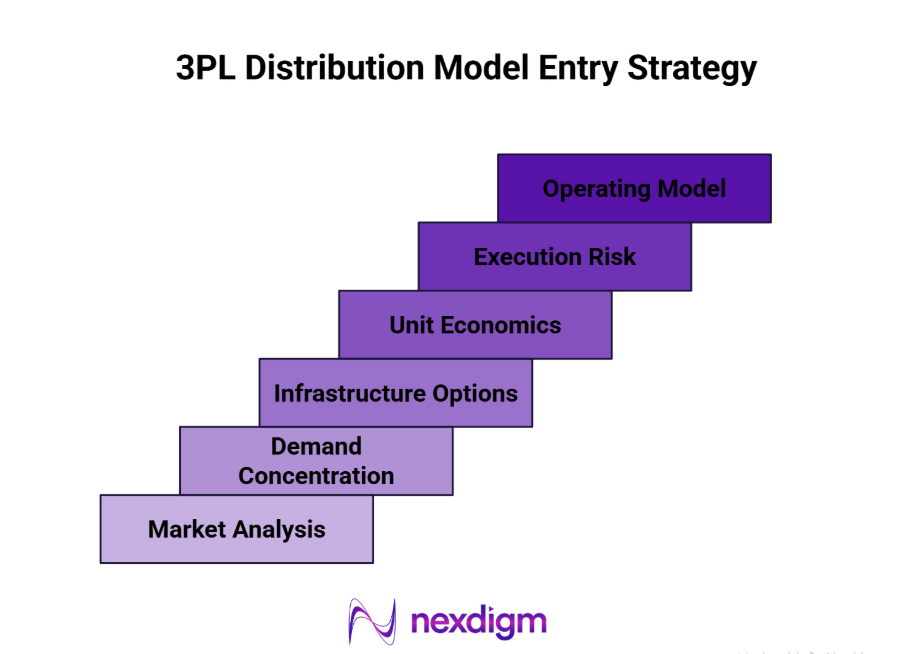
- Market and account profile: Evaluate target customer volumes, inventory characteristics, contract expectations and service requirements.
- Demand concentration: Assess customer density, seasonality and the potential to consolidate multiple accounts within a shared network.
- Infrastructure options: Compare available warehouse capacity, transport partners, facility specifications and lease structures.
- Unit economics: Model cost, revenue, utilization and margin under dedicated, shared and asset-light scenarios.
- Execution risk: Assess partner dependence, service-level exposure, capacity availability and operational control.
- Operating-model roadmap: Determine the appropriate entry structure and the conditions under which infrastructure should be internalized.
This creates a model-selection decision based on the economics of the target market rather than a preference for owning or outsourcing assets.
Nexdigm Case: Rebalancing Warehouse and Distribution Economics
A global diagnostics provider operating in India faced inefficiencies across its distribution network. Nexdigm assessed the company’s demand profile, distribution structure and facility economics across a network serving more than 200 distributors.
The resulting network redesign generated 16% distribution cost savings and improved service levels by 7%. Further network, inventory and transportation optimization generated an additional 27% reduction in overall supply-chain costs.
The case demonstrates the value of matching network structure to actual demand rather than allowing an existing asset configuration to determine how the market is served.
To take the next step, simply visit our Request a Consultation page and share your requirements with us.
Harsh Mittal
+91-8422857704