

Expansion decisions for third-party logistics (3PL) providers involve more than identifying regions with rising trade volumes. A market may handle substantial cargo yet offer limited opportunities because of established competitors, expensive infrastructure, fragmented demand or difficult cross-border procedures.
The stronger opportunity lies where trade growth aligns with unmet logistics needs, accessible infrastructure and commercially viable customer segments. Trade data helps providers evaluate these conditions before committing to warehouses, transport fleets, distribution centres or local partnerships.
Identify Where Trade Demand Is Growing
The first step is to understand which markets are generating new freight demand. Import and export data can reveal changes in shipment volumes, commodity categories, trading partners and the frequency of cross-border transactions.
The World Trade Organization’s October 2025 trade update reported that merchandise export volumes increased by 10.4% year on year in Asia during the first half of 2025. Africa and South and Central America also recorded export growth of 6.3% and 7.4%, respectively. These regional figures provide useful screening signals, but they do not establish that every country or logistics segment within those regions offers attractive returns.
Providers should examine trade at a more granular level, including:
- Commodity Mix: Identify sectors generating demand for specialised handling, temperature control, dangerous goods management or secure storage.
- Trading Partner Concentration: Determine whether a market depends heavily on a small number of origins or destinations.
- Trade Growth Consistency: Separate sustained expansion from temporary spikes caused by commodity prices, inventory adjustments or disruptions.
- Shipment Characteristics: Assess shipment sizes, frequency and likely transport modes to estimate the services customers need.
This analysis helps narrow the search from broad regional growth to specific markets, corridors and industries.
Map Trade Flows Against Logistics Infrastructure
Growing trade creates an opportunity only when providers can move goods reliably and at a competitive cost. Port capacity, airport connectivity, road and rail links, customs procedures, warehouse availability and inland distribution access all influence the economics of expansion.
UNCTAD’s Review of Maritime Transport 2025 reported that global maritime trade volumes grew by 2.2% in 2024, while distance-adjusted trade, measured in ton-miles, increased by 5.9%. Longer shipping routes contributed to the difference. For 3PL providers, this demonstrates why cargo volume alone can be misleading: changes in routing and transit distance can alter demand for transport coordination, storage and freight management.
The World Bank’s Logistics Performance Indicators 2.0 provide another useful reference. Based on shipment-tracking data for 2023 and 2024, they assess international supply chain connectivity and speed across maritime, aviation and postal logistics. Their indicators help identify differences between markets in connectivity and delays at important logistics nodes.
Providers can combine these external indicators with local port statistics, warehouse utilisation, road freight rates and customs clearance records to identify where demand is growing faster than logistics capacity.
Assess Competition And Customer Potential
A promising trade corridor does not automatically translate into an attractive market for every 3PL provider. The next step is to understand who already serves the market and which customer needs remain insufficiently addressed.
3PL trade analysis can connect commodity-level trade flows with importer and exporter activity, shipment origins, destination markets and existing service coverage. This helps providers identify customer clusters and evaluate whether expansion should focus on freight forwarding, contract logistics, fulfilment, customs brokerage or specialised transport.
Competitive analysis should examine service capabilities rather than provider counts alone. Established operators may dominate large enterprise contracts while smaller exporters struggle to access reliable consolidation or cross-border distribution services.
Providers should also estimate customer concentration, contract size, sales cycles and the cost of acquiring new accounts. A market with many potential customers but high service complexity may be less attractive than a smaller market where demand is concentrated and infrastructure is accessible.
Evaluate Commercial Viability Before Investing
Market selection must connect demand indicators to operational economics. Providers should estimate expected shipment volumes, revenue per shipment, handling costs, transport costs, labour availability, facility expenses and the investment needed to meet service commitments.
Scenario analysis is particularly important where trade patterns are volatile. A market assessment should test whether projected returns remain viable if volumes grow more slowly, freight rates change, border delays increase or a major customer leaves.
Expansion does not always require a new facility. Depending on demand and service requirements, providers may enter through local carrier partnerships, shared warehousing, cross-docking arrangements or a dedicated customer contract before committing to a permanent network.
The 3PL Market Expansion Assessment Framework
Use five steps to compare candidate markets consistently:
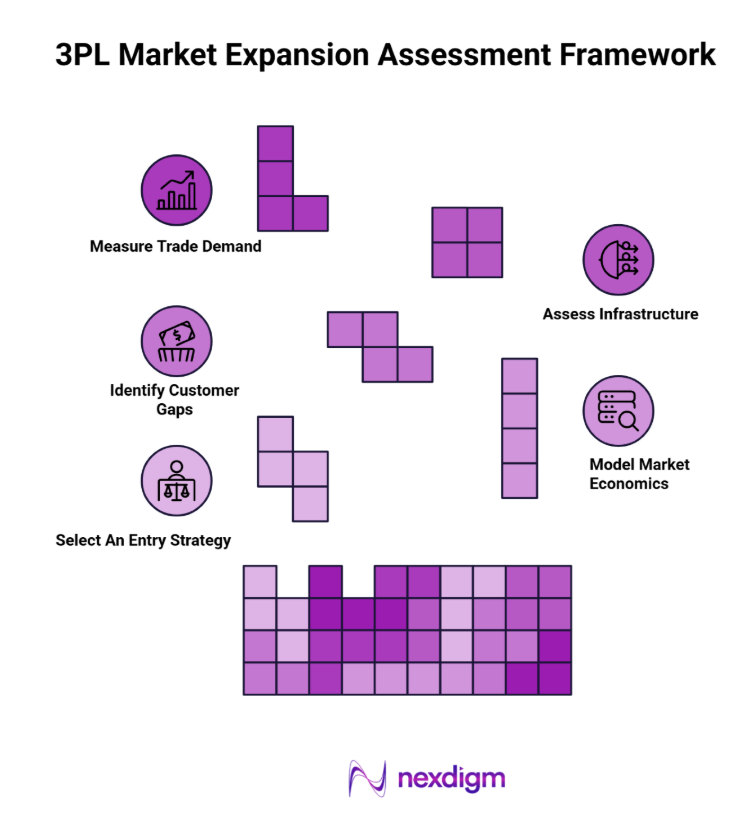
- Measure Trade Demand: Track import and export growth, commodity mix, trading partners and shipment characteristics.
- Assess Infrastructure: Evaluate port and airport connectivity, inland transport access, customs performance and warehouse availability.
- Identify Customer Gaps: Map target industries, importer and exporter clusters, competitor capabilities and underserved service requirements.
- Model Market Economics: Estimate revenue potential, operating costs, capital requirements and downside scenarios.
- Select An Entry Strategy: Rank markets by commercial viability and choose between partnerships, shared facilities or direct investment.
The result should be a prioritised expansion pipeline with clear assumptions, investment thresholds and measurable milestones.
Nexdigm’s Case Study: Prioritising A New Distribution Market
A regional 3PL compares three potential markets using trade growth, port connectivity, customer concentration and estimated operating costs. One market shows strong import growth but high facility expenses. Another offers moderate growth, established inland connections and several underserved manufacturers. The provider prioritises the second market for a partnership-led entry.
Trade data is most valuable when it helps 3PL providers connect market demand with service gaps and realistic operating economics. Combining trade flows, infrastructure indicators, customer intelligence and investment scenarios creates a stronger basis for expansion than relying on headline growth rates alone.
To take the next step, simply visit our Request a Consultation page and share your requirements with us.
Harsh Mittal
+91-8422857704