

5G has reached a scale where simply measuring subscriptions and network speed no longer captures the commercial opportunity. Global 5G subscriptions reached approximately 3.3 billion by Q2 2026, while mobile network traffic exceeded 220 exabytes per month, growing 23% year over year.
The more important question is how operators and technology providers can convert this installed network base into differentiated revenue. Fixed Wireless Access, private networks, network slicing and industrial applications are becoming increasingly relevant as operators move beyond conventional connectivity.
Consumer Connectivity Is Reaching a Different Stage of Maturity
The initial 5G opportunity was largely associated with faster consumer connectivity. But once high-speed mobile networks become widespread, the willingness to pay for additional speed becomes harder to expand.
The report estimates that video accounts for approximately 75% of total mobile network traffic, while overall traffic exceeds 220 EB per month. The resulting growth in network usage does not necessarily translate into equivalent increases in consumer revenue.
This is pushing operators toward services where connectivity can be tied directly to a business requirement.
Fixed Wireless Access Is Turning Network Capacity Into Broadband Revenue
Fixed Wireless Access is one of the clearest examples. 71% of global FWA providers are deploying 5G, particularly in locations where fibre-to-the-home infrastructure can be expensive to deploy.
The commercial proposition is different from a conventional mobile data plan. The operator is competing for household broadband expenditure and can potentially build longer-term relationships through bundled connectivity, home security, cloud services or smart-home applications.
This makes geographic assessment important. Areas with limited fixed broadband availability, sufficient population density and adequate 5G coverage can present a different opportunity from already well-served urban markets.
Enterprise 5G Creates a Different Value Proposition
The larger opportunity may increasingly come from enterprise applications. 5G Standalone architectures allow operators to create network slices with differentiated latency, throughput and security.
The number of commercial 5G SA network-slicing offerings increased from 65 to 84 during the first six months of 2026. The report identifies applications across industrial logistics, utilities and media broadcasting, where guaranteed network performance can be linked to operational requirements.
India is also moving toward these applications. The country had approximately 430 million 5G subscriptions at the end of 2025, with the number projected to reach 1.1 billion by 2031. Operators are increasingly directing attention toward FWA, enterprise private networks and edge data centres.
Building a 5G Commercial Opportunity Framework
A 5G market assessment services approach needs to begin with the customer’s operational problem rather than the technical capability of the network.
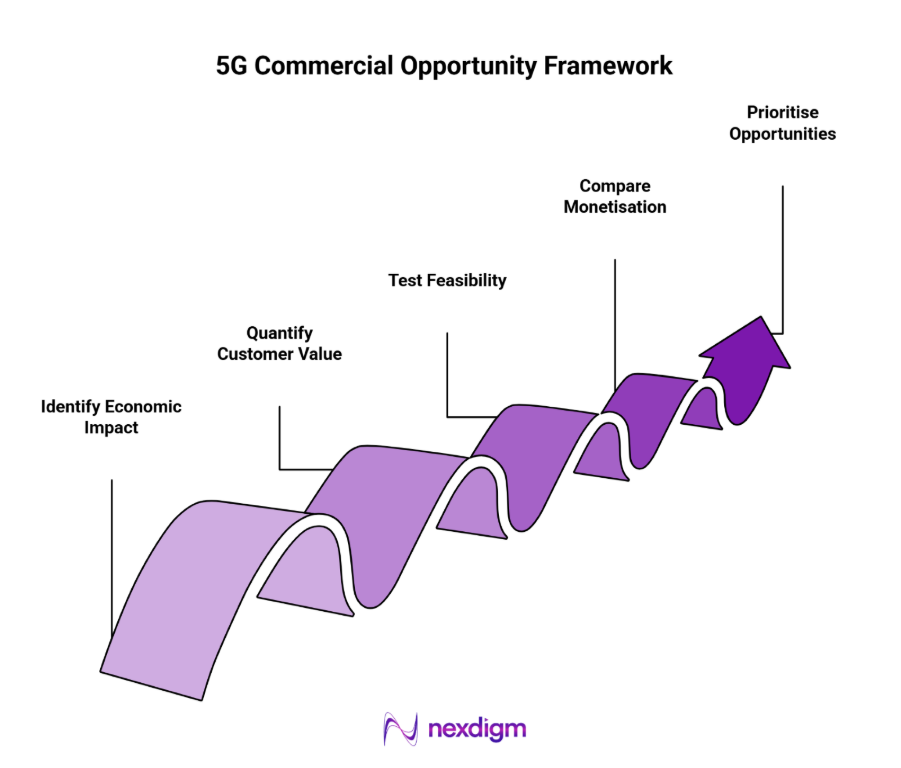
- Identify where connectivity changes the economics.
Assess industries where latency, reliability, bandwidth or security has a measurable operational impact. This can include logistics, utilities, manufacturing, healthcare, broadcasting and residential broadband. - Quantify the customer value pool.
Determine what the customer currently spends on connectivity and adjacent infrastructure, what inefficiencies exist and how much economic value a 5G-enabled solution could generate. - Test infrastructure and deployment feasibility.
Coverage, spectrum, edge infrastructure, device availability, private-network requirements and integration costs can determine whether a theoretically attractive use case is commercially deployable. - Compare monetisation models.
Operators can monetise through FWA subscriptions, private-network contracts, SLA-backed network slices, device bundles, managed services or application-specific connectivity. The appropriate model depends on customer requirements and willingness to pay. - Prioritise opportunities by return potential.
The final assessment should compare market size, customer readiness, competitive intensity, deployment requirements and expected revenue to determine where investment should be concentrated.
This becomes increasingly relevant as operators reposition themselves. The report notes that 45% of global operators identify AI monetisation as a priority, indicating a broader movement toward enterprise technology services rather than connectivity alone.
Nexdigm Case: Evaluating Enterprise 5G Monetization Opportunities
A telecom operator assessed 5G opportunities across 4 industries, interviewing 1,500 enterprise users and benchmarking 28 competing offerings. Nexdigm prioritised FWA, private networks and network slicing, supporting a roadmap targeting 18% incremental B2B revenue within three years.
Nexdigm’s 5G market assessment services help telecom and technology companies evaluate demand, use cases, competitive positioning, pricing, infrastructure requirements and commercial opportunities.
To take the next step, simply visit our Request a Consultation page and share your requirements with us.
Harsh Mittal
+91-8422857704