

The API supplier landscape is increasingly shaped by global manufacturing concentration, regulatory scrutiny, and the need for reliable supply. FDA data shows that, as of 2025, 44% of API manufacturers supplying FDA-approved products were in India and 22% were in China, compared with 11% in the U.S. FDA’s FY2025 analysis also found that the distribution of API manufacturing locations for U.S.-based application products shifted toward India and China between 2020 and 2025, while shares in Europe and the U.S. declined.
The market is not simply about manufacturing scale. In FY2025, FDA recorded 1,951 registered API establishments, illustrating the breadth of the global supplier base. At the same time, supplier quality remains a material consideration: FDA reported that 72% of API sites subject to certain regulatory actions over the preceding five years were sites exclusively supplying compounding pharmacies, with many located in China and India.
For pharmaceutical companies, the strongest supplier is therefore not necessarily the largest or lowest-cost option. Active pharmaceutical ingredient supplier analysis needs to consider the combination of manufacturing capability, quality, regulatory readiness, capacity, geographic positioning, technology, commercial terms, and long-term strategic fit.
Strategic Fit Goes Beyond Supplier Size
API suppliers can differ considerably in their manufacturing technologies, molecule portfolios, geographic footprints, production scale, regulatory experience, and customer focus. A large supplier may provide capacity and geographic reach, while a specialist may offer deeper expertise in a particular therapeutic area, complex molecule, or manufacturing process. The right supplier therefore depends on what the pharmaceutical company is sourcing, where the product is marketed, and what requirements the supply relationship must satisfy.
Major Dimensions That Define the Supplier Fitness
A meaningful comparison of supplier fitness can begin with the following three questions:
- Can the Supplier Deliver Consistently? Examine manufacturing capacity, quality systems, technical capabilities, lead times, and track record across relevant API categories.
- Can the Supplier Meet Regulatory Needs? Assess certifications, inspection history, documentation, regulatory experience, and readiness for target-market requirements.
- Can the Relationship Create Long-Term Value? Consider pricing, scalability, geographic exposure, technology, development support, and potential for strategic collaboration.
Together, these dimensions provide a stronger foundation for identifying suppliers that fit both immediate procurement requirements and longer-term pharmaceutical strategies.
How Nexdigm’s Experts Assess Dimensions for Supplier Fitness
Nexdigm’s experts can assess API suppliers by connecting individual supplier attributes with the pharmaceutical company’s specific sourcing requirements. The evaluation can examine:
- Capability Against Requirements: Compare manufacturing technology, capacity, molecule expertise, quality systems, and technical capabilities against the specific API being sourced.
- Regulatory & Quality Readiness: Review certifications, inspection history, documentation, compliance experience, and readiness to meet the regulatory expectations of target markets.
- Supply & Geographic Resilience: Assess manufacturing locations, capacity dependencies, lead times, logistics exposure, supplier concentration, and availability of alternative production sources.
- Commercial & Strategic Fit: Evaluate pricing, contractual flexibility, scalability, development support, and the supplier’s potential to support longer-term sourcing objectives.
By applying these dimensions together, Nexdigm can provide a more contextual assessment of supplier fitness, helping pharmaceutical companies distinguish between suppliers that are broadly capable and those that are specifically suited to their requirements.
Supplier Fitness Revealing Long-Term Partnership Potential
The assessment can also reveal which API suppliers have the potential to support a more strategic relationship. Nexdigm can interpret supplier performance across capacity, technical expertise, regulatory readiness, responsiveness, scalability, and commercial alignment to identify partners that may support evolving requirements. This can help pharmaceutical companies distinguish between suppliers suited primarily to transactional procurement and those capable of supporting long-term collaboration, capacity planning, technical development, and supply continuity.
How Nexdigm’s Assessment Creates Meaningful Supplier Insight
Nexdigm’s assessment can help pharmaceutical companies turn supplier information into actionable insight by highlighting capability gaps, qualification considerations, supply risks, and areas of strategic fit. By bringing these factors together, the analysis can support more informed supplier prioritization and help organizations identify where additional qualification, diversification, or deeper commercial engagement may be warranted. The assessment therefore provides a bridge between supplier intelligence and practical sourcing decisions.
Nexdigm’s API Supplier Assessment Framework
Nexdigm can translate supplier-fit insights into a structured assessment that helps pharmaceutical companies compare and prioritize API suppliers. The assessment involves the following steps:
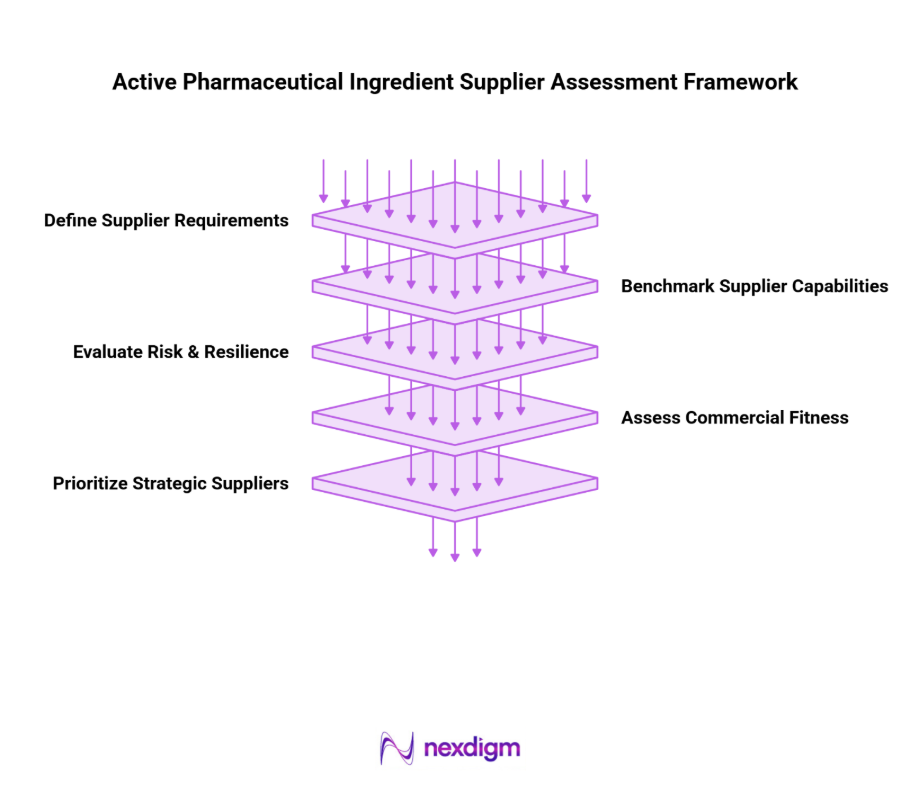
- Define Supplier Requirements: Establish API-specific requirements covering molecule, volume, quality, regulatory markets, technical specifications, and sourcing objectives.
- Benchmark Supplier Capabilities: Compare manufacturing expertise, capacity, technology, quality systems, geographic footprint, and relevant API experience.
- Evaluate Risk & Resilience: Examine supplier concentration, geographic exposure, capacity dependencies, lead times, continuity measures, and alternative-source availability.
- Assess Commercial Fit: Compare pricing, minimum order quantities, contractual terms, logistics, scalability, and potential long-term economics.
- Prioritize Strategic Suppliers: Segment suppliers according to overall fitness, qualification potential, sourcing risk, and their ability to support future requirements.
This framework helps convert active pharmaceutical ingredient supplier analysis into a practical basis for supplier qualification, sourcing decisions, and long-term partnership planning.
Nexdigm’s Case
Nexdigm supported a pharmaceutical company in assessing API suppliers across quality, regulatory readiness, manufacturing capacity, geographic exposure, and commercial fit. The analysis classified 14% as priority strategic suppliers, 25% as suitable secondary sources, and identified 10 suppliers requiring further qualification, helping the company strengthen its supplier portfolio and reduce sourcing concentration.
To take the next step, simply visit our Request a Consultation page and share your requirements with us.
Harsh Mittal
+91-8422857704