

Personalized learning is becoming an important part of the digital education landscape as learners increasingly expect content, assessments, and learning pathways suited to their individual needs. India EdTech research values the market at USD 5.55 billion, with AI-enabled personalization identified as an important growth driver. India’s 949 million broadband subscriptions and 290 million 5G subscriptions further support technology-intensive learning models.
Adaptive technologies can respond to learner performance, pace, preferences, and engagement, enabling platforms to adjust content and assessments dynamically. Yet adoption depends on more than technological capability. Learner willingness, institutional readiness, content quality, affordability, infrastructure, and measurable outcomes can determine whether personalized learning solutions achieve sustainable adoption.
A structured Adaptive learning technology market assessment can help EdTech companies, education institutions, investors, and technology providers evaluate demand, identify relevant use cases, benchmark competitors, and assess the commercial potential of adaptive learning models.
Why Personalized Learning Is Gaining Attention
Traditional learning models often provide the same content and pace to diverse learners. Adaptive technologies can instead use performance and behavioral signals to adjust difficulty, recommend content, and provide targeted support.
This creates potential for more individualized learning experiences across K-12, test preparation, higher education, vocational training, and professional learning. The opportunity varies by learner segment and education model, making market-level assessment important before scaling adaptive solutions.
Engagement Does Not Automatically Mean Better Outcomes
A personalized platform may increase interaction without necessarily improving learning outcomes. Effective adaptive learning requires relevant content, accurate learner profiling, appropriate interventions, and feedback mechanisms that support genuine academic progress. Recent research highlights that digital education providers increasingly need to assess engagement, retention, completion, conversion, and learner value, rather than relying solely on user numbers.
Nexdigm’s Support Towards Adaptive Learning Opportunities
Nexdigm combines education-sector research, EdTech intelligence, consumer insights, competitive benchmarking, and strategic advisory to assess technology-led education opportunities.
Its EdTech researchand Adaptive learning technology market assessment identifies AI and gamification-enabled personalized learning as growth drivers, supported by expanding digital infrastructure. Nexdigm’s research also examines learner behavior, delivery models, competitive dynamics, pricing, and business-model sustainability.
This enables stakeholders to evaluate adaptive learning within the broader context of learner demand, technology readiness, institutional adoption, competitive positioning, and commercial viability.
Nexdigm’s Adaptive Learning Technology Market Assessment
Nexdigm’s Adaptive learning technology market assessment evaluates where personalized learning can create value and which market conditions can support adoption. The assessment focuses on:
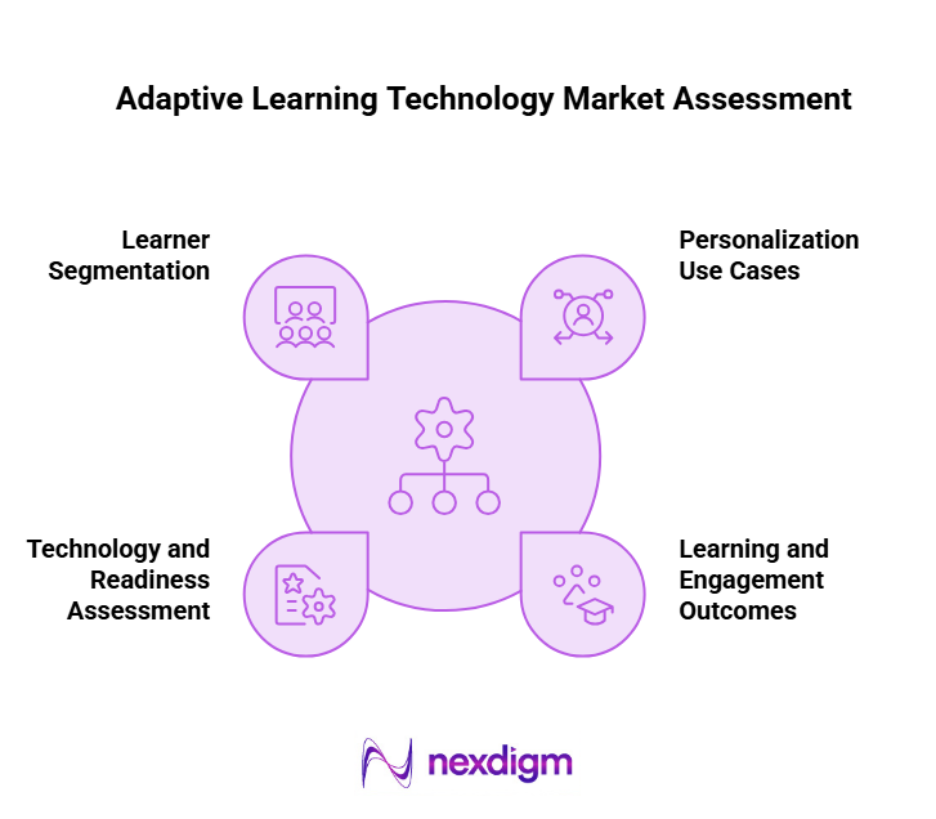
- Learner Segmentation: Analyzing learner demographics, academic needs, behavior, affordability, learning preferences, and digital usage to identify segments most likely to adopt adaptive learning solutions.
- Personalization Use Cases: Nexdigm evaluates applications including adaptive content, personalized learning pathways, AI tutoring, automated recommendations, differentiated assessments, and targeted feedback to identify high-value use cases.
- Technology and Readiness Assessment: Assessing digital infrastructure, platform capabilities, data availability, device access, and institutional readiness to determine the feasibility of deploying adaptive technologies.
- Learning and Engagement Outcomes: Nexdigm examines completion, engagement, retention, assessment performance, and learner progression to identify how personalization can contribute to measurable educational outcomes.
These dimensions help stakeholders move from identifying interest in personalized learning to understanding which learners to target, what capabilities to build, and where scalable opportunities exist.
How Nexdigm Converts Adaptive Learning Insights into Market Opportunity
The assessment can support strategic decisions across the personalized learning value chain. The valuable insights collected form the assessment helps ed-tech companies with:
- Product Development: Identify adaptive learning features that align with learner preferences and institutional needs, enabling providers to prioritize personalization, intelligent recommendations, assessments, feedback mechanisms, and engagement enhancements.
- Effective Market Entry: Evaluate education segments and geographies based on digital readiness, learner demand, competitive intensity, and adoption potential.
- Platform Positioning: Benchmark competing adaptive learning solutions to uncover market gaps and strengthen differentiation through personalized experiences, measurable outcomes, learner engagement, and technology capabilities.
- Better Institutional Partnerships: Identify schools, universities, coaching centers, and training providers where adaptive learning solutions can address specific educational challenges, learner needs, and institutional objectives.
- Investment Decisions: Evaluate market potential, adoption drivers, competitive dynamics, scalability, and unit economics to support investment decisions in adaptive learning ventures.
By combining market intelligence, demand analysis, and competitive benchmarking, Nexdigm helps ed-tech providers identify growth opportunities, strengthen market positioning, and develop scalable adaptive learning strategies that support sustainable business expansion.
Nexdigm’s Case
Nexdigm supported a leading digital skilling platform operating across Asia to improve learner engagement. After benchmarking 14 global competitors and redesigning its retention approach, the platform achieved a 34% increase in course completion and a 19% rise in paid conversions within five months. The results demonstrate how data-led understanding of learner behavior can translate into measurable improvements in both engagement and commercial performance.
To take the next step, simply visit our Request a Consultation page and share your requirements with us.
Harsh Mittal
+91-8422857704