

Advanced driver assistance systems (ADAS) are changing the composition of automotive sourcing requirements. Camera-based driver monitoring, radar-assisted braking, lane-keeping functions, and increasingly sophisticated sensor-fusion systems depend on components with different technology requirements, manufacturing constraints and qualification timelines. For automakers, sourcing these components involves assessing an interconnected supplier ecosystem rather than selecting individual parts on price.
The challenge is particularly significant as ADAS features expand across vehicle segments. A supplier capable of delivering a camera module for a high-volume passenger vehicle may not have the engineering depth, validation infrastructure or production flexibility required for a more advanced platform. Procurement research must therefore examine technology readiness, production capacity, commercial competitiveness, and exposure to supply-chain disruption together.
ADAS Sourcing Requires a System-Level View
An ADAS architecture typically combines several component categories:
- Cameras: Support lane detection, traffic-sign recognition, driver monitoring, and object classification. Image quality, low-light performance, processing compatibility and calibration requirements influence supplier suitability.
- Radar sensors: Enable distance measurement and object detection across different weather and visibility conditions. Frequency bands, detection range, resolution and interference management are relevant comparison criteria.
- LiDAR systems: Provide detailed environmental mapping for selected advanced driving applications. Cost, packaging, durability and manufacturing scalability remain important considerations.
- Ultrasonic sensors: Commonly support parking assistance and short-range obstacle detection. Reliability, detection consistency, and unit economics are central to supplier evaluation.
- Electronic control units and processors: Handle sensor inputs, processing and system coordination. Their performance depends on semiconductor availability, software compatibility, and functional safety requirements.
These categories have different supplier structures. Some vendors specialise in sensors, while others provide integrated ADAS platforms combining hardware, software, and system engineering. Comparing them under a single price-based model can obscure important differences in technical scope.
Comparing Technology, Capacity and Commercial Competitiveness
Supplier evaluation should begin with application requirements. Detection range, resolution, response time, environmental tolerance and compatibility with the vehicle’s electrical architecture determine whether a component is technically appropriate. Automotive-grade qualification, functional-safety processes and cybersecurity support also influence the time and cost required to integrate a supplier into a vehicle programme.
Production capacity requires a separate assessment. Automakers should examine current output, plant locations, manufacturing processes, expansion plans and the supplier’s existing customer commitments. Installed capacity does not necessarily indicate available capacity. A vendor operating at high utilisation may struggle to accommodate a new programme, particularly during a simultaneous production ramp across multiple OEM customers.
Commercial comparisons should extend beyond quoted component prices. Relevant factors include:
- Tooling and engineering charges.
- Software licensing and recurring support costs.
- Calibration and integration requirements.
- Warranty exposure and expected component life.
- Logistics, duties, and regional manufacturing costs.
- Cost implications of design changes and future upgrades.
This approach makes ADAS component sourcing research more useful for procurement decisions because it connects supplier economics with technical suitability and programme-level requirements.
Where Supplier Risk Concentrates
ADAS sourcing carries risks that may sit several tiers below the direct supplier. A camera-module vendor, for example, may depend on a concentrated group of image-sensor manufacturers, specialised processors and optical-component producers. Radar systems can have similar dependencies involving semiconductor suppliers and specialised radio-frequency components.
A structured risk review should examine:
- Geographic concentration: Whether critical components depend on a limited number of countries or manufacturing locations.
- Sub-tier dependencies: Whether suppliers rely on single-source chips, sensors, materials or specialist manufacturing processes.
- Qualification constraints: How difficult it would be to approve an alternative component or vendor.
- Capacity exposure: Whether existing commitments could restrict supply during a vehicle launch.
- Technology continuity: Whether the supplier has a credible roadmap for future vehicle architectures and software updates.
The commercial impact of a disruption depends on replaceability. A relatively inexpensive sensor can create substantial production exposure if its specifications are unique and the replacement qualification process is lengthy.
Mapping the ADAS Supplier Landscape
The supplier landscape includes established automotive technology groups such as Bosch, Continental, Denso, Aptiv, Valeo and ZF, alongside specialised technology companies and semiconductor vendors. Their capabilities differ across sensing technologies, electronic control, software, and system integration.
Automakers should distinguish between component manufacturers, system integrators, and technology providers. A company supplying a radar chip is not directly comparable with a Tier 1 supplier delivering a complete radar module. Mapping the value chain clarifies where technical ownership, manufacturing capacity, and commercial dependencies sit.
Nexdigm’s procurement research can support this assessment through supplier identification, capability profiling, regional market comparisons and analysis of technology and capacity developments. The objective is to provide an evidence-based view of potential suppliers and the structure of the markets in which they operate.
ADAS Component Supplier Evaluation Framework
A practical assessment can be organised into five stages:
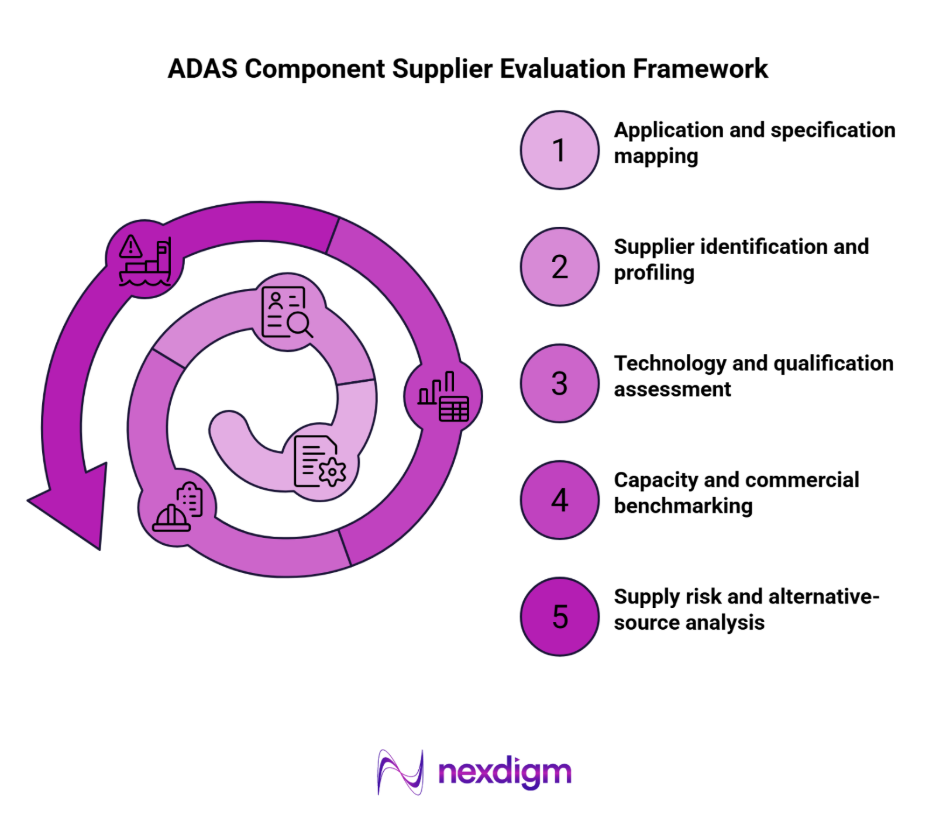
- Application and specification mapping: Define the vehicle functions, performance requirements, operating conditions and integration needs for each component.
- Supplier identification and profiling: Map established vendors, emerging specialists, manufacturing locations, product portfolios and OEM relationships.
- Technology and qualification assessment: Compare product specifications, automotive-grade credentials, functional safety capabilities and technology roadmaps.
- Capacity and commercial benchmarking: Evaluate installed capacity, utilisation indicators, expansion plans, regional cost differences and total sourcing economics.
- Supply risk and alternative-source analysis: Identify sub-tier dependencies, geographic concentration, qualification barriers, and potential alternative suppliers.
This framework allows procurement teams to compare suppliers against the requirements of a specific vehicle programme rather than relying on broad market rankings.
Case Study: Evaluating ADAS Supplier Options
An automaker assessing a new ADAS platform needed alternatives across camera and radar components. Nexdigm’s market assessment mapped 24 suppliers across six markets, compared manufacturing footprints and technology portfolios, and identified five vendors for deeper evaluation, including three with relevant regional production capabilities.
To take the next step, simply visit our Request a Consultation page and share your requirements with us.
Harsh Mittal
+91-8422857704