
Additive manufacturing is steadily moving beyond prototyping as manufacturers look for practical, repeatable production applications. The latest Wohlers Report 2026 values the global additive manufacturing market at $24.2 billion in 2025, representing 10.9% year-over-year growth.
More notably, AM services accounted for 48% of total market revenue, while services grew 15.5%, signaling increasing value from actual production and service delivery rather than equipment sales alone.
Manufacturers are now evaluating applications where 3D printing can deliver measurable advantages in customization, complex geometries, lightweighting, tooling, spare parts, and lower-volume production. The shift is making application economics, production readiness, quality, and scalability central to adoption decisions.
Production Adoption Is Accelerating
Additive manufacturing is gaining commercial momentum as production applications expand. The global market reached $24.2 billion in 2025, growing 10.9% year over year, while AM services grew 15.5% and represented 48% of total revenue. These figures indicate increasing movement toward production-oriented applications, services, and scalable manufacturing models.
What Is Driving the Shift Toward Production
The move toward production is being shaped by improvements in additive manufacturing technologies, materials, software, and process control. As these capabilities mature, manufacturers can consider a broader range of production applications rather than limiting 3D printing to prototypes.
- Improved Production Capabilities: Faster machines, larger build volumes, better automation, and improved process consistency are making additive manufacturing more suitable for repeatable production.
- Broader Material Choices: Advances in polymers, metals, composites, and specialty materials are expanding the range of components that can be produced using additive technologies.
- Shorter Development Cycles: Digital production can reduce tooling requirements and enable faster design changes, supporting more responsive product development and manufacturing.
Together, these developments are making 3D printing increasingly relevant where production flexibility, design complexity, customization, and speed create a clear advantage over traditional processes.
Nexdigm’s Industry-led Expertise in Scaling Additive Manufacturing
As additive manufacturing moves toward production, manufacturers need to determine which opportunities are technically feasible, commercially attractive, and scalable. Nexdigm help businesses evaluate these opportunities and develop informed adoption strategies by focusing on areas such as:
- Production-Readiness Assessment: Evaluate applications based on technology maturity, production requirements, material suitability, quality standards, and scalability.
- Market Opportunity Analysis: Assess demand trends, end-use industries, adoption patterns, and competitive dynamics to identify high-potential production applications.
- Commercial Evaluation: Compare additive and conventional manufacturing across cost, tooling, lead times, production volumes, and potential value creation.
- Strategic Prioritization: Rank applications and markets according to technical readiness, commercial attractiveness, competitive positioning, and long-term growth potential.
This enables manufacturers to move beyond experimentation and identify where additive manufacturing can transition into scalable, commercially viable production.
Nexdigm’s Additive Manufacturing Market Assessment
Nexdigm’s Additive manufacturing market assessment follows a structured process to evaluate market potential, technology maturity, application opportunities, and competitive dynamics. The assessment helps manufacturers identify where additive manufacturing can move from experimentation to scalable production through the following steps:
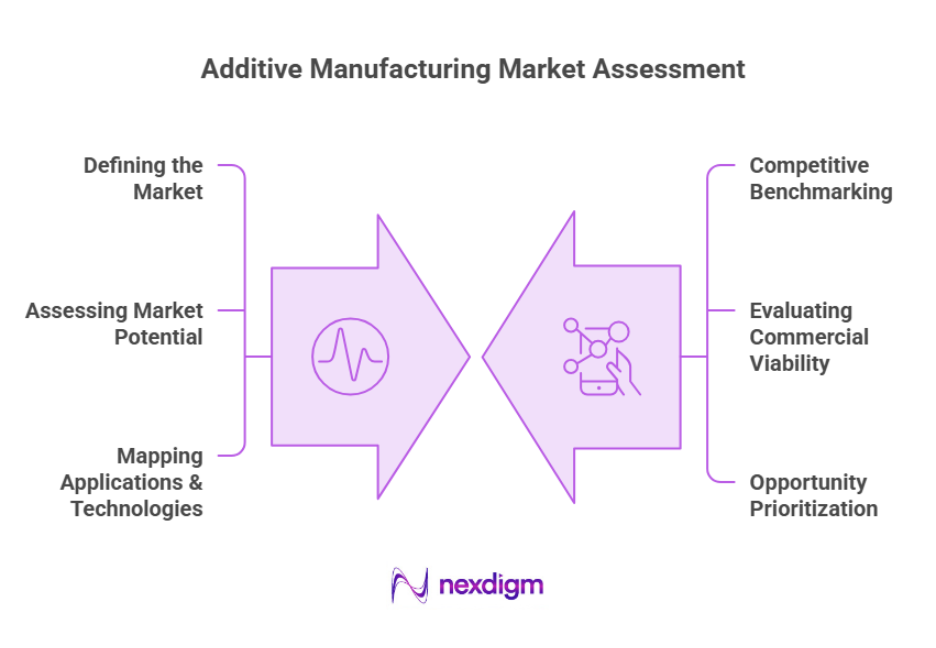
- Define the Market: Establish the relevant technologies, materials, applications, end-use industries, and geographic markets for assessment.
- Assess Market Potential: Analyze market size, growth trends, adoption levels, demand drivers, and emerging opportunities across priority segments.
- Map Applications & Technologies: Evaluate production applications against technology maturity, material suitability, design complexity, production volumes, and scalability.
- Benchmark the Competition: Assess key players, capabilities, technology adoption, partnerships, investments, and market positioning to identify competitive gaps.
- Evaluate Commercial Viability: Compare production economics, tooling requirements, lead times, scalability, and potential value creation against conventional manufacturing methods.
- Prioritize Opportunities: Rank applications and markets according to attractiveness, readiness, competitive intensity, and long-term commercial potential.
This structured approach helps manufacturers translate market intelligence into clear priorities for technology adoption, application development, investment, and production-scale expansion.
Business Benefits of Nexdigm’s Additive Manufacturing Market Assessment
Nexdigm’s structured assessment helps manufacturers reduce uncertainty around additive manufacturing and focus resources on opportunities with stronger commercial and strategic potential. This involves:
- Focused Investment: Identify additive manufacturing technologies, applications, and target markets with stronger commercial potential, helping manufacturers allocate resources efficiently, maximize returns, and build scalable growth strategies.
- Reduced Adoption Risk: Evaluate technical feasibility, market demand, competitive dynamics, operational requirements, and economic viability before implementation, enabling more informed decisions and minimizing investment uncertainty.
- Faster Opportunity Identification: Detect emerging applications, technology developments, and high-growth market segments early, allowing manufacturers to capitalize on opportunities and respond proactively to industry changes.
- Better Competitive Positioning: Benchmark competitors, technology adoption trends, and evolving market dynamics to uncover whitespace opportunities, strengthen differentiation strategies, and improve long-term market competitiveness.
These benefits help manufacturers make more confident decisions on where to invest, which applications to prioritize, and how to scale additive manufacturing sustainably.
Nexdigm’s Case
Nexdigm supported a precision engineering firm through manufacturing capability benchmarking, identifying opportunities to improve production accuracy and quality. The assessment delivered a 20% improvement in CNC tolerance accuracy and a 15% reduction in defect rates, strengthening competitiveness in high-performance component markets and supporting more reliable manufacturing outcomes.
To take the next step, simply visit our Request a Consultation page and share your requirements with us.
Harsh Mittal
+91-8422857704