

Advanced materials are becoming increasingly important as manufacturers seek higher performance without compromising weight, durability, thermal management, or electrical functionality. A September 2026 industry assessment estimates the global advanced materials market at $98.22 billion in 2026, up from $91.27 billion in 2025, representing 7.6% year-over-year growth.
The market is projected to reach $134.03 billion by 2030, reflecting an 8.1% CAGR. Demand is being shaped by aerospace lightweighting, automotive electrification, electronics miniaturization, energy systems, and high-performance industrial applications.
As requirements become more specialized, manufacturers increasingly need to assess which material categories, applications, and end-use markets offer the strongest growth and commercial potential.
Where Advanced Materials Are Creating New Demand
Demand for advanced materials is expanding across industries, but the performance requirements differ significantly by application. Aerospace prioritizes lightweight strength, automotive increasingly requires materials suited to electrification, while electronics emphasizes thermal management and miniaturization.
Energy and industrial applications add requirements around durability, corrosion resistance, and high-temperature performance. This variation makes application-level demand analysis essential for identifying attractive material opportunities and understanding where market growth is likely to be concentrated.
Matching Materials to Application Requirements
Selecting the right advanced material depends on the performance demands of each application. Manufacturers increasingly evaluate materials across weight, strength, thermal behavior, durability, conductivity, cost, and manufacturability. This application-specific perspective helps identify where advanced materials can replace conventional options, improve product performance, and create opportunities for differentiated manufacturing solutions.
With material requirements varying significantly across applications, structured market and demand analysis becomes essential. Nexdigm helps manufacturers connect material performance requirements with market trends, application demand, competitive developments, and emerging opportunities to support more informed material and investment decisions.
Nexdigm’s Insights for Assessing Advanced Materials Requirements
Nexdigm helps manufacturers convert complex advanced-material developments into actionable market intelligence. By combining demand trends, application requirements, supplier intelligence, and competitive analysis, Nexdigm provides a clearer basis for evaluating material opportunities and making strategic decisions by:
- Identifying High-Growth Applications: Determine where changing industry requirements are creating stronger demand for advanced materials.
- Evaluating Material Opportunities: Compare material categories based on performance requirements, adoption potential, supply availability, and commercial attractiveness.
- Assessing Supplier Dynamics: Understand key suppliers, production capabilities, technology developments, and competitive positioning across relevant material markets.
- Guiding Strategic Investments: Use market and application insights to support decisions around material development, sourcing, partnerships, capacity expansion, and market entry.
This enables manufacturers to identify where advanced materials can create the greatest performance and commercial advantage while reducing uncertainty around future market opportunities.
Why Advanced Materials Assessment Matters
As material technologies and end-market requirements evolve, manufacturers need more than technical specifications to determine where advanced materials can create value. Nexdigm combines market intelligence, industry expertise, application analysis, and competitive benchmarking to assess both material fit and commercial opportunity.
A structured assessment framework helps businesses evaluate whether a material aligns with application requirements, emerging demand, supply availability, competitive dynamics, and long-term growth potential. This provides a stronger basis for decisions, while reducing uncertainty around emerging opportunities.
Nexdigm’s Advanced Materials Market Assessment Framework
Nexdigm’s Advanced materials market assessment provides a structured view of demand, applications, technologies, suppliers, and competitive dynamics. The framework helps manufacturers identify attractive material opportunities and align them with evolving industry requirements.
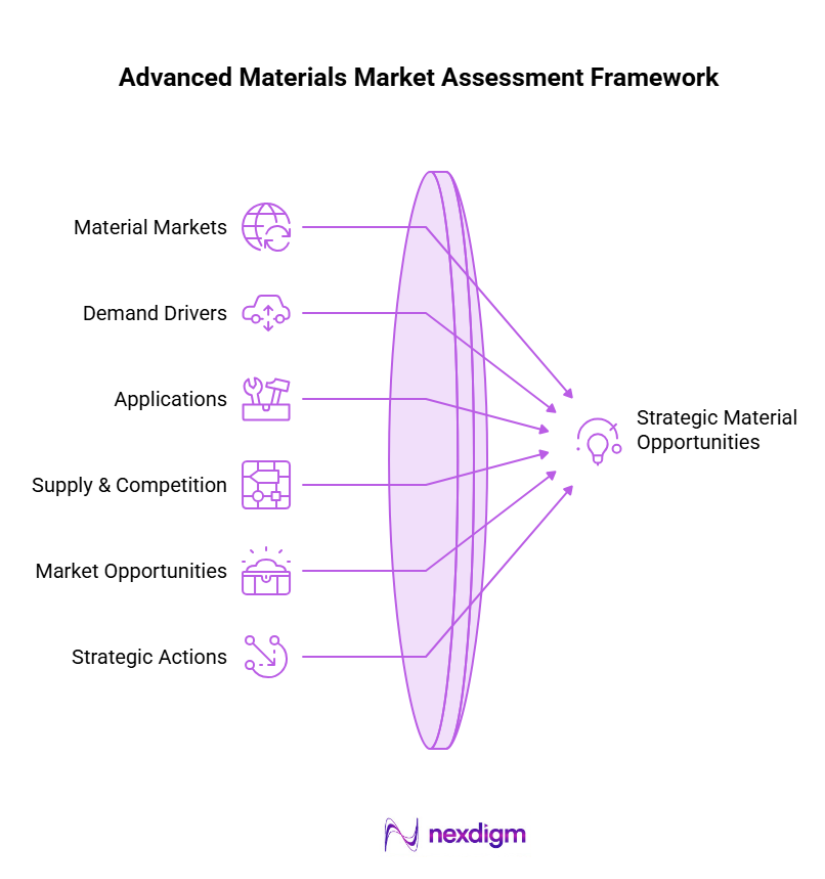
- Define Material Markets: Identify relevant material categories, technologies, applications, end-use industries, and geographic markets.
- Map Demand Drivers: Assess industry growth, lightweighting requirements, thermal performance needs, durability, electrification, electronics demand, and other application-specific drivers.
- Evaluate Applications: Determine material suitability across performance requirements, production conditions, adoption levels, and commercial potential.
- Assess Supply & Competition: Analyze suppliers, manufacturing capabilities, technology developments, capacity, competitive positioning, and emerging market participants.
- Identify Market Opportunities: Highlight high-growth applications, material substitution opportunities, emerging technologies, localization potential, and underserved demand.
- Prioritize Strategic Actions: Rank opportunities according to market attractiveness, technical relevance, supply considerations, competitive intensity, and commercial viability.
This framework helps manufacturers translate complex material-market developments into clear priorities for sourcing, product development, investment, partnerships, and market expansion.
Nexdigm’s Advanced Materials Assessment Supporting Strategic Growth Decisions
Insights from the advanced materials assessment can help manufacturers move from opportunity identification to strategic action. Nexdigm translates market, technology, application, and competitive intelligence into decision support across three key growth areas:
- Investment Decisions: Evaluate market attractiveness, demand potential, technology maturity, competitive intensity, and supply dynamics to identify where capital investment can create stronger long-term value.
- Partnership Opportunities: Identify potential technology providers, material specialists, manufacturers, and strategic partners whose capabilities can accelerate product development, commercialization, or market access.
- Market Expansion: Assess attractive industries, applications, customer segments, and geographic markets to determine where advanced-material capabilities can support sustainable expansion.
- Growth Prioritization: Compare opportunities based on commercial potential, implementation feasibility, competitive positioning, and strategic alignment to establish clear priorities.
By connecting market intelligence with strategic choices, Nexdigm helps manufacturers direct investments, build relevant partnerships, and pursue expansion opportunities with greater market clarity and confidence.
Nexdigm’s Case
Nexdigm supported an industrial manufacturer in assessing advanced-material opportunities across lightweighting and thermal-management applications. The analysis identified three priority material segments, narrowed the supplier landscape by 35%, and helped prioritize two high-potential applications, enabling more focused investment planning and reducing uncertainty around material sourcing and market expansion.
To take the next step, simply visit our Request a Consultation page and share your requirements with us.
Harsh Mittal
+91-8422857704