

The automotive aftermarket is becoming increasingly important as vehicle populations age, driving demand for replacement parts, maintenance, and repair products. In 2025, the global vehicle parc remained above 1.5 billion vehicles, creating a large installed base requiring ongoing servicing. The global automotive aftermarket is also projected to continue expanding through the decade, supported by rising vehicle ownership and longer vehicle lifespans.
In the United States alone, consumers spent more than $500 billion on automotive repair and maintenance in 2024, reflecting the scale of aftermarket activity. Across emerging markets, growing vehicle populations are creating additional demand for replacement components. These developments make aftermarket auto parts trade intelligence valuable for identifying product demand, buyer markets, supplier networks, and emerging trade opportunities.
Aftermarket Demand Is Closely Linked to the Vehicle Parc
Unlike new-vehicle demand, aftermarket requirements build over the life of a vehicle. As vehicles age, demand increases for products such as braking components, filters, batteries, tires, suspension parts, lighting, and replacement body components. Markets with large or rapidly expanding vehicle populations can therefore create sustained aftermarket opportunities. Differences in vehicle age, model mix, driving conditions, repair practices, and purchasing power can also influence which parts are in demand.
Where Trade Signals Become Commercially Useful
Aftermarket trade patterns can reveal where product demand and supplier activity are developing.
- Product Demand: Rising imports of specific replacement parts can indicate growing repair requirements, vehicle ageing, or stronger aftermarket activity.
- Buyer and Supplier Networks: Changes in importers, distributors, exporters, and sourcing countries can reveal emerging commercial relationships and market opportunities.
Together, these signals help businesses identify which parts are moving, who is buying them, where suppliers are gaining relevance, and which markets may support further expansion.
Nexdigm’s Role in Reading Aftermarket Trade Signals
Aftermarket trade data becomes more valuable when product movements are connected with the businesses, vehicles, and markets driving demand. Experts at Nexdigm refer to aftermarket auto parts trade intelligence to interpret:
- Connect Demand with Products: Analyze product-level imports alongside vehicle parc, age, and usage patterns to understand which replacement categories are gaining demand.
- Map Market Participants: Identify manufacturers, exporters, importers, distributors, and other channel participants to understand how aftermarket supply networks are structured.
- Growth Opportunities: Compare trade growth, supplier activity, buyer networks, and market conditions to identify products and markets with stronger expansion potential.
This approach helps businesses move from observing aftermarket trade movements to understanding where demand, sourcing, and commercial opportunities are developing.
The Need for Aftermarket Trade Intelligence
Aftermarket demand varies significantly across countries based on vehicle age, fleet size, driving conditions, repair practices, and consumer spending. Trade data can reveal which parts are gaining demand, where imports are increasing, and which suppliers are strengthening their presence. Nexdigm’s strategic framework of Aftermarket auto parts trade intelligence helps businesses connect these signals to identify attractive products, sourcing opportunities, customer networks, and markets for expansion.
Nexdigm’s Aftermarket Trade Assessment Framework
Nexdigm translates aftermarket trade signals into a structured assessment by examining products, demand drivers, buyers, suppliers, and market conditions. The framework can cover:
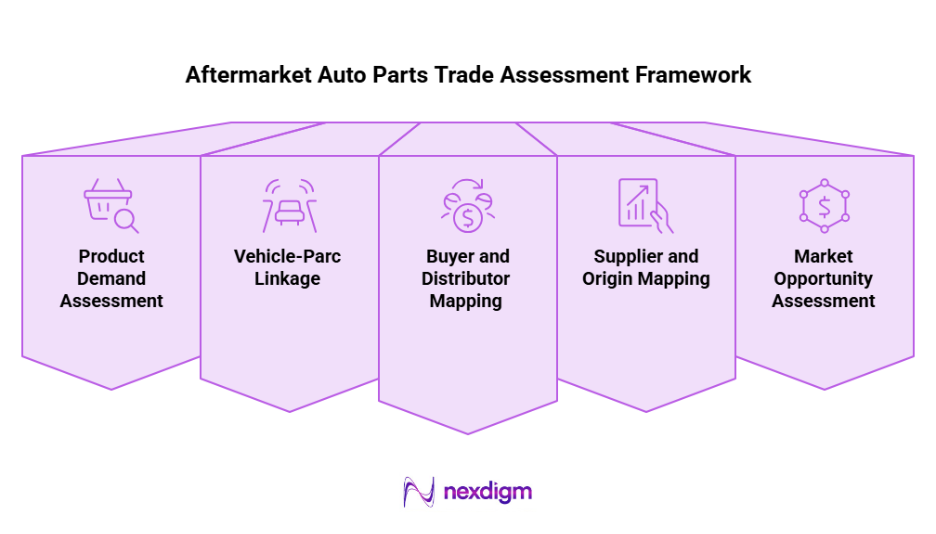
- Product Demand Assessment: Analyze HS codes, product categories, import volumes, trade values, and growth rates to identify replacement parts with increasing demand.
- Vehicle-Parc Linkage: Compare parts of trade with vehicle population, average vehicle age, model mix, and replacement cycles to understand the underlying demand potential.
- Buyer and Distributor Mapping: Identify importers, distributors, wholesalers, retailers, and repair networks to understand channel structures and locate important customer groups.
- Supplier and Origin Mapping: Assess manufacturers, exporters, supplier countries, production locations, and sourcing relationships to identify established and emerging supply bases.
- Market Opportunity Assessment: Compare market size, trade growth, competition, vehicle characteristics, supplier availability, and market-access conditions to prioritize attractive aftermarket opportunities.
This framework gives businesses a connected view of the aftermarket ecosystem, helping them identify where demand is growing, who controls supply, and which markets offer stronger commercial potential.
How Nexdigm’s Framework Identifies Stronger Commercial Potential
Nexdigm’s framework goes beyond measuring aftermarket trade growth by connecting demand, product movement, suppliers, buyers, and competitive conditions. This allows businesses to:
- Prioritize High-Demand Products: Combine import growth with vehicle age, parc size, and replacement cycles to identify product categories with sustainable aftermarket demand.
- Identify Attractive Markets: Compare market growth, vehicle characteristics, competition, buyer networks, and supplier availability to determine where expansion potential is stronger.
- Evaluate Supply Opportunities: Assess supplier presence, sourcing patterns, product availability, and trade routes to identify commercially viable sourcing and partnership opportunities.
- Target Relevant Buyers: Map importers, distributors, wholesalers, and repair networks to identify customer groups aligned with priority product categories and markets.
By connecting these dimensions, Nexdigm helps businesses prioritize where to compete, what products to focus on, which buyers to target, and where sourcing opportunities can support profitable growth.
Nexdigm’s Case
Nexdigm supported an automotive-sector client by assessing aftermarket trade. The analysis identified 26% growth in selected product imports, while five markets recorded more than 15% growth in targeted aftermarket demand. The assessment also identified eight priority product categories and 10 key distributor networks, helping the client refine its market-expansion and product-prioritization strategy.
To take the next step, simply visit our Request a Consultation page and share your requirements with us.
Harsh Mittal
+91-8422857704