

Agent banking is becoming an important way for financial institutions to reach customers beyond traditional branches. The opportunity is particularly strong in markets where people have mobile access but limited physical banking infrastructure. The World Bank’s Global Findex 2025 found that 79% of adults globally now own a financial account, while 1.3 billion adults remain without one.
It also found that 86% of adults worldwide own a mobile phone, creating a significant base for digital and agent-led financial services. The agent ecosystem is also expanding. For banks, fintech companies, and investors, these figures point to a growing distribution opportunity.
However, expanding an agent network requires more than identifying underserved areas. An Agent banking market opportunity analysis helps assess customer demand, transaction potential, location suitability, agent economics, and future scalability.
Nexdigm Finds Where Demand Exists
Nexdigm begins by identifying markets where banking access is limited but customer demand is strong enough to support additional financial touchpoints.
Its geographic and market analysis considers distance from branches and ATMs, population density, customer demographics and competitor presence.
Nexdigm uses these indicators to separate genuine access gaps from locations where demand may be too limited to support a new agent.
This helps financial institutions focus expansion on markets with stronger potential.
Nexdigm Measures Transaction Demand
A new agent needs regular customer activity to remain commercially viable. Nexdigm analyzes transaction behavior to estimate the type and volume of activity an agent could potentially generate.
The analysis looks at:
- Cash Demand: Nexdigm estimates potential cash-in and cash-out activity based on local financial behavior.
- Payment Demand: Nexdigm evaluates digital and merchant payment activity to identify markets where payment services could grow.
- Product Demand: Nexdigm studies demand for accounts, savings, credit, insurance, remittances, and other financial products.
- Usage Frequency: Nexdigm assesses how regularly customers may use agent services.
These insights help financial institutions compare markets according to both customer need and transaction potential.
Nexdigm Maps the Right Locations
Location can have a direct effect on agent productivity. Nexdigm combines customer, geographic, and market data to identify locations where an agent can reach a meaningful customer base.
Nexdigm assesses customer concentration, local businesses, transport accessibility, existing agents and competitor networks.
This enables banks to identify underserved areas without unnecessarily placing agents in markets that already have sufficient coverage.
How Nexdigm Tests Agent Economics
Customer demand is only one part of the opportunity. Nexdigm also examines whether the economics of an agent network can support sustainable operations.
Its assessment covers:
- Expected transaction volumes: Estimates the number and frequency of customer transactions to assess revenue potential and overall business viability.
- Agent commissions: Evaluates commission structures to ensure agents remain motivated while maintaining profitability for the financial institution.
By connecting demand with economics, Nexdigm helps financial institutions identify markets where agent expansion has a stronger commercial case.
For investors, this provides a clearer view of how agent banking can contribute to distribution efficiency and market expansion.
Nexdigm Framework for Agent Banking Market Opportunity Analysis
Nexdigm evaluates agent banking opportunities through four areas:
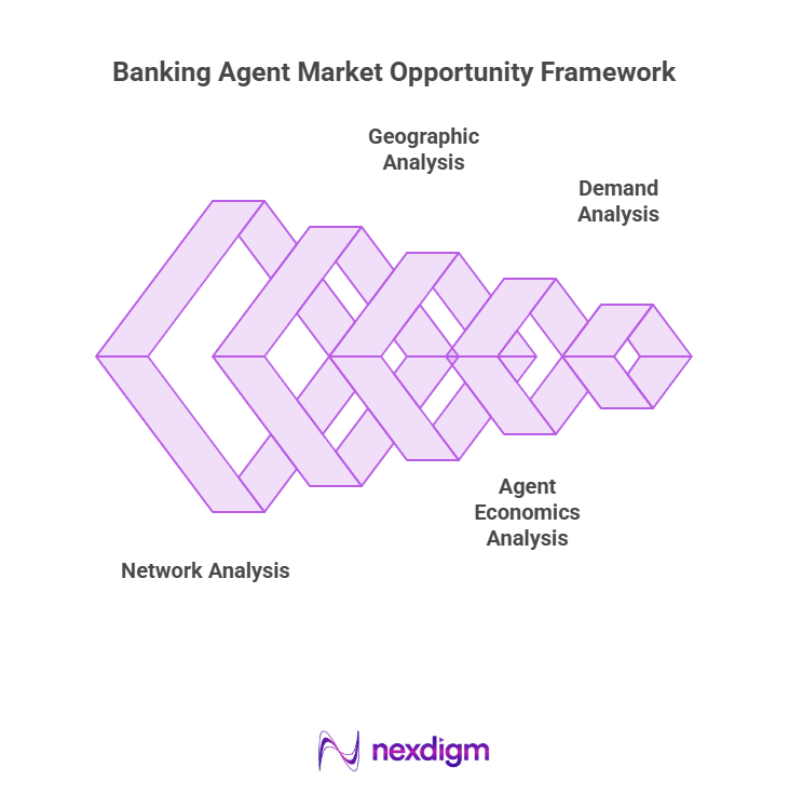
- Geographic Analysis: Nexdigm maps underserved locations, population density, financial access, competition, and market growth to identify priority areas for expansion.
- Demand Analysis: Nexdigm studies transaction behavior, customer needs, cash requirements, payment activity, and product demand to estimate agent usage potential.
- Agent Economics Analysis: Nexdigm evaluates transaction volumes, commissions, operating costs, revenue potential, and scalability to assess whether agent models can remain commercially viable.
- Network Analysis: Nexdigm compares existing coverage, market demand, and expansion potential to identify where additional agents can improve reach and network performance.
Together, these analyses help banks understand where demand exists, how strong it is, and whether local economics can support expansion.
Building a Stronger Agent Network with Nexdigm
Agent banking can give financial institutions a flexible way to extend financial services without relying entirely on traditional branches. Its commercial potential depends on choosing the right locations, understanding transaction demand, and maintaining sustainable agent economics.
Through Agent banking market opportunity analysis, Nexdigm helps banks, fintech companies, and investors assess these factors together.
As mobile financial services continue to expand, Nexdigm enables institutions to identify underserved markets, evaluate agent opportunities, and direct investment toward locations where broader financial access and commercial potential can develop together.
Nexdigm’s Case
A financial institution used Nexdigm’s Agent banking market opportunity analysis to identify underserved locations and evaluate agent economics. Over 12 months, the institution expanded active agent coverage by 27%, increased agent transaction volumes by 34%, reduced network expansion costs by 19%, and improved service reach across priority markets.
To take the next step, simply visit our Request a Consultation page and share your requirements with us.
Harsh Mittal
+91-8422857704