

Agricultural procurement operates within a planning environment where demand, supply and prices can change significantly over a relatively short period. Monsoon variability, crop-cycle shifts, transportation constraints, international commodity movements and supplier disruptions can all affect the availability and cost of essential inputs.
For agribusinesses, these disruptions rarely occur in isolation. A delayed fertilizer shipment can affect application schedules, while a shortage of a particular seed variety may force buyers to consider alternatives at short notice. A disruption in one category can also place pressure on related purchases, logistics and inventory requirements.
Procurement planning therefore needs to extend beyond annual budgets and routine supplier negotiations. Organisations must anticipate potential disruptions, understand their exposure and prepare sourcing responses before market conditions deteriorate. Agri-Procurement Risk Planning provides a structured approach to connecting demand forecasts, supplier intelligence, market monitoring and contingency sourcing.
Why Seasonal Procurement Is Particularly Exposed
Agricultural demand follows narrow purchasing windows
Seeds, fertilizers and crop protection products are often required within specific periods linked to sowing, crop growth and harvesting schedules. Purchasing delays can reduce the usefulness of an input even when the product eventually becomes available.
This creates a difficult procurement trade-off. Buying too early may increase inventory costs and expose organisations to storage constraints, while buying too late can reduce supplier choice and increase dependence on emergency sourcing.
Demand forecasts also become less reliable when weather conditions alter planting decisions or shift regional crop patterns.
Market volatility affects input affordability
Several agricultural inputs are exposed to international commodity markets, imported raw materials, energy prices, freight rates and currency movements. Fertilizer procurement, particularly for phosphatic and potassic products, can be influenced by international supply conditions and import dependence.
Crop protection products may also face changes in raw material availability and manufacturing costs. Machinery and irrigation equipment can be affected by component availability, transportation and exchange-rate movements.
A procurement budget prepared using historical prices may therefore become outdated well before the purchasing period begins.
Supplier concentration increases disruption exposure
Organisations that depend on a small group of manufacturers, distributors or regional dealers may face limited alternatives when a supplier experiences production delays or allocation restrictions.
Supplier concentration can be difficult to identify when purchasing is decentralised. Different locations may appear to have separate supplier relationships even when they ultimately depend on the same manufacturer or distribution network.
The risk is particularly significant for specialised products that require technical approval or have limited substitutes.
Logistics and infrastructure disruptions affect availability
Road closures, port congestion, warehouse constraints and regional transportation interruptions can delay agricultural inputs. Weather events can also affect storage facilities and distribution routes.
In such situations, a supplier may have adequate inventory but still be unable to deliver within the required window. Procurement plans that focus only on supplier stock levels may therefore underestimate actual delivery risk.
Why Reactive Procurement Is Expensive
When procurement teams respond only after a disruption occurs, they often face a reduced set of sourcing options. Emergency orders may involve higher prices, expedited transportation, smaller shipment sizes or less favourable payment terms.
The organisation may also accept product substitutions without sufficient time for technical and quality assessment. In agriculture, this can create operational consequences that extend beyond the procurement function.
Reactive buying can also disrupt working capital planning. Organisations may accumulate excess inventory in some categories while simultaneously facing shortages in others.
A more resilient approach requires identifying exposure before the purchasing season begins and preparing specific responses for different disruption scenarios.
What a More Resilient Procurement Plan Should Include
Agribusinesses should connect seasonal demand forecasts with supplier capacity, market intelligence and inventory requirements. Historical purchasing data can establish baseline demand, but forecasts should also account for crop patterns, regional conditions, planned acreage and possible changes in input consumption.
Procurement teams should classify categories according to their operational importance and supply risk. Products with limited substitutes or long replenishment times require stronger contingency arrangements than readily available standard items.
Organisations should also establish practical response triggers. These may include unusual price movements, supplier delivery delays, changes in import availability or inventory falling below a defined threshold.
Nexdigm supports procurement planning through market research, supplier intelligence, sourcing analysis and risk assessment. Its research can help organisations evaluate supplier markets, understand external cost drivers and identify alternative sourcing options before disruption affects operations.
Agri-Procurement Risk Planning Framework
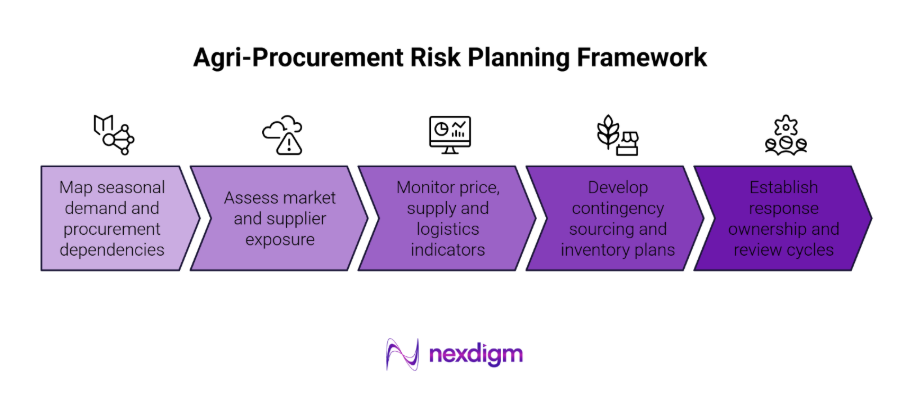
- Map seasonal demand and procurement dependencies
Build a procurement calendar covering input requirements, expected order periods, delivery lead times and critical agricultural windows. Identify categories where late delivery could disrupt operations or customer commitments. - Assess market and supplier exposure
Evaluate supplier concentration, production capacity, geographic dependencies, import exposure and the availability of alternative products. Identify categories where disruptions could affect multiple locations or business units. - Monitor price, supply and logistics indicators
Track relevant commodity prices, freight conditions, supplier lead times, regional availability and regulatory developments. Establish thresholds that trigger procurement reviews or sourcing decisions. - Develop contingency sourcing and inventory plans
Identify qualified backup suppliers, alternative delivery routes and acceptable product substitutes. Define safety stock and buffer requirements according to category criticality, replenishment time and storage constraints. - Establish response ownership and review cycles
Assign responsibility for monitoring disruptions, approving substitutions, activating alternative suppliers and communicating procurement changes. Review the plan before each major agricultural season and update it when market conditions change.
Nexdigm’s Case Study: Strengthening Seasonal Procurement Readiness
Nexdigm assessed seasonal sourcing exposure across 5 agricultural input categories, 4 regions and 17 suppliers. The study identified 3 high-dependency categories and developed contingency sourcing priorities covering supplier alternatives, inventory buffers and market monitoring.
To take the next step, simply visit our Request a Consultation page and share your requirements with us.
Harsh Mittal
+91-8422857704