

India’s agri-tech opportunity is becoming less about how many farmers can be reached and more about how much value can be captured from each relationship.
The funding environment has changed sharply. Agri-tech investments fell from $498.28 million in 2023 to $390.52 million in 2024 and $182.19 million in 2025. As capital becomes more selective, startups are being forced to demonstrate contribution margins, cash-flow discipline, retention, and a credible route to scale.
The result is a more demanding market in which a large farmer base is no longer sufficient to support a business model.
The Farmer Is a Difficult Customer to Monetize Directly
Direct-to-farmer businesses face an unusually complicated acquisition environment.
Farmers already have established relationships with input retailers, commission agents, cooperatives, and local intermediaries. These relationships often extend beyond transactions. Seasonal credit, input recommendations, crop sales, and informal guarantees can all be bundled into one local relationship.
A digital platform entering this ecosystem has to acquire the customer without necessarily replacing all of those functions.
Direct farmer CAC can reach ₹1,500–₹3,500 per transacting farmer, while standalone digital advisory platforms may struggle to generate recurring subscription revenue. A business that acquires customers cheaply but monetizes them only once can therefore remain structurally unprofitable.
Marketplaces Face a Margin Problem at the Farm Gate
Farm-gate procurement platforms have another challenge: transaction economics.
Output marketplaces can operate on take-rates of roughly 1.5%–2.5%, while still carrying collection, sorting, quality assessment, transportation, and working-capital costs.
The result is a difficult equation. Increasing transaction volume can increase revenue while simultaneously increasing the amount of capital required to operate the network.
This explains the shift toward asset-light models. Instead of owning every physical node, startups can work through FPOs, local retailers, cooperatives, and other existing rural networks.
Fintech Changes the Monetization Equation
Embedded financial services can provide a different revenue stream.
When lending is integrated into an existing agricultural transaction, customer acquisition can be tied to an actual economic activity such as input purchase, crop procurement, or seasonal working capital.
Partnerships with banks and NBFCs can also reduce the capital required on the startup’s own balance sheet.
This creates a broader opportunity for agri-tech businesses: technology can become the distribution layer for financial, input, procurement, and logistics services rather than being sold as a standalone product.
Farm Technology Needs Utilization Before Adoption
Agricultural technology businesses face a separate challenge when their products require physical assets.
Drone spraying, sensors, machinery platforms, and other hardware-led models can offer attractive gross margins, but utilization determines whether those economics survive at scale.
A drone fleet that flies only occasionally carries the cost of hardware, batteries, maintenance, pilots, and compliance without generating enough revenue per asset.
For these businesses, the commercial model may need to shift toward service-based deployment, shared assets, or clustered demand through FPOs and large farms.
The Strongest Business Models Solve More Than One Transaction
A sustainable agri startup market assessment should examine the entire monetization architecture rather than rank startups by funding, user numbers, or gross transaction value.
The critical questions include:
- What does the customer already pay for? Identify existing expenditure on inputs, credit, logistics, advisory, procurement, and farm services before assuming willingness to pay for a new digital product.
- Where is the recurring transaction? Prioritize business models with repeat purchasing, seasonal credit, recurring services, or frequent commercial interactions rather than one-time software adoption.
- Who already owns the relationship? Map retailers, FPOs, commission agents, cooperatives, processors, and lenders to determine whether the startup is competing with or leveraging existing rural distribution.
- How much physical infrastructure is required? Assess warehouses, collection centres, vehicles, machinery, drones, and field personnel against expected utilization and revenue per asset.
- Where does the margin accumulate? Trace revenue from farmer to platform to supplier, lender, processor, or logistics provider to determine whether the startup captures sufficient value to support acquisition and operating costs.
Nexdigm’s Agri-Tech Commercial Viability Framework
Nexdigm evaluates agri-tech businesses through five commercial lenses:
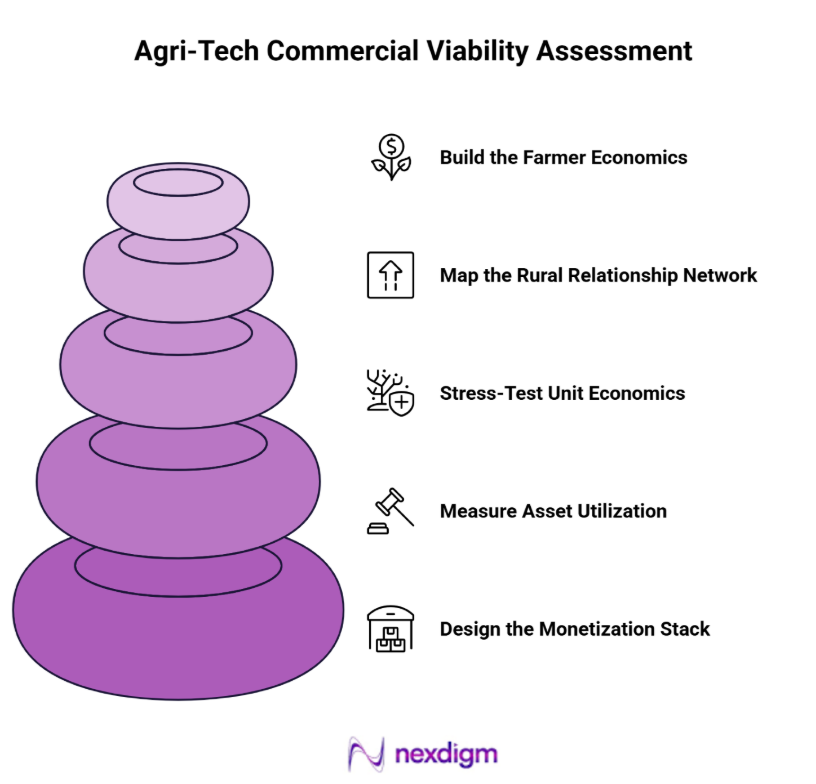
- Build the Farmer Economics: Quantify customer acquisition cost, transaction frequency, average revenue per user, retention, and willingness to pay to establish the underlying revenue pool.
- Map the Rural Relationship Network: Identify retailers, FPOs, PACS, commission agents, processors, and lenders that already influence farmer decisions and assess their potential as distribution partners.
- Stress-Test Unit Economics: Model take-rates, gross margins, fulfilment costs, service costs, CAC, working capital, and contribution margins across customer cohorts.
- Measure Asset Utilization: For hardware and logistics-led businesses, assess utilization, revenue per asset, maintenance, replacement cycles, and geographic density required to achieve breakeven.
- Design the Monetization Stack: Evaluate opportunities to combine inputs, procurement, credit, advisory, logistics, data, and SaaS into a commercially sustainable customer relationship.
Case Study: Nexdigm’s Agri-Tech Unit-Economics Turnaround
An agri-tech startup operating an asset-heavy grain procurement marketplace across Madhya Pradesh was burning ₹1.8 crore per month, with CM2 at -4.2% because of farm-gate collection costs, sorting rejections, and transit moisture losses.
Nexdigm redesigned the operating model, divesting physical collection depots and shifting toward embedded input distribution and financial services. The company partnered with 80 local PACS and retail dealers and integrated an algorithmic credit-scoring system for partnered NBFCs.
The resulting model generated an 8% gross margin on agricultural inputs alongside a 2.5% loan origination fee. Within 12 months, CM2 improved to +5.1%, while the working-capital cycle fell from 52 days to 14 days.
To take the next step, simply visit our Request a Consultation page and share your requirements with us.
Harsh Mittal
+91-8422857704