

Agribusinesses depend on reliable access to fertilizers, seeds, crop protection products, machinery, and other essential farm inputs. Yet, supply vulnerabilities can originate much further upstream than the immediate supplier relationship. India’s dependence on imported fertilizer raw materials illustrates this exposure.
According to a March 2026 response by the Ministry of Chemicals and Fertilizers, imports accounted for 86% of rock phosphate, 78% of natural gas used in the urea sector, and 100% of muriate of potash requirements in 2024–25. These figures highlight how input availability can be influenced by international sourcing markets and trade dependencies.
An effective agri supplier diversification strategy can help businesses identify alternative supply channels, evaluate vendor capabilities, and reduce excessive dependence on specific suppliers, regions, or input sources.
The Risk Often Sits Beyond the Immediate Supplier
A business may work with several distributors but still depend on the same manufacturer, raw material source, or import market. This creates hidden concentration across the supply chain. Understanding these upstream connections is essential to identifying whether a supplier base is genuinely diversified or simply appears broad at the point of purchase.
Questions That Reveal Supplier Concentration
Supplier concentration cannot be understood by counting vendors alone. Agribusinesses need to examine where inputs originate, how suppliers depend on common manufacturers or markets, and how easily alternatives can be accessed. They must also consider the impact of potential disruptions on availability, costs, and operations. These questions help identify hidden dependencies before diversification decisions are made.
What Makes Supplier Diversification Difficult in Agricultural Input Markets?
Diversifying agricultural input suppliers involves more than identifying additional vendors. Differences in product specifications, regulatory requirements, seasonal availability, supplier capacity, and regional distribution can limit viable alternatives. Nexdigm helps businesses examine these market-specific challenges through supplier and industry research, assessing whether potential sources can meet procurement requirements. This enables organizations to identify practical diversification opportunities.
Nexdigm’s Industry-led Expertise in Agricultural Supplier Markets
Our industry-focused research capabilities help businesses understand evolving agricultural input markets, supplier networks, and procurement dynamics. This expertise supports:
- Supplier and Market Intelligence: Market mapping and supplier identification across agricultural categories to help businesses understand available sourcing options and market participants.
- Competitive and Commercial Assessment: Supplier benchmarking and commercial evaluation to compare capabilities, assess sourcing alternatives, and support an informed agri supplier diversification strategy.
This approach helps agribusinesses look beyond their existing vendor relationships, identify relevant sourcing alternatives, and make supplier diversification decisions based on market evidence and operational requirements.
How Nexdigm’s Experts Conduct the Supplier Diversification Process
Our experts follow a structured approach to help businesses identify, evaluate, and prioritize alternative suppliers across critical agricultural input categories. This process involves:
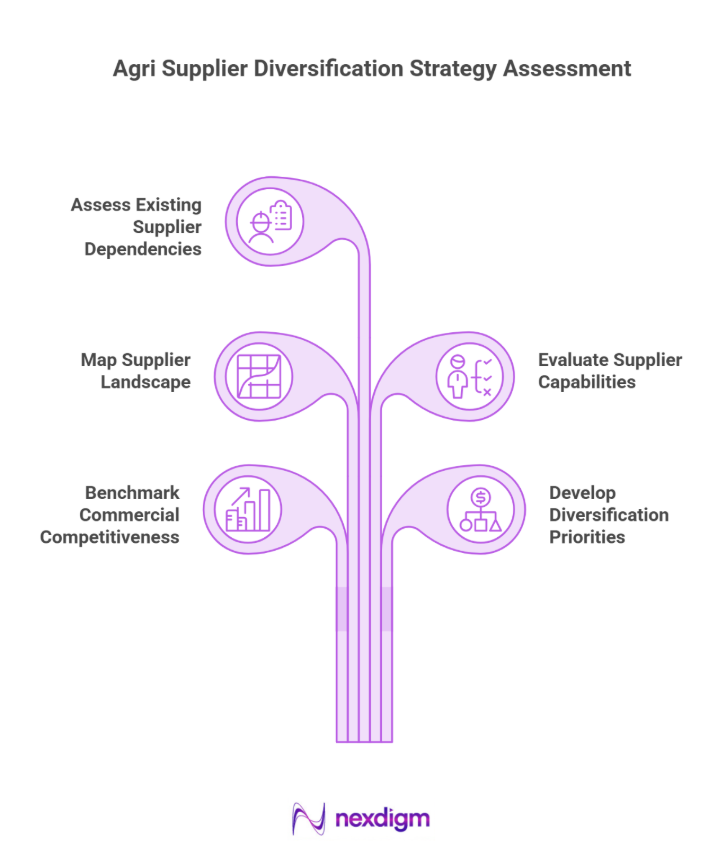
- Assessing Existing Supplier Dependencies: Examine current supplier relationships, procurement shares, sourcing locations, and upstream dependencies to identify areas of concentration.
- Mapping the Wider Supplier Landscape: Identify manufacturers, importers, distributors, and regional vendors across domestic and international markets to expand the pool of potential sourcing alternatives.
- Evaluating Supplier Capabilities: Assess product portfolios, quality standards, production capacity, geographic reach, distribution infrastructure, and delivery capabilities against procurement requirements.
- Benchmarking Commercial Competitiveness: Compare pricing structures, supply terms, logistics considerations, and other relevant commercial factors to understand the feasibility of alternative sourcing options.
- Developing Diversification Priorities: Shortlist suitable suppliers and identify categories where additional sourcing relationships could reduce concentration and improve procurement flexibility.
This process helps businesses translate supplier market intelligence into actionable diversification priorities and build a more balanced agricultural procurement network.
Nexdigm’s Support Towards Sustainable Supplier Diversification Strategies
Supplier diversification should create long-term sourcing resilience rather than simply increase the number of vendors. Our evaluation approach helps agribusinesses assess alternatives with a focus on:
- Building Long-term Supplier Relationships: Identify suppliers with consistent supply capabilities, reliable distribution networks, and the potential to support evolving procurement requirements.
- Reducing Geographic and Supply Dependencies: Explore sourcing options across different regions and markets to limit exposure to localized disruptions and concentrated supply networks.
- Considering Responsible Sourcing Practices: Examine available information on supplier quality systems, environmental practices, certifications, and operational standards to support more informed supplier selection.
- Strengthening Supply Network Flexibility: Evaluate alternative suppliers and sourcing channels that can accommodate seasonal demand changes, volume fluctuations, and changing input requirements.
By integrating these considerations into supplier evaluation, Nexdigm helps businesses develop diversification strategies that balance immediate procurement needs with longer-term supply resilience.
Nexdigm’s Case
A regional agricultural cooperative looking to diversify its fertilizer and crop protection sourcing engaged Nexdigm to assess its supplier options across 3 procurement markets. The research evaluated 25 suppliers and found that 28% had limited capacity to support seasonal demand fluctuations, while 24% lacked adequate product traceability information. Based on the assessment, the cooperative shortlisted 8 suppliers for further technical evaluation and commercial discussions.
To take the next step, simply visit our Request a Consultation page and share your requirements with us.
Harsh Mittal
+91-8422857704