

Agricultural supplier selection has become increasingly important as agribusinesses balance product quality, supply capacity, cost competitiveness, and regional availability. According to the FAO’s July 2026 statistical update, global agricultural use of inorganic fertilizers reached 197 million tonnes of nutrients in 2024, while global production stood at 216 million tonnes.
The data also highlights differences in fertilizer use across regions, reflecting varied agricultural requirements and market conditions. These developments underline the importance of understanding supplier capabilities beyond product availability.
Through agri supplier identification analysis, organizations like Nexdigm help agribusinesses identify relevant manufacturers, distributors, and emerging providers, assess their market positioning, and evaluate supplier suitability against specific procurement and operational requirements.
Why Supplier Selection Requires More Than Product Availability
Agricultural suppliers differ in product specifications, quality standards, manufacturing scale, distribution networks, and technical capabilities. A supplier with a broad portfolio may not necessarily meet regional delivery requirements, while a smaller provider may offer specialized products or stronger local market access. Evaluating these differences helps agribusinesses identify suppliers that align with their commercial and operational priorities.
Areas That Define Supplier Suitability
Supplier suitability depends on more than product range or quoted price. Agribusinesses must consider product specifications, quality certifications, manufacturing capacity, inventory availability, and distribution reach. Geographic presence, customer segments, and commercial positioning also influence supplier relevance. Evaluating these factors together helps organizations identify providers that can meet operational requirements, maintain consistent supply, and support procurement objectives across different agricultural input categories.
Understanding Supplier Markets Before Making Selection Decisions
Agricultural supplier markets include multinational manufacturers, regional producers, specialized providers, and distributors with varying capabilities. Their suitability can differ across product categories and geographies. Nexdigm’s research-led approach helps organizations understand these market differences, examine supplier positioning, and identify the parameters that matter most when evaluating potential providers.
How Nexdigm Identifies Relevant Agricultural Market Participants
Identifying suitable suppliers requires a structured view of companies operating across agricultural input categories. Our experts help agribusinesses identify relevant market participants through agri supplier identification analysis which focuses on the following research areas:
- Manufacturer and Distributor Mapping: Identify established manufacturers, regional producers, distributors, and specialized providers across seeds, fertilizers, crop protection products, and agricultural equipment.
- Supplier Portfolio and Market Profiling: Examine product offerings, geographic presence, customer segments, manufacturing locations, and competitive positioning to understand supplier capabilities.
- Emerging Supplier Identification: Research niche companies, regional market entrants, and specialized providers that may offer alternative products or access to underserved markets.
This process helps organizations build a relevant supplier universe and identify potential providers for further assessment.
Nexdigm’s Agribusiness Supplier Evaluation Framework
Once potential suppliers have been identified, their capabilities need to be assessed against defined procurement requirements. Our experts support this evaluation through:
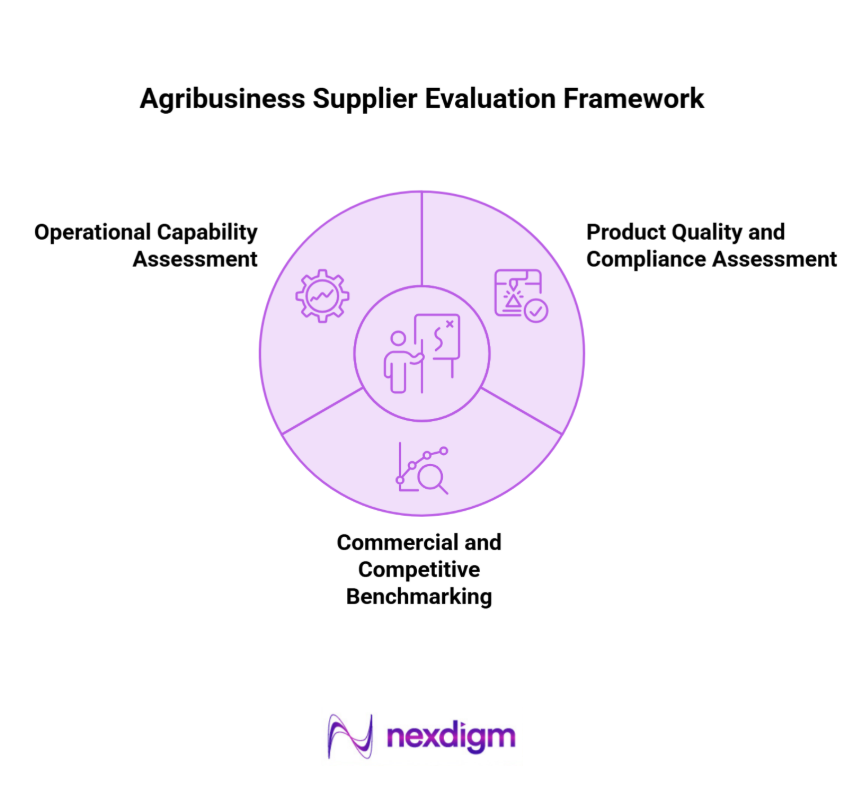
- Operational Capability Assessment: Examine manufacturing infrastructure, production capacity, inventory availability, distribution networks, and ability to meet demand.
- Product Quality and Compliance Assessment: Review product specifications, quality certifications, registrations, technical standards, and relevant regulatory requirements.
- Commercial and Competitive Benchmarking: Compare pricing indicators, product breadth, geographic reach, customer segments, and competitive differentiation.
By bringing these parameters together, we help agribusinesses compare suppliers more consistently and identify providers that warrant further due diligence.
Business Benefits of Nexdigm’s Agricultural Supplier Identification Analysis
A structured supplier assessment can help agribusinesses improve visibility across fragmented agricultural input markets. Our research can support several business priorities:
- More Relevant Supplier Shortlists: Identify providers that align with specific product, quality, capacity, and geographic requirements.
- Improved Supplier Diversification: Discover regional manufacturers and specialized providers to broaden sourcing alternatives.
- Stronger Procurement Decisions: Compare supplier capabilities and commercial positioning to support more informed selection.
- Greater Supply Visibility: Understand manufacturing capacity, distribution reach, and potential supplier limitations before entering procurement discussions.
These insights help organizations connect supplier research with practical procurement priorities and make more informed sourcing decisions.
Nexdigm’s Case
An agribusiness sought to identify reliable suppliers across seeds, fertilizers, and crop protection products while evaluating alternatives to its existing supplier network. Nexdigm assessed 28 suppliers based on product portfolios, quality certifications, production capacity, geographic coverage, and commercial positioning. The research found that 32% had limited distribution reach, while 25% showed gaps in product category coverage. Based on the findings, the organization identified alternative providers and shortlisted suppliers for further evaluation.
To take the next step, simply visit our Request a Consultation page and share your requirements with us.
Harsh Mittal
+91-8422857704