

Agricultural products move through a network of participants before reaching processors, manufacturers, retailers or export markets. Farmers, farmer producer organisations, aggregators, input suppliers, transporters, warehouses, processors, distributors and technology providers each influence the efficiency of this network.
For agribusinesses, understanding these relationships is essential when entering new markets, redesigning procurement operations or building partnerships. A supply chain may appear to have several available service providers, yet depend on a small number of aggregators, transport corridors or processing facilities. Mapping the ecosystem helps organisations identify these dependencies and assess where partnerships can improve performance.
Why Agricultural Supply Chain Mapping Matters
Agricultural supply chains are shaped by geography, seasonality and the characteristics of individual commodities. Grain procurement may involve mandis, commission agents, aggregators, warehouses and bulk transporters. Fresh produce networks often require collection centres, grading facilities, packhouses, cold storage and refrigerated distribution.
The same partner can also perform different roles across regions. A local aggregator may collect produce from farmers in one market and act as a distributor in another. A processor may source directly from farmer groups in one location but depend on intermediaries elsewhere. These differences make it difficult to understand market structure through company lists alone.
Supply chain mapping provides visibility into the participants, their responsibilities and the relationships connecting them. It can reveal where value is added, where costs accumulate and where operational bottlenecks are likely to emerge.
Identifying the Partners Across the Agricultural Value Chain
The mapping exercise should begin by defining the product, geography and supply chain stage under review. A broad national map may be useful for strategic market entry, while a crop-specific regional map may be more relevant for procurement or distribution planning.
Key participants generally include:
- Production and sourcing partners: Farmers, farmer producer organisations, cooperatives, contract farming networks and agricultural input providers.
- Aggregation and market access partners: Collection centres, traders, commission agents, mandis and commodity aggregators.
- Infrastructure partners: Warehouses, cold storage operators, packhouses, grading units and processing facilities.
- Logistics and distribution partners: Transporters, freight operators, wholesalers, distributors and retail networks.
- Enabling partners: Agricultural technology platforms, testing laboratories, financial institutions and certification providers.
The map should record each participant’s role, operating locations, product coverage, capacity, customer base and relationship with other partners. Where possible, it should distinguish between direct service providers and intermediaries.
Using Partner Intelligence to Understand Supply Chain Structure
A structured agri supply chain partner mapping exercise goes beyond identifying companies. It examines how partners interact, where they operate and which capabilities they contribute to the overall chain. This is particularly important when organisations depend on multiple intermediaries between the farm gate and the processing or consumption market.
The analysis should identify the flow of products, information and payments. For example, a processor may purchase through an aggregator, use a third-party warehouse and rely on an independent transporter. Each relationship introduces different commercial terms, operational responsibilities and potential risks.
Mapping should also capture geographic concentration. Several suppliers may operate in the same market but depend on one collection hub or transport route. A disruption at that point could affect multiple sourcing relationships simultaneously. Understanding these connections helps organisations distinguish genuine supplier diversity from the appearance of choice.
Comparing Partner Capabilities and Strategic Importance
Not all partners contribute equally to supply chain performance. Some are easily replaceable, while others provide specialised infrastructure, access to fragmented producers or capabilities that would be difficult to replicate.
A partner assessment should consider operational capacity, geographic reach, product expertise, financial stability, technology adoption and compliance. For infrastructure providers, utilisation and service reliability may be more important than the number of facilities. For aggregators, procurement reach, farmer relationships and quality management may carry greater weight.
Strategic importance can be assessed through several questions:
- Does the partner control access to a critical sourcing region or customer segment?
- Can its services be replaced without significant cost or disruption?
- Does it provide specialised infrastructure or technical capabilities?
- Is the relationship dependent on a single individual, facility or route?
- Can the partner scale with changing volumes and new market requirements?
These questions help procurement and strategy teams prioritise partners for deeper due diligence, long-term agreements or alternative sourcing arrangements.
Turning Supply Chain Mapping into Action
A completed map should support decisions rather than remain a static directory. Organisations can use it to identify under-served regions, evaluate potential partners, reduce unnecessary intermediaries and improve coordination between procurement, logistics and distribution.
India’s agricultural infrastructure programmes illustrate the importance of this ecosystem approach. The Agriculture Infrastructure Fund, for example, supports investment in post-harvest management infrastructure and community farming assets. Such initiatives create opportunities for collaboration among producers, storage operators, processors and financial institutions, but organisations still need to assess which partners can deliver reliable services in specific markets.
Nexdigm supports businesses through supply chain research, partner mapping, market intelligence and commercial assessment. Its work can help organisations identify relevant participants, evaluate capabilities, understand market relationships and prioritise partnership opportunities across agricultural value chains.
Agricultural Supply Chain Partner Mapping Framework
A practical mapping exercise should cover:
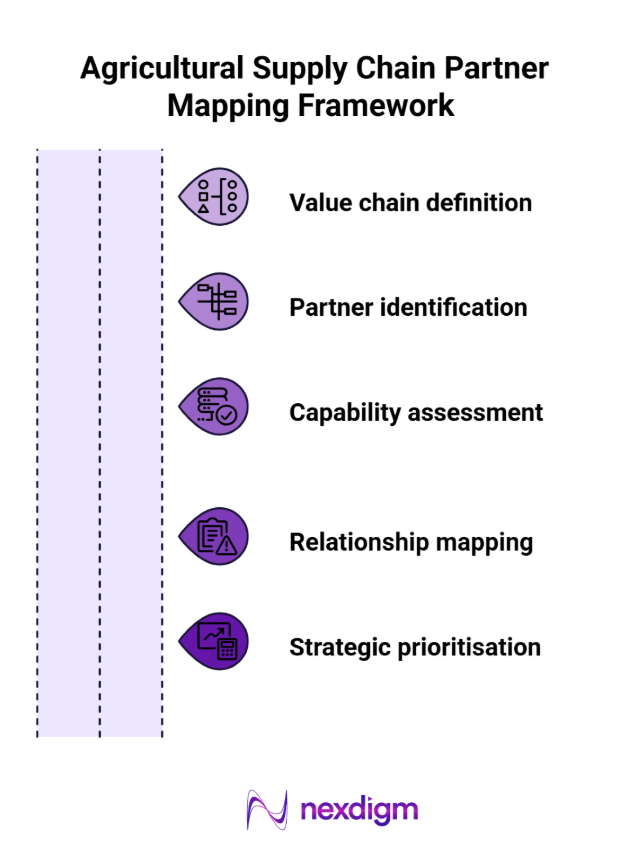
- Value chain definition: Product category, geography, supply chain stages and business objective.
- Partner identification: Producers, aggregators, processors, infrastructure providers and distributors.
- Capability assessment: Capacity, technical expertise, market access and operating performance.
- Relationship mapping: Product flows, commercial dependencies, intermediaries and concentration points.
- Strategic prioritisation: Replaceability, operational importance, risk exposure and partnership potential.
Nexdigm’s Case Study: Mapping Agricultural Value Chain Partners
Nexdigm mapped 57 supply chain partners across 5 commodity networks, assessing their roles, geographic reach, infrastructure and commercial relationships. The study prioritised 12 partners for further engagement and identified 5 critical points of supply chain concentration.
To take the next step, simply visit our Request a Consultation page and share your requirements with us.
Harsh Mittal
+91-8422857704