

Agribusiness competitive pricing intelligence consulting helps agricultural companies understand market movements, competitor strategies, customer expectations, and cost pressures influencing commercial performance. Through structured Pricing Analysis Services, businesses can assess competitor prices, product portfolios, regional demand, farmer affordability, channel margins, production costs, promotional activity, and value perceptions.
These insights reveal pricing gaps, premium opportunities, demand risks, and margin improvement potential across seeds, fertilizers, crop protection products, equipment, livestock inputs, and agricultural technologies. Effective pricing intelligence supports price optimization, market positioning, portfolio planning, revenue forecasting, and strategic decision-making, enabling agribusinesses to strengthen competitiveness, protect profitability, improve customer value, and achieve sustainable growth.
An illustrative 10% improvement in pricing intelligence accuracy can strengthen commercial outcomes. Pricing Analysis Services evaluate competitor prices, customer demand, costs, portfolios, and channel margins, helping agribusinesses improve price realization, protect profitability, identify opportunities, and achieve sustainable long-term growth.
Pricing Intelligence for Agricultural Portfolio and Channel Growth
Pricing intelligence aligns agricultural product portfolios, customer segments, channel economics, competitor movements, and demand patterns to improve market coverage, strengthen price realization, protect margins, and support sustainable commercial growth. Some core benefits of it are:
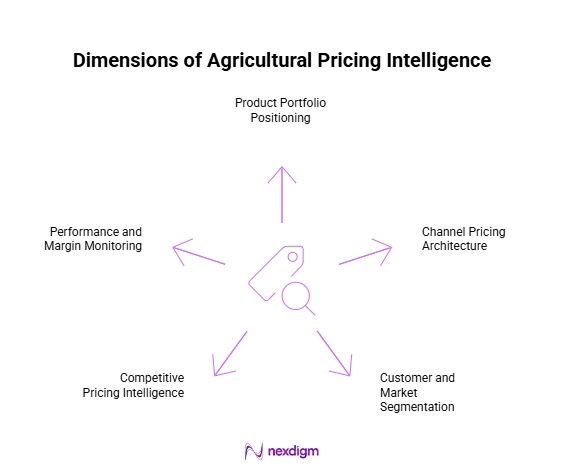
- Product Portfolio Positioning: Evaluate product roles, lifecycle stages, value propositions, demand potential, and margin contribution. Elements in focus include portfolio balance, differentiation, cross-selling opportunities, and revenue optimization.
- Channel Pricing Architecture: Assess pricing across distributors, dealers, retailers, e-commerce, cooperatives, and direct sales. Elements in focus include channel margins, price consistency, discount control, and market access.
- Customer and Market Segmentation: Segment customers by farm size, geography, crop, purchasing power, and usage needs. Elements in focus include affordability, willingness to pay, demand sensitivity, and targeted pricing.
- Competitive Pricing Intelligence: Monitor competitor prices, promotions, product features, pack sizes, and channel offers. Elements in focus include benchmark gaps, positioning opportunities, substitution risks, and responsive price adjustments.
- Performance and Margin Monitoring: Track price realization, sales volumes, channel performance, customer response, and profitability. Elements in focus include margin leakage, portfolio productivity, forecast accuracy, and continuous pricing refinement.
Nexdigm’s Role in Optimizing Agricultural Product and Channel Pricing
Nexdigm’s Pricing Analysis Services enable agribusinesses to optimize product portfolios and channel performance through agricultural pricing analysis, competitive pricing intelligence, channel pricing optimization, portfolio pricing strategy, market price benchmarking, and value-based pricing. By evaluating competitor prices, customer segments, channel margins, product positioning, and demand patterns, Nexdigm helps organizations improve price realization, strengthen channel profitability, enhance portfolio performance, and achieve sustainable commercial growth.
Nexdigm’s Integrated Channel Pricing Model for Agribusiness Growth
Nexdigm’s integrated channel pricing model aligns product value, customer segments, channel economics, competitive benchmarks, and demand patterns to strengthen price realization, expand market coverage, protect margins, and accelerate agribusiness growth. Data Driven steps followed by Nexdigm’s experts are:
Step 1: Assess Channel Economics
Nexdigm evaluates distributor margins, dealer incentives, logistics costs, service requirements, and sales expenses to establish sustainable pricing structures across channels.
Step 2: Segment Products and Customers
Products and customers are classified by value, demand, purchasing capacity, usage needs, and profitability to support targeted channel-specific pricing decisions.
Step 3: Benchmark Market Pricing
Competitor prices, promotions, pack sizes, channel discounts, and market positioning are compared to identify pricing gaps and improve commercial competitiveness.
Step 4: Design Channel Price Architecture
Nexdigm develops differentiated prices, margins, discounts, and incentive structures for distributors, retailers, e-commerce, cooperatives, and direct-sales channels.
Step 5: Monitor Performance and Refine
Price realization, channel volumes, margin leakage, customer response, and competitor movements are tracked to continuously refine pricing and support profitable growth.
Nexdigm’s Case
Nexdigm helped an agribusiness optimize product and channel pricing across multiple distribution networks. The initiative improved price realization by 12%, increased channel margins by 9%, and accelerated portfolio revenue growth by 11%, strengthening long-term commercial performance.
To take the next step, simply visit our Request a Consultation page and share your requirements with us.
Harsh Mittal
+91-8422857704