

Agribusiness is transforming at a pace the world has never seen. With global food demand projected to increase by 56% by 2050, the sector is being reshaped by pressures far beyond traditional farming cycles.
In such a landscape, benchmarking isn’t a support tool, it’s a long-term survival strategy.
Strategic benchmarking shows businesses where they stand, where the industry is moving, and how global frontrunners are building resilient agricultural ecosystems.
Why Agribusiness Strategy Benchmarking Matters More Than Ever
- Builds Resilience in Volatile Markets: Climate-related disasters now cause over USD 15 billion in agricultural losses every year worldwide.
- Drives Sustainability and ESG Compliance: Over 55% of global farmland now faces moderate to severe water scarcity at least one month each year.
- Improves Operational Efficiency: Post-harvest losses in developing regions exceed USD 400 billion annually, driven by poor storage and weak logistics.
- Strengthens Investment and Innovation Planning: Global AgriTech investments exceeded USD 51 billion in the last five years.
- Sharpens Competitive Positioning: More than 60% of agribusinesses that benchmark regularly report gaining market share within 12–18 months.
Nexdigm’s Agribusiness Strategy Benchmarking
At Nexdigm, we recognize that agribusiness leaders require actionable intelligence to shape long-term strategies. Our agribusiness strategy benchmarking framework is designed to provide a structured comparison of global practices, enabling organizations to identify performance gaps, adopt best-in-class models, and unlock growth opportunities.
Key Areas to Benchmark in Agribusiness
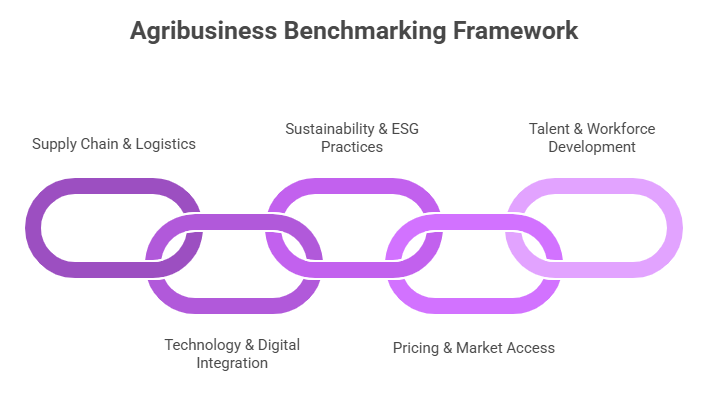
- Supply Chain & Logistics: Cold-chain capacity gaps cause post-harvest losses worth USD 400 billion globally. Benchmarking evaluates traceability, cold storage availability, last-mile delivery models, and distributor efficiency.
- Technology & Digital Integration: Smart farming tools can improve yields by 15–25%, yet adoption varies widely. Benchmarking helps track IoT integration, drone use, predictive analytics, and farm automation practices across top performers.
- Sustainability & ESG Practices: Benchmark regenerative agriculture models, water use efficiency, carbon reduction initiatives, and circular farming practices that align with global sustainability goals.
- Pricing & Market Access: Agricultural export revenues reached USD 2 trillion globally, but market access varies greatly. Benchmarking pricing structures, contract farming practices, and export competitiveness ensures stronger market penetration.
- Talent & Workforce Development: More than 500 million smallholder farmers depend on accessible training and digital literacy. Benchmarking shows how global leaders build farm-level capability and future-ready workforces.
Nexdigm Case
A regional agribusiness cooperative struggled to reduce post-harvest losses that exceeded 12% annually across its fruit and vegetable supply chain. Nexdigm conducted a multi-country benchmarking study covering cold-chain models, yield optimization practices, and sustainability frameworks from eight global leaders. Within nine months, the cooperative reduced losses to under 6%, improved farmer profitability by 18%, and secured two new export partnerships
To take the next step, simply visit our Request a Consultation page and share your requirements with us.
Harsh Mittal
+91-8422857704