

Agricultural commodity sourcing is influenced by production cycles, international trade flows, regional supply conditions, and changing price trends. The FAO Food Price Index averaged 133.9 points in October 2026, declining 1.2% month-on-month. Its cereal price index fell 4.5%, while the vegetable oil index increased 0.3%, reflecting differences across commodity categories.
In India, 2025–26 foodgrain production is estimated at 348.66 million tonnes, while oilseed production is estimated at 41 million tonnes, according to government estimates reported by the RBI. These developments highlight the importance of market-specific sourcing decisions.
Agricultural commodity sourcing analysis helps businesses compare origin markets, understand supplier networks, evaluate commercial conditions, and identify opportunities for more reliable procurement.
Why Origin Markets Matter in Commodity Procurement
Agricultural commodities differ in their production geography, export orientation, seasonal availability, and quality characteristics. A sourcing market with substantial production may not necessarily offer the best commercial opportunity if export restrictions, logistics constraints, or supplier concentration affect accessibility. Understanding these differences helps procurement teams assess the broader market context before selecting suppliers or negotiating contracts.
Market Signals That Influence Sourcing Decisions
Businesses evaluating agricultural commodity markets should consider three interconnected factors:
- Production and Export Position: Examine crop output, export volumes, trade participation, and the role of major producing countries in global supply.
- Price and Cost Movement: Track commodity benchmarks, regional price differences, currency movements, freight costs, and other factors influencing landed procurement costs.
- Availability and Market Access: Assess seasonal supply cycles, export policies, logistics infrastructure, and supplier access to understand sourcing continuity.
Together, these indicators help procurement teams distinguish between markets that appear attractive on price and those that offer practical sourcing opportunities.
Nexdigm’s Origin Market Intelligence: Where to Source and Why
Our expertise helps businesses develop a comparative understanding of agricultural commodity markets across domestic and international origins. Our research can cover commodities such as grains, pulses, oilseeds, sugar, cotton, spices, and other agricultural products, depending on business requirements.
Our agricultural commodity sourcing analysis can also identify market-specific factors such as export regulations, import dependence, infrastructure access, and trade relationships, helping procurement teams evaluate the relative attractiveness of different sourcing origins rather than relying on production volumes or quoted prices alone.
How Nexdigm’s Experts Assess Market Signals That Influence Sourcing Decisions
Identifying attractive sourcing origins requires more than reviewing production volumes or export rankings. Our experts examine market signals to understand how changing conditions influence commodity availability, pricing, and procurement feasibility. Our assessment focuses on three areas:
- Production and Export Trends: Analyze crop output, harvest estimates, export volumes, and trade patterns to identify markets with relevant supply potential.
- Price and Cost Indicators: Examine commodity benchmarks, regional price movements, currency fluctuations, freight rates, and other factors affecting landed procurement costs.
- Supply Access and Market Conditions: Review seasonal cycles, export policies, infrastructure, trade restrictions, and sourcing dependencies to understand market accessibility.
By connecting these indicators, Nexdigm helps businesses distinguish between potential sourcing markets and origins that offer practical procurement opportunities.
Mapping Supplier Networks Across Agricultural Commodity Origins with Nexdigm
Understanding a sourcing market is only the first step; businesses also need to identify the suppliers operating within it. Our expertise helps organizations map participants across agricultural commodity value chains through four key areas:
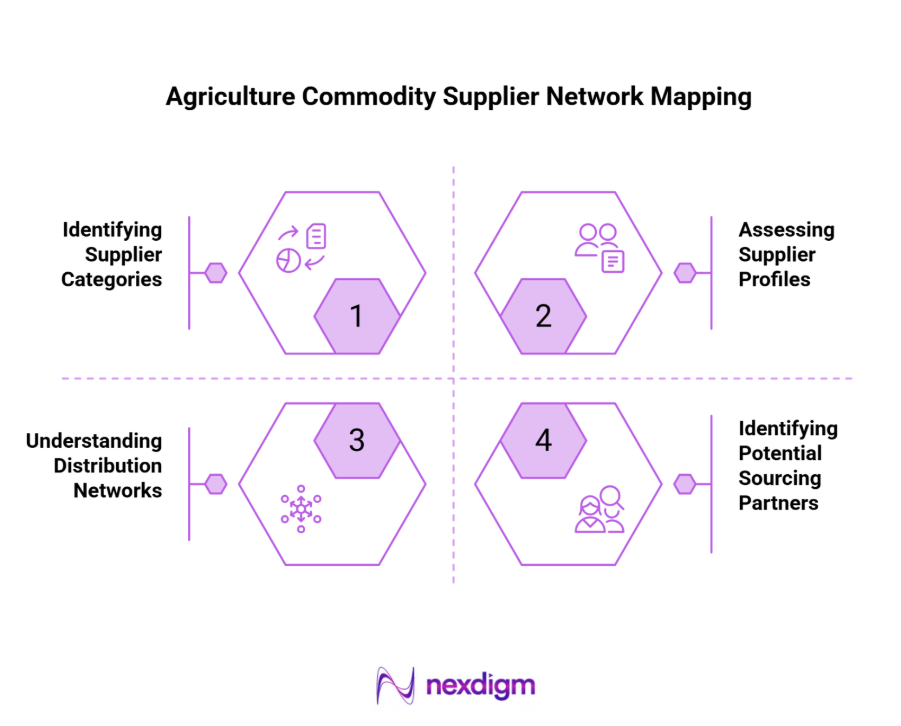
- Identifying Supplier Categories: Map farmers’ organizations, cooperatives, aggregators, commodity traders, processors, exporters, and distributors operating across shortlisted origin markets.
- Assessing Supplier Profiles: Examine supplier locations, commodity portfolios, procurement arrangements, sourcing relationships, customer segments, and geographic reach.
- Understanding Distribution Networks: Assess suppliers’ roles in domestic distribution and international trade, including their market presence and connections across the value chain.
- Identifying Potential Sourcing Partners: Use supplier-level insights to understand how commodities move from production regions to buyers and identify relevant partners within each origin market.
This structured mapping gives businesses a clearer view of supplier networks and supports more informed sourcing decisions.
Nexdigm’s Case
A food processing company evaluating new sourcing origins engaged Nexdigm to map agricultural commodity suppliers across five markets. The research assessed 30 suppliers, identifying that 24% had limited distribution reach and 18% lacked consistent quality documentation. These insights helped the company shortlist eight suppliers for further evaluation and commercial discussions.
To take the next step, simply visit our Request a Consultation page and share your requirements with us.
Harsh Mittal
+91-8422857704