
Agricultural drones are becoming increasingly relevant to crop monitoring, precision spraying, and field-level decision-making. According to the American Farm Bureau Federation, drone-treated agricultural acreage in the United States reached 16.4 million acres in 2025, a 59% increase over 2024. In India, the Ministry of Agriculture reported that 454,083 farmers had participated in agricultural drone demonstrations and field interventions by August 2026.
However, suppliers differ in flight performance, payload capacity, imaging technologies, application accuracy, and after-sales support. These differences make supplier selection an important consideration for agribusinesses. Agricultural drone supplier benchmarking helps organizations compare manufacturers and technology providers, understand their competitive strengths, and identify solutions suited to specific crop monitoring and precision application requirements.
Why Agricultural Drone Capabilities Differ Across Applications
Agricultural drones serve distinct purposes, from capturing multispectral imagery and identifying crop stress to spraying pesticides and distributing fertilizers. Monitoring applications depend on imaging quality, sensor accuracy, and data processing, whereas application-focused drones require suitable payload capacity, spraying mechanisms, and flight endurance. Understanding these differences helps buyers compare suppliers against actual field requirements.
What Buyers Should Examine Before Comparing Drone Suppliers
A supplier’s suitability depends on how its equipment performs under specific agricultural conditions. Three considerations help establish relevant benchmarking criteria:
- Imaging and Monitoring Performance: Compare camera resolution, multispectral sensors, mapping accuracy, and data processing capabilities for effective crop assessment.
- Precision Application Capabilities: Examine payload capacity, spraying systems, droplet control, flight endurance, and application consistency across different crops.
- Operational and Service Readiness: Assess battery support, maintenance availability, operator training, regulatory compliance, and regional service infrastructure before supplier selection.
These criteria help businesses distinguish equipment specifications from capabilities that matter in actual agricultural operations.
Nexdigm’s Approach to Understanding the Agricultural Drone Supplier Market
Our experts help agribusinesses develop a clearer understanding of the agricultural drone ecosystem through market intelligence and supplier research. Our experts examine manufacturers, drone technology developers, imaging solution providers, and specialized agricultural application companies. We assess product portfolios, market presence, technology positioning, and commercial capabilities to identify relevant participants across crop monitoring and precision application segments.
Looking Beyond Drone Specifications with Nexdigm’s Experts
Two suppliers may offer similar drone models but differ considerably in their underlying technology and operational capabilities. Our experts conduct an agriculture drone supplier benchmarking that helps businesses compare providers across several areas:
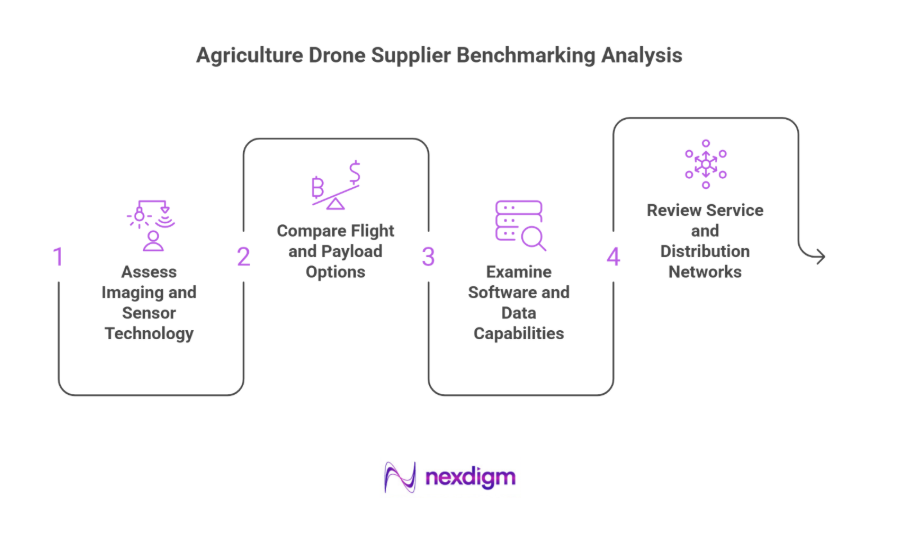
- Imaging and Sensor Technology: Assess RGB, multispectral, and thermal imaging capabilities, sensor configurations, and crop analytics integration.
- Flight and Payload Engineering: Compare flight duration, payload limits, navigation systems, spraying mechanisms, and operational efficiency.
- Software and Data Capabilities: Examine mapping platforms, image processing, analytics, reporting tools, and compatibility with farm management systems.
- Service and Distribution Networks: Review technical assistance, spare-parts availability, operator training, warranty arrangements, and regional market coverage.
This comparison helps organizations understand where suppliers offer differentiated capabilities and where further technical evaluation may be necessary.
How Nexdigm Benchmarks Suppliers Against Agricultural Use Cases
A drone designed for crop surveillance may not be suitable for high-volume spraying or fertilizer distribution. Our experts help businesses evaluate suppliers against intended agricultural applications, considering crop characteristics, field conditions, operating requirements, and technology needs. This use-case-led assessment provides a more relevant basis for comparing drone providers and identifying solutions suited to specific farming operations.
Building a Shortlist from Competitive Supplier Benchmarking
Nexdigm’s experts consolidate supplier profiles, product comparisons, technology assessments, and commercial intelligence into structured benchmarking outputs. Our research helps businesses identify competitive strengths, recognize capability gaps, and prioritize manufacturers for further evaluation. These insights can support procurement planning, supplier shortlisting, and discussions around potential technology partnerships.
Nexdigm’s Case
An agricultural inputs company sought drone suppliers for crop surveillance and precision spraying. Nexdigm benchmarked 24 providers across imaging, payload, flight performance, and service capabilities. The assessment found that 29% had limited multispectral capabilities, while 21% lacked adequate regional support. The company prioritized suppliers for technical and commercial evaluation.
To take the next step, simply visit our Request a Consultation page and share your requirements with us.
Harsh Mittal
+91-8422857704