

Agricultural input demand is entering a period where historical growth rates alone provide an incomplete picture of the market. India’s gross cropped area is stabilising near 220 million hectares, while changes in water availability, crop choices, climate conditions, regulation and farm economics are reshaping what farmers purchase.
For input manufacturers, the more relevant question is therefore not simply how large the market will become. It is which categories will gain demand, which will face substitution and how quickly these shifts could occur across different agricultural regions.
The Next Growth Cycle Will Come From Changing Input Intensity
Land expansion has traditionally provided a straightforward source of agricultural-input growth. With cultivated acreage becoming relatively stable, future demand will increasingly depend on what happens on existing farmland.
Crop substitution is already changing the input mix. Water-stressed regions can shift away from water-intensive paddy toward maize, pulses and oilseeds. These crops create different requirements for seed replacement, nutrient application and crop protection.
Cropping intensity also matters. A hectare producing two or three crops annually can generate considerably more annual input demand than the same hectare under single-season cultivation.
This means manufacturers need to track crop economics and cultivation intensity alongside acreage when estimating future market size.
Water Availability Could Reallocate Demand Between Categories
Water is becoming an increasingly important variable in crop and input selection.
Where groundwater availability declines or irrigation costs increase, farmers may favour crops requiring less water or adopt technologies that improve input-use efficiency. This can create simultaneous opportunities across different categories.
Drought-tolerant and heat-tolerant seeds can gain relevance in stressed regions. Water-soluble fertilizers and fertigation products can benefit where farmers are investing in pressurised irrigation. Precision application technologies can become more attractive where reducing water and chemical use improves farm economics.
The resulting demand shift is therefore likely to be driven by the interaction between resource constraints and technology adoption rather than by any single input category.
Climate Risk Is Changing What Farmers Need From Products
Weather volatility also changes the value of agricultural inputs.
Unseasonal rainfall during harvest, heat during grain filling and changing pest cycles can increase demand for varieties with greater stress tolerance and crop-protection products that provide flexibility across changing field conditions.
For seed companies, this can shift R&D priorities toward abiotic-stress traits. For crop-protection manufacturers, it can increase demand for targeted formulations and products that work at lower application volumes.
The commercial opportunity lies in identifying where climate exposure is sufficiently high to change farmer purchasing behaviour.
Substitution Will Matter as Much as Market Expansion
Some input categories may grow even when conventional alternatives stagnate.
Crop protection is one example. Regulatory pressure and residue requirements can increase demand for biological control agents, microbial products and lower-dose chemistries. Precision spraying can further support concentrated formulations by reducing the amount of carrier water required per acre.
Crop nutrition is undergoing a similar transition. Conventional blanket application remains important, but coated fertilizers, nano-inputs, foliar products and water-soluble formulations can capture demand where farmers have suitable irrigation infrastructure and sufficient technical capability.
This creates a market in which category growth rates can diverge sharply.
Three Scenarios, Three Different Input Markets
A forward-looking demand model should therefore test multiple agricultural futures rather than produce a single extrapolated CAGR.
Under an incremental-evolution scenario, conventional bulk fertilizers could grow around 1.5% to 2.0% annually, while hybrid seed volumes could expand by approximately 5.0% to 5.5%. Specialty biologicals and soluble fertilizers could grow at 8% to 10% from a smaller base.
An accelerated-adoption scenario would produce a different market structure. Hybrid seeds could reach 7.5% to 8.5% CAGR, while biological crop protection and precision fertigation could expand by approximately 14% to 18%.
A downside scenario involving repeated climate disruptions, higher input costs and constrained subsidy spending could reduce specialty-input growth to below 3%, while conventional fertilizer consumption could stagnate or contract.
The value of scenario analysis is in showing where demand remains resilient and where growth depends on specific assumptions.
Forecasting the Categories That Will Actually Move
An agricultural input demand forecast can translate these variables into category- and region-specific demand curves. Nexdigm can evaluate:
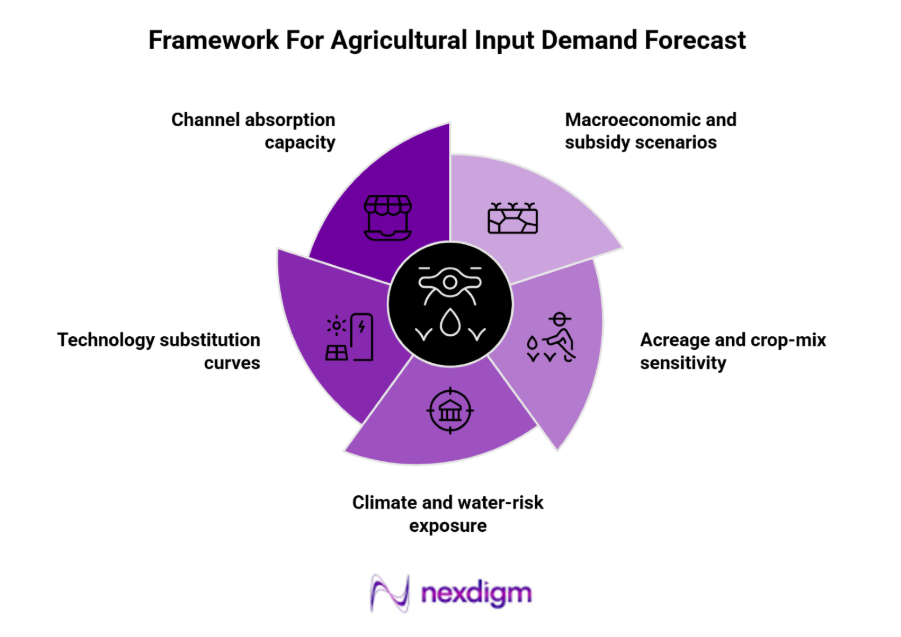
- Acreage and crop-mix sensitivity: Model how changes in cereal, oilseed, pulse, horticulture and commercial-crop acreage alter the underlying requirement for seeds, nutrients and crop protection.
- Macroeconomic and subsidy scenarios: Test how fertilizer pricing, subsidy revisions, raw-material costs, MSP movements and farmer purchasing power could affect consumption volumes and product substitution.
- Technology substitution curves: Estimate the pace at which biologicals, nano-formulations, precision application and water-soluble products could capture demand from conventional inputs.
- Climate and water-risk exposure: Map groundwater availability, irrigation coverage, rainfall variability and crop-specific climate sensitivity to identify regions where input requirements could change fastest.
- Channel absorption capacity: Assess dealer inventory, seasonal stocking, credit availability and inventory turnover to determine whether projected farmer demand can translate into actual product sales.
The resulting forecast can support decisions around product development, manufacturing capacity, portfolio allocation and regional commercial investment.
Case Study: Redirecting Investment Toward the Faster-Growing Categories
An agricultural-input manufacturer assessed future demand across seven crop belts covering approximately 86 million cultivated acres. The model tested 18 product categories under three market scenarios and identified specialty nutrition and biological crop protection as the fastest-growing segments.
Under the accelerated-adoption scenario, the specialty portfolio was projected to increase from INR 210 crore to INR 495 crore by 2030, while conventional products increased from INR 1,180 crore to INR 1,390 crore. Redirecting 25% of planned product-development investment toward the higher-growth categories was estimated to increase 2030 portfolio revenue potential by INR 96 crore.
To take the next step, simply visit our Request a Consultation page and share your requirements with us.
Harsh Mittal
+91-8422857704