

Agricultural mechanization does not expand simply because farmers become more prosperous. It often accelerates when the economics of manual labour stop working.
Across India, rising rural wages, migration into non-farm employment and labour shortages during narrow planting and harvesting windows are changing the economics of farm operations. For machinery manufacturers, however, demand depends on another variable: whether the equipment can be used frequently enough to justify its cost.
Labour Availability Is Becoming an Economic Constraint
Peak agricultural labour rates can reach approximately INR 400 to INR 600 per day in labour-constrained regions. The issue is not only the wage itself. Delays during planting or harvesting can affect crop quality and expose farmers to weather risk.
Manual harvesting of an acre of wheat can require five to seven workers for a full day, pushing direct labour costs above INR 5,000 per acre. A combine harvester can complete the same operation in roughly 25 to 30 minutes at a custom-hiring rate of INR 2,000 to INR 3,000 per acre.
Where equipment is available, the economics can therefore favour mechanisation even before considering the value of completing the operation within the optimal crop window.
Farm Size Determines Who Can Own the Machine
The ownership case becomes weaker as landholdings become smaller.
More than 86% of India’s operational holdings are classified as small or marginal. A farmer operating approximately 1.2 hectares may not generate enough annual machine hours to justify purchasing equipment costing several lakh rupees.
The asset could remain idle for much of the year while financing, maintenance and depreciation continue.
This creates a distinction between machinery demand and machinery ownership. A farmer may have strong demand for mechanised services without ever becoming the owner of the equipment.
Custom Hiring Changes the Addressable Market
Custom Hiring Centres and Farm Machinery Banks address this utilisation problem by converting machinery from an ownership decision into an access decision.
Under these models, local entrepreneurs, Farmer Producer Organizations and other operators purchase machinery and rent it to surrounding farmers on an hourly or per-acre basis. Government assistance through mechanisation programmes can further reduce the initial capital burden.
This expands the potential customer base for machinery manufacturers. Instead of selling one machine to one farmer, manufacturers can access a wider service market where a single asset serves multiple farms.
Mechanization Is Still Uneven Across Farm Operations
The greatest opportunities are not necessarily in the operations that are already highly mechanised.
Land preparation and primary tillage have relatively high mechanisation levels, estimated at around 70% to 75%. Harvesting and threshing remain closer to 34%, while sowing, planting and weeding have considerably lower penetration.
This creates several potential growth pools.
Harvesting equipment can benefit from labour shortages during compressed crop windows. Precision seeders and planters can address labour availability and planting consistency. Sprayers can reduce dependence on manual application while improving application speed.
The opportunity therefore needs to be assessed operation by operation.
Regional Demand Is Moving Beyond the Traditional Markets
Punjab and Haryana have historically represented mature mechanisation markets. Future growth can increasingly come from central, western and southern agricultural regions where labour availability is tightening but machinery penetration remains lower.
Sugarcane belts in Maharashtra and Karnataka, for example, face strong incentives to mechanise harvesting. Paddy-growing regions in Karnataka and Andhra Pradesh are also adopting mechanical transplanting and related equipment as labour constraints intensify.
The strongest market is therefore likely to emerge where three conditions overlap: labour pressure, sufficient crop value and enough operating hours to make equipment financially viable.
Turning Labour Pressure Into Equipment Demand
A commercial agricultural machinery market assessment can evaluate each market through five connected dimensions:
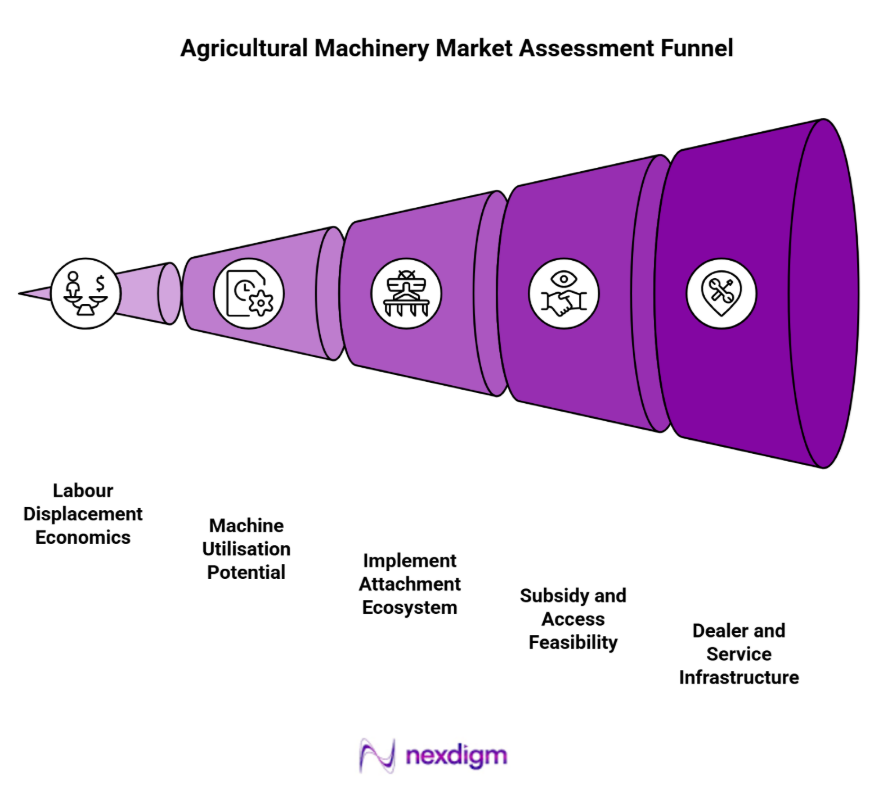
- Labour Displacement Economics: Compare local agricultural wages, labour availability and operation-specific costs against machinery rental or ownership economics to identify where mechanisation produces a measurable financial benefit.
- Machine Utilisation Potential: Model annual operating hours across crop calendars, neighbouring districts and multiple machinery applications to determine whether equipment can achieve acceptable utilisation.
- Implement Attachment Ecosystem: Assess demand for complementary implements such as seed drills, rotavators, laser levellers and sprayers, allowing manufacturers to estimate the broader revenue opportunity around each tractor or machine.
- Subsidy and Access Feasibility: Examine state-level subsidy programmes, equipment empanelment, application processes and payment timelines to understand their effect on customer affordability.
- Dealer and Service Infrastructure: Evaluate spare-parts availability, technician coverage, field-service capability and dealer density because equipment demand is difficult to sustain without reliable after-sales support.
The resulting analysis can help manufacturers identify priority regions, determine the right product mix and assess whether direct ownership, dealer-led sales or custom-hiring models offer the stronger route to market.
Case Study: Building a Higher-Utilisation Machinery Model
A machinery manufacturer assessed four agricultural districts covering approximately 3.2 million cultivated acres. Labour costs had increased by 17% over three seasons, while average tractor utilisation among small operators remained below 300 hours annually. A district-level demand model identified 1,100 farms and 38 FPO-linked service operators with sufficient rental demand to support shared machinery. A proposed 120-tractor deployment was projected to increase average annual utilisation to 610 hours, reduce farmer mechanisation costs by 14% and generate approximately INR 58 crore in annual equipment and service revenue at 70% fleet utilisation.
To take the next step, simply visit our Request a Consultation page and share your requirements with us.
Harsh Mittal
+91-8422857704