

Farm mechanization decisions influence more than equipment acquisition. The machinery selected by an agricultural business affects labour requirements, operating schedules, fuel consumption, maintenance costs and the efficiency of field operations. For organisations managing large farms, contract farming networks or agricultural service operations, choosing the right supplier is therefore a significant procurement decision.
The market includes tractor manufacturers, implement producers, harvesting equipment specialists, irrigation machinery suppliers and providers of precision agriculture technologies. Their capabilities differ considerably, making supplier selection dependent on crop type, land conditions, operational scale and the level of mechanization required.
Understanding the Machinery Requirements of Agricultural Operations
The first step in supplier evaluation is defining the operating requirement. A tractor intended for haulage and general fieldwork may not meet the needs of an operation requiring specialised implements or high-precision applications. Similarly, harvesting equipment designed for large, uniform fields may be unsuitable for fragmented holdings or crops with different harvesting conditions.
Agribusinesses should assess machinery against the full operating cycle. This includes land preparation, sowing, planting, irrigation, crop maintenance, harvesting, threshing and post-harvest handling. Equipment requirements should also account for soil conditions, field size, terrain, crop spacing and the availability of trained operators.
India’s farm mechanization levels vary across operations. Government-reported ICAR estimates for 2020–21 placed mechanization at approximately 70% for seedbed preparation, 40% for sowing and planting, 33% for weeding and interculture, and 34% for harvesting and threshing. These differences indicate that equipment demand and adoption opportunities are not uniform across the agricultural value chain.
Comparing Machinery Suppliers and Product Capabilities
Supplier evaluation should consider product range, technical specifications, manufacturing capability and service infrastructure. Buyers should compare equipment by operating capacity, power requirements, compatibility with existing machinery, durability and suitability for local conditions.
A supplier with a broad portfolio may offer advantages for organisations seeking standardisation across multiple operations. Specialist manufacturers, however, may provide more suitable solutions for specific crops or applications. The evaluation should establish whether the vendor can meet the required performance standards and support the equipment throughout its operating life.
After-sales service is particularly important. Machinery downtime during sowing or harvesting windows can disrupt operations and create significant financial consequences. Procurement teams should examine dealer coverage, service response times, spare parts availability, warranty terms and access to trained technicians.
How Supplier Analysis Supports Better Machinery Procurement
A structured agricultural machinery supplier analysis helps organisations identify manufacturers and distributors whose products align with their operating requirements. It should map suppliers by equipment category, power range, application, geographic presence, service network and market positioning.
The analysis should also compare total cost of ownership rather than relying only on the purchase price. Relevant costs include financing, fuel or energy consumption, maintenance, spare parts, operator training, insurance and expected downtime. Equipment utilisation is another important consideration. Machinery purchased for a narrow seasonal window may have a different economic profile from equipment used throughout the year.
For operations with variable demand, buyers should assess whether ownership, leasing or custom-hiring arrangements are more appropriate. India’s mechanization ecosystem includes Custom Hiring Centres and other shared-access models that can help farmers and agricultural enterprises access machinery without bearing the full cost of ownership. Supplier research can help identify equipment providers capable of supporting these arrangements.
Evaluating Service Networks, Technology and Operating Costs
The strength of a machinery supplier is partly determined by what happens after delivery. A vendor may offer competitive equipment but lack the service infrastructure required to maintain it across distant locations. Buyers should verify the presence of authorised dealers, mobile service teams, spare parts inventories and escalation procedures.
Technology features also require practical assessment. GPS guidance, sensors, telematics and precision application systems may improve operational visibility, but their value depends on compatibility, connectivity, operator capability and ongoing support. Procurement teams should distinguish useful functionality from features that add cost without addressing a defined operational need.
A supplier comparison should examine:
- Equipment performance under relevant crop and field conditions.
- Availability of compatible implements and attachments.
- Warranty coverage, service response and spare parts access.
- Fuel efficiency, maintenance requirements and expected lifecycle costs.
- Operator training, technology support and upgrade options.
Where possible, field demonstrations and reference checks should complement technical documentation. Feedback from existing users can provide insight into reliability, service quality and the practical limitations of equipment.
Building a Machinery Sourcing Strategy Around Utilisation
Machinery procurement should be connected to operational planning. Buyers need to estimate the area covered, hours of use, seasonal demand and number of machines required across locations. This helps prevent over-investment in underutilised assets or dependence on too few machines during critical periods.
A mixed sourcing strategy may be appropriate. Core equipment can be purchased from established manufacturers with reliable service networks, while specialised or infrequently used machinery can be accessed through hiring arrangements. Standardising selected equipment categories may also simplify operator training, maintenance and spare parts management.
Nexdigm supports agricultural businesses through supplier research, market mapping, machinery benchmarking and commercial analysis. Its work can help procurement teams compare manufacturers, assess distribution and service capabilities, understand market positioning and evaluate sourcing options against operating requirements.
Agricultural Machinery Supplier Evaluation Framework
A structured assessment should include:
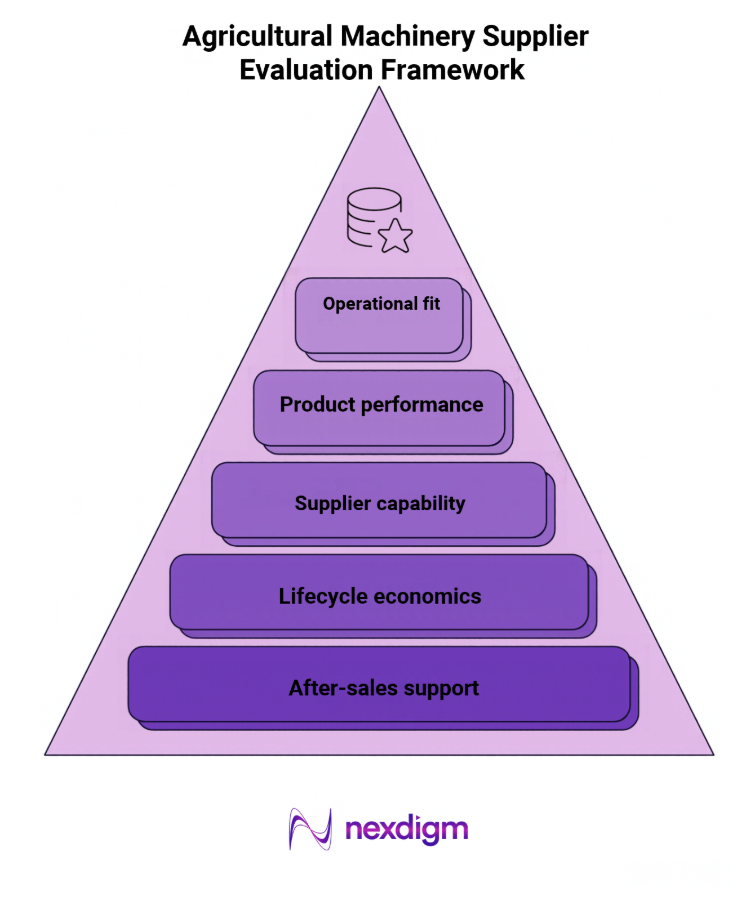
- Operational fit: Crop suitability, field conditions, capacity and compatibility with existing equipment.
- Product performance: Specifications, durability, efficiency and implement availability.
- Supplier capability: Manufacturing strength, product range, dealer network and market presence.
- Lifecycle economics: Purchase price, financing, fuel, maintenance, spare parts and downtime.
- After-sales support: Warranty, service response, operator training and technology assistance.
Nexdigm’s Case Study: Benchmarking Farm Machinery Manufacturers
Nexdigm assessed 29 machinery suppliers across 6 equipment categories, comparing technical specifications, dealer coverage, service infrastructure and lifecycle cost factors. The research shortlisted 7 manufacturers for further procurement assessment and identified service gaps across 4 target regions.
To take the next step, simply visit our Request a Consultation page and share your requirements with us.
Harsh Mittal
+91-8422857704