
Agricultural demand is becoming increasingly difficult to forecast using food consumption alone. Crops now compete for demand from food, animal feed, industrial processing, biofuels, and energy-linked applications.
A crop can experience rapid demand growth even when household consumption remains relatively stable.
Crop demand is no longer a single-market story
India’s foodgrain production is estimated at around 357.73 million MT, but the future demand trajectory of individual crops will increasingly depend on how their output is allocated across end uses.
Maize provides a clear example. With approximately 26% of maize demand linked to ethanol under the E20 transition, industrial demand can materially change procurement requirements and price expectations.
For agricultural businesses, the question is therefore not only how much demand will exist, but which end use will capture incremental supply.
Maize shows how industrial demand can reset procurement
Maize is simultaneously a food, feed, and industrial input.
When ethanol demand expands, the resulting competition for maize can alter procurement economics for starch, animal feed, and other users. This can create regional price pressure even before national supply appears constrained.
Scenario analysis illustrates the difference:
- Baseline scenario: approximately 4.2% CAGR
- Industrial demand scenario: approximately 7.8% CAGR
- Policy-driven demand shock: approximately 10.5% CAGR
The range matters because procurement strategies designed around a single growth rate can quickly become outdated.
Three forces can move the agricultural demand curve
- Industrial substitution: Crops increasingly enter ethanol, starch, bio-based products, and other industrial value chains.
- Dietary transition: Changes in protein, dairy, processed food, and convenience consumption influence demand for grains, pulses, oilseeds, and animal feed.
- Import dependence: Where domestic supply is structurally insufficient, changes in global prices and trade policy can transmit directly into domestic demand and procurement economics.
Oil palm exposes the timing gap between policy and supply
Edible oil imports remain structurally important, with India importing roughly 55–60% of edible oil consumption, representing around $14–16 billion in annual imports.
Oil palm has a different demand outlook because plantation development requires time. Policy can increase the attractiveness of domestic production quickly, but new acreage and mature yields cannot respond at the same speed.
Forecasting must therefore account for the lag between demand creation, acreage expansion, yield development, and commercial output.
Pulses make import substitution part of the forecast
India’s pulse demand is another example where consumption, domestic productivity, and imports interact.
Estimated production of around 25.2–27.4 million MT leaves room for supply-demand gaps to influence imports and prices. Demand forecasting for pulses therefore needs to incorporate both consumption growth and the potential impact of productivity improvements, acreage changes, and government policy.
Forecasts become useful when they reach procurement geography
A national demand forecast has limited commercial value if it cannot answer where additional supply should come from.
Businesses need to connect demand projections with production clusters, yield potential, transport economics, irrigation, processing capacity, and procurement models.
That converts a market forecast into a sourcing decision.
Nexdigm’s Agricultural Product Demand Forecasting: Turning Growth Into Procurement Decisions
Nexdigm’s Agricultural product demand forecasting framework can combine:
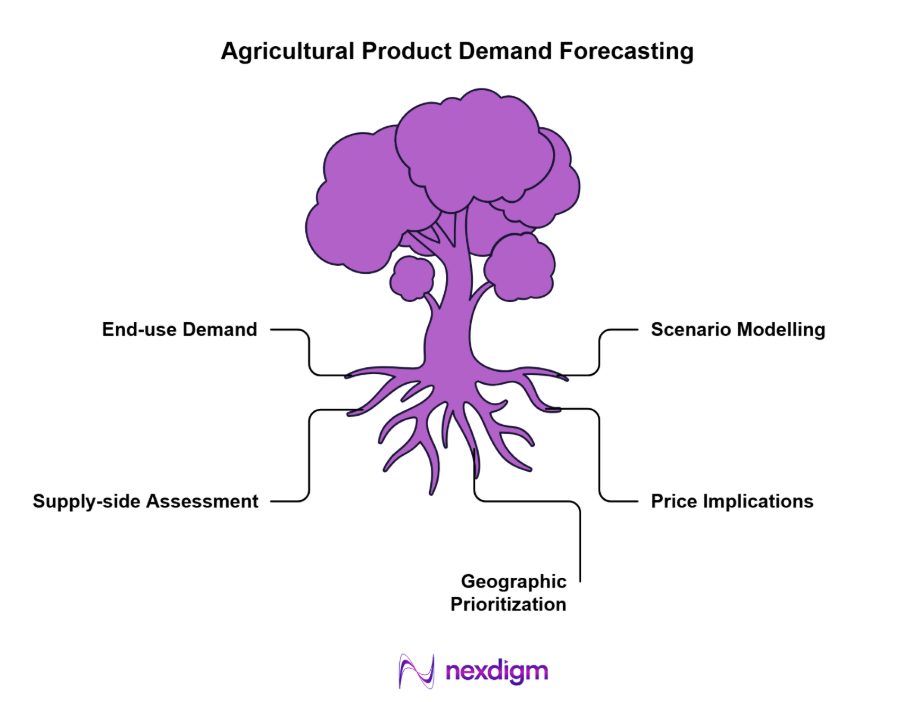
- End-use demand: food, feed, industrial, energy, and export applications.
- Scenario modelling: baseline, accelerated growth, policy shifts, and supply shocks.
- Supply-side assessment: acreage, yields, productivity, imports, and production constraints.
- Price implications: procurement costs, regional price spreads, and input exposure.
- Geographic prioritization: production clusters, logistics corridors, processing locations, and sourcing potential.
The analysis can help businesses determine which crops are likely to experience sustained demand growth, where supply constraints may emerge, and how procurement or capacity plans should respond.
Nexdigm Case: Securing Maize Before the Price Curve Tightened
An assessment for a starch and liquid-glucose manufacturer identified rising procurement risk after two ethanol plants entered the regional market, pushing maize spot prices 32% higher. A direct contract-farming programme covering 12,000 hectares in Northern Bihar, supported by rail-linked collection, reduced farm-gate procurement costs by 18% versus local spot prices and secured multi-year supply.
To take the next step, simply visit our Request a Consultation page and share your requirements with us.
Harsh Mittal
+91-8422857704