

Manufacturers that depend on agricultural raw materials face a sourcing environment shaped by harvest cycles, regional production patterns, weather conditions and fluctuating market prices. Unlike many industrial inputs, agricultural commodities may vary in quality and availability between seasons, even when they are sourced from the same region.
For food processors, ingredient manufacturers, bio-based product companies and other agricultural buyers, sourcing decisions must balance quality, volume, cost and continuity. A procurement strategy built around a single supplier or a narrow sourcing region can become vulnerable when harvests are delayed, transportation is disrupted or local demand increases.
Understanding Regional and Seasonal Supply Patterns
Agricultural production is distributed unevenly across regions. Factors such as soil conditions, rainfall, irrigation access, crop selection, and local farming practices shape both the quantity and quality of available raw materials. Seasonal cycles also govern when commodities reach the market and how long they can be stored without losing quality.
Manufacturers should start by identifying the production geography for each critical raw material. Key details to map include:
- Location: Major producing states and relevant district-level clusters.
- Market Timing: Harvesting windows and typical market arrival patterns.
- Competition: The presence of competing buyers in the area.
Evaluating these elements helps procurement teams separate regions offering steady commercial supply from those where availability is compressed into a brief seasonal window.
Assessments must also capture crop-specific quality differences. Parameters such as grain moisture, oil content, fibre characteristics, sugar concentration, and starch levels directly influence processing yields. A raw material that satisfies baseline market standards may still fall short of the requirements for a specific manufacturing process.
Building a Supplier Base Beyond the Immediate Procurement Market
Manufacturers often source through a combination of farmers, farmer producer organisations, aggregators, traders, mandis, cooperatives and organised commodity suppliers. Each channel offers different advantages in terms of volume, traceability, pricing and procurement flexibility.
Direct sourcing may improve visibility into production practices and quality, but it requires field-level coordination, aggregation and collection infrastructure. Traders and aggregators can consolidate fragmented supply, although buyers may have less direct visibility into the origin of the material. Organised suppliers may offer more standardised documentation and delivery arrangements, depending on their capabilities.
Using Research to Improve Raw Material Sourcing Decisions
A structured agricultural raw material sourcing research programme helps manufacturers compare sourcing regions, identify qualified suppliers and understand the commercial conditions influencing availability. It should examine production volumes, harvest calendars, market arrivals, supplier concentration, logistics infrastructure and competing demand.
The research should connect regional supply with the manufacturer’s actual consumption requirements. A location with high production may not be a practical sourcing market if most of its output is already committed or if transport costs make procurement uneconomical. Similarly, a smaller production cluster may offer reliable quality and stronger access through established local partners.
Price analysis should consider seasonal patterns rather than relying on a single market quotation. Buyers can assess historical price movements, harvest-period discounts, storage costs, transport expenses and the cost of carrying inventory between seasons. This creates a more realistic view of landed raw material cost.
Managing Quality, Traceability and Seasonal Risk
Supplier qualification should begin with product specifications linked to processing requirements. These may include moisture limits, foreign matter, purity, size, grade, chemical composition and other relevant quality parameters. Sampling and testing procedures should be agreed before procurement begins.
Traceability becomes particularly important when raw materials are used in products subject to food safety, sustainability or export requirements. Manufacturers should understand the supplier’s ability to document origin, handling practices, storage conditions and movement through intermediaries.
Seasonal risk planning should include alternative sourcing regions and suppliers. However, diversification needs to be practical. A second supplier should be qualified for the required specification and capable of delivering commercially viable volumes, rather than appearing as an alternative only on paper.
Procurement teams should evaluate:
- Harvest timing and regional production concentration.
- Supplier capacity, aggregation reach and delivery commitments.
- Quality consistency, testing and origin documentation.
- Transportation, storage and inventory carrying costs.
- Exposure to weather disruptions, price volatility and competing demand.
Aligning Procurement Contracts with Agricultural Cycles
Contract structures should reflect the timing and uncertainty of agricultural supply. Fixed-volume commitments may offer planning certainty but can become difficult to fulfil when production is affected by weather or yield variation.
Flexible volume bands phased delivery schedules and quality-linked pricing can provide a more balanced arrangement.
Manufacturers should also coordinate procurement with production planning. Purchasing too early can increase storage and working capital costs, while late procurement may expose the business to shortages or higher prices.
Forecasts should therefore incorporate consumption rates, inventory positions, expected harvest arrivals and supplier lead times.
Nexdigm supports manufacturers through sourcing research, supplier intelligence, regional market analysis and commodity benchmarking.
Its work can help organisations evaluate sourcing locations, compare supplier capabilities, understand seasonal market dynamics and develop procurement strategies that support continuity and cost control.
Agricultural Raw Material Sourcing Framework
A practical sourcing strategy should include:
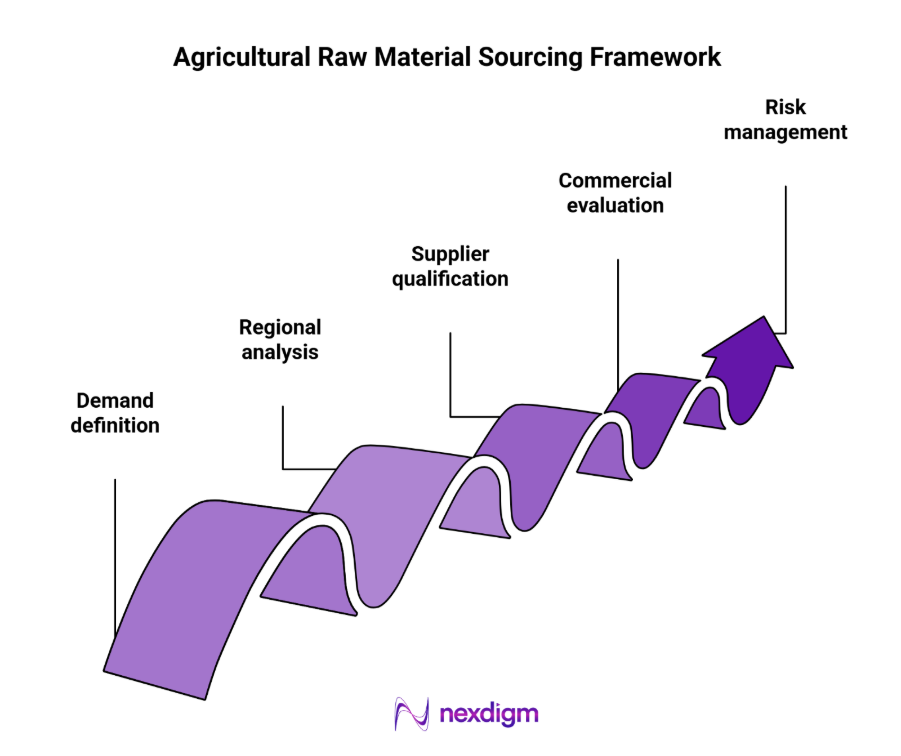
- Demand definition: Annual consumption, quality specifications and production schedules.
- Regional analysis: Production clusters, harvest calendars, market arrivals and competing demand.
- Supplier qualification: Capacity, aggregation networks, traceability and quality controls.
- Commercial evaluation: Seasonal prices, freight, storage, working capital and landed cost.
- Risk management: Alternative regions, flexible contracts, inventory buffers and disruption planning.
Nexdigm’s Case Study: Evaluating Multi-Regional Raw Material Sources
Nexdigm assessed 24 sourcing locations across 6 agricultural commodities, comparing production seasonality, supplier concentration, quality parameters and landed costs. The research identified 9 viable supplier clusters and 3 opportunities to diversify regional procurement.
To take the next step, simply visit our Request a Consultation page and share your requirements with us.
Harsh Mittal
+91-8422857704