

Two seed suppliers may offer the same crop variety at different prices, but the difference in their commercial value may extend well beyond the quoted rate. One supplier may provide stronger germination results, more reliable delivery and better regional coverage. Another may offer lower prices but require larger minimum orders or have limited replacement provisions. Comparing suppliers only on price can therefore produce procurement decisions that look economical initially but create additional costs during the growing season.
Seed buyers need a consistent way to assess product quality, commercial terms and supplier performance. This is where benchmarking becomes useful. It establishes comparable purchasing conditions and helps organisations identify whether their existing sourcing arrangements remain competitive.
Price Comparison Needs a Common Basis
Seed prices can vary according to crop, variety, seed category, treatment, packaging size, supplier channel and regional market conditions. A meaningful comparison must account for these differences before identifying a price advantage.
For example, the price of hybrid maize seed should not be benchmarked against a conventional open-pollinated variety simply because both products serve the same crop. Similarly, treated and untreated seeds may carry different costs and performance-related requirements.
Procurement teams should standardise their comparisons using:
- Crop and variety specifications.
- Seed category and applicable quality standards.
- Packaging size and quantity.
- Treatment and additional product features.
- Delivery location and transportation terms.
- Payment conditions and applicable taxes.
The objective is to compare equivalent products and purchasing conditions rather than produce a misleading ranking based on headline prices.
Quality Is Part of the Commercial Equation
A lower-priced seed lot may not offer better value if it presents quality inconsistencies or higher replacement requirements. Buyers should examine germination, physical purity, seed health, moisture levels and varietal authenticity alongside price.
The Seeds Act, 1966 provides the statutory basis for specifying minimum germination and purity standards for notified seed varieties in India. Procurement teams should ensure that suppliers meet applicable requirements and that quality claims are supported by relevant documentation.
Quality benchmarking should consider both the supplier’s general processes and the performance of individual lots. A producer may have a strong reputation, but incoming consignments still require appropriate inspection and verification.
Conducting agricultural seed procurement benchmarking Across Suppliers
Nexdigm’s agricultural seed procurement benchmarking brings procurement, agronomy, quality assurance and supply chain teams into the same assessment. Each function contributes a different perspective: procurement examines prices and contracts, agronomy evaluates varietal suitability, quality teams verify seed standards, and supply chain teams assess delivery reliability.
The comparison should cover several dimensions rather than rely on a single weighted score. These may include:
- Product and agronomic suitability: Whether the variety meets crop requirements and performs appropriately in the intended region.
- Quality consistency: Whether germination, purity, seed health and batch documentation remain consistent across consignments.
- Commercial competitiveness: Whether the supplier’s prices, discounts, payment terms and minimum order quantities are competitive.
- Supply reliability: Whether orders arrive in the required quantities and within the relevant planting window.
- Service performance: Whether the supplier resolves complaints, supports quality investigations and responds to changes in demand.
This approach allows organisations to distinguish suppliers that are commercially competitive from those that offer stronger overall sourcing value.
Understanding Price Differences Across Regions
Regional price variations can reflect differences in transportation, dealer margins, demand, local availability and distribution arrangements. Buyers sourcing across several states should investigate whether price differences arise from legitimate cost factors or inconsistent commercial terms.
A supplier may offer favourable pricing in one market because it has an established distribution network, while another region may require additional logistics or intermediary costs. The comparison should therefore include delivered cost rather than factory or distributor price alone.
Regional benchmarking can also reveal opportunities for consolidated purchasing. Where demand is spread across multiple locations, procurement teams may be able to negotiate improved terms through coordinated ordering, provided inventory and delivery requirements remain manageable.
Measuring Supplier Performance Over Time
A single procurement cycle does not provide enough evidence to establish long-term supplier reliability. Organisations should monitor performance across seasons and compare suppliers using consistent indicators.
Useful measures include order fulfilment rates, delivery lead times, quality rejection levels, complaint resolution time, stock availability and adherence to agreed commercial terms. These indicators can help identify suppliers whose performance has weakened despite competitive pricing.
Seasonal changes also need to be considered. A supplier that performs well during a normal monsoon season may face difficulties when weather conditions alter demand across regions. Performance reviews should therefore examine how providers respond to unexpected requirements and supply disruptions.
Turning Benchmark Findings into Procurement Decisions
Benchmarking should produce actionable decisions, not merely a list of suppliers ranked by score. Organisations can use the findings to renegotiate existing contracts, revise specifications, consolidate demand or qualify alternative producers.
For example, a supplier offering a modest price premium may remain the preferred choice if it demonstrates stronger quality consistency and reliable delivery. Another supplier may be suitable for selected crop categories or regional requirements rather than the entire procurement portfolio.
This segmented approach helps buyers avoid excessive dependence on one provider while maintaining consistent quality and commercial control.
How Nexdigm Supports Agricultural Seed Procurement Benchmarking
Nexdigm supports agribusinesses through market research, supplier benchmarking, price intelligence and procurement analysis. Its research can help clients compare seed prices, evaluate supplier capabilities, understand regional cost differences and identify opportunities to improve sourcing terms across crops and markets.
Seed Procurement Benchmarking Scorecard
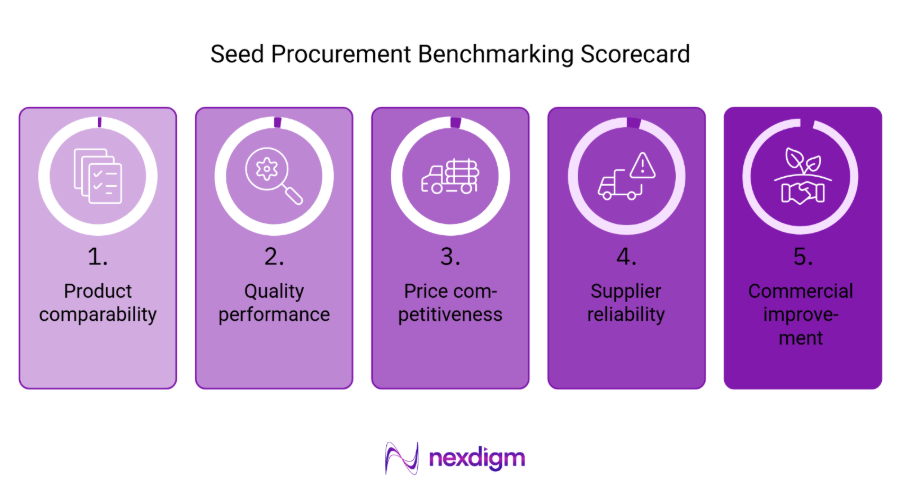
- Product comparability: Confirm crop, variety, seed category, packaging and treatment specifications.
- Quality performance: Compare germination, purity, seed health and batch consistency.
- Price competitiveness: Evaluate unit prices, delivered costs, discounts and payment conditions.
- Supplier reliability: Assess delivery performance, availability and seasonal responsiveness.
- Commercial improvement: Identify negotiation opportunities, sourcing alternatives and supplier development priorities.
Nexdigm’s Case Study: Benchmarking Agricultural Seed Procurement
Nexdigm compared 18 seed suppliers across six crop categories, analysed 42 pricing and quality indicators and reviewed delivery performance across 8 regional markets. The assessment identified 4 priority sourcing opportunities.
To take the next step, simply visit our Request a Consultation page and share your requirements with us.
Harsh Mittal
+91-8422857704