

Agricultural sourcing decisions are becoming more complex as input prices, supplier availability, trade conditions, and regional supply patterns continue to shift. The World Bank reported that its fertilizer price index fell 22% in the third quarter of 2026, reversing much of the previous quarter’s increase, but still projected an annual rise of around 14% for 2026.
Meanwhile, the FAO Food Price Index averaged 133.9 points in October 2026, remaining 5.9% above its year-earlier level. These contrasting movements highlight the need for informed sourcing decisions. Through agricultural sourcing strategy research, agribusinesses can evaluate supplier markets, compare sourcing options, understand cost movements, and assess risks to build procurement strategies aligned with business requirements.
The Interconnected Factors Behind Agricultural Sourcing Decisions
Agricultural sourcing is influenced by more than price negotiations. Seasonal demand, crop cycles, regional production patterns, logistics capacity, and supplier concentration all affect input availability and procurement costs. A sourcing strategy must account for these interconnected factors to balance commercial competitiveness with supply continuity. Organizations that overlook regional or seasonal differences may face avoidable procurement pressure when market conditions change.
Priorities That Shape a Stronger Sourcing Strategy
A resilient sourcing model requires visibility across the commercial, operational, and risk dimensions of procurement. Three priorities provide a practical starting point:
- Supplier Mix: Assess supplier concentration, geographic coverage, production capabilities, and product portfolios to identify alternatives and reduce dependence on limited sourcing channels.
- Input Availability and Cost: Examine pricing trends, seasonal demand, inventory levels, and regional supply conditions to support procurement timing and budget planning.
- Supply and Market Risk: Evaluate trade restrictions, logistics exposure, regulatory developments, and geopolitical disruptions to identify vulnerabilities that could affect sourcing continuity.
Together, these priorities help organizations move beyond price-led purchasing towards a sourcing model that balances supplier diversity, input availability, cost efficiency, and supply continuity.
Nexdigm’s Industry-Led Expertise in Agricultural Sourcing
Our industry-led expertise combines sector understanding with agricultural sourcing strategy research to help agribusinesses navigate evolving supplier markets. Our experts assess input categories, regional supply dynamics, cost movements, and emerging sourcing challenges. This perspective helps organizations identify relevant suppliers, evaluate procurement alternatives, anticipate market shifts, and develop sourcing strategies aligned with operational priorities and long-term business objectives.
How Nexdigm’s Experts Assess Key Agricultural Sourcing Priorities
Nexdigm’s experts evaluate sourcing requirements across four interconnected areas to help agribusinesses make informed procurement decisions. These areas are:
- Supplier Diversification: Assess existing supplier concentration, identify alternative manufacturers and distributors, and evaluate opportunities to broaden sourcing networks.
- Input Cost Competitiveness: Compare market prices, supplier quotations, commercial terms, and regional cost differences to identify competitive sourcing options.
- Availability and Supply Capacity: Examine production capabilities, inventory conditions, distribution reach, and seasonal availability to understand suppliers’ ability to meet demand.
- Sourcing Risk Exposure: Evaluate import dependencies, logistics constraints, regulatory developments, and geographic vulnerabilities that may affect procurement continuity.
This structured assessment helps organizations prioritize sourcing opportunities while balancing cost, availability, supplier reliability, and risk.
Nexdigm’s Sourcing Assessment Supporting Category-Level Strategies
The findings from supplier and market assessments can help agribusinesses define sourcing priorities for individual input categories. Our experts support this transition by translating research into practical recommendations, including:
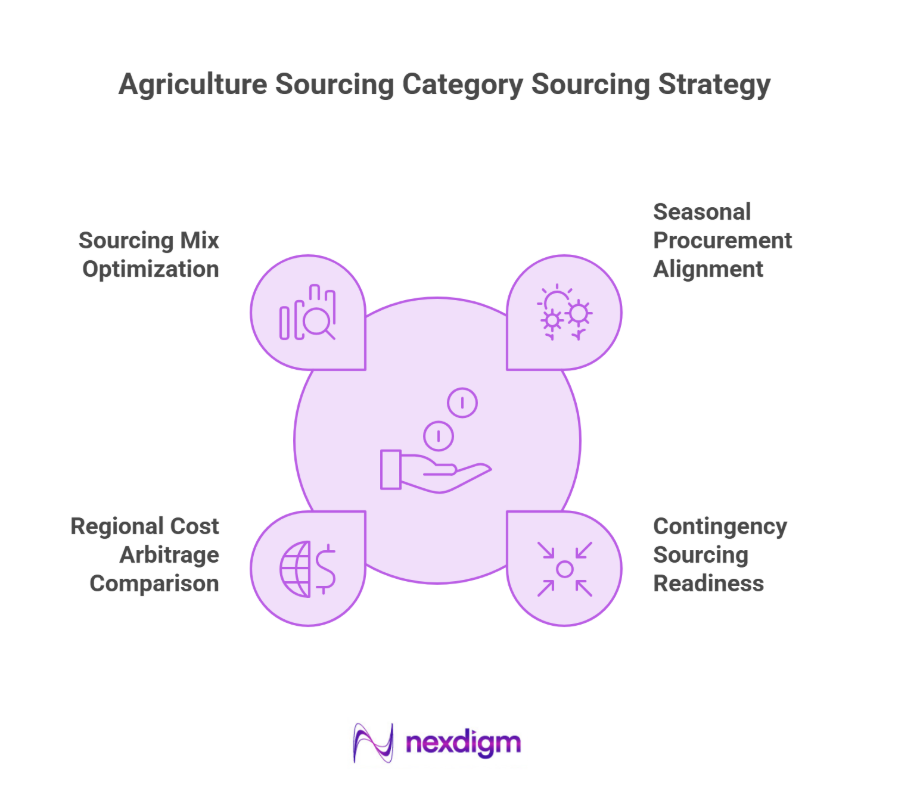
- Sourcing Mix Optimization: Identify opportunities to balance established suppliers, regional manufacturers, and emerging providers across agricultural input categories.
- Regional Cost Arbitrage: Compare sourcing locations to understand differences in input costs, supplier pricing, transportation considerations, and market access.
- Seasonal Procurement Alignment: Match supplier capabilities and regional availability with crop cycles and peak input demand periods.
- Contingency Sourcing Readiness: Identify backup suppliers, alternative sourcing regions, and potential responses to disruptions affecting critical agricultural inputs.
This approach connects market research with procurement planning, helping organizations move from supplier evaluation to more structured sourcing decisions.
Nexdigm’s Case
An agribusiness sought to optimize its sourcing network across fertilizers, seeds, and crop protection products. Nexdigm assessed 24 suppliers based on pricing, product portfolios, geographic coverage, production capacity, and supply reliability. The research found that 24% had limited regional distribution, while 20% showed significant pricing differences across markets. Based on these findings, the organization identified alternative sourcing regions and prioritized suppliers for further evaluation.
To take the next step, simply visit our Request a Consultation page and share your requirements with us.
Harsh Mittal
+91-8422857704