

Agricultural storage plays a direct role in protecting product quality, managing seasonal surpluses and maintaining continuity between harvest and consumption. For agribusinesses, food processors, commodity traders and institutional buyers, the choice of storage partner can influence inventory losses, working capital requirements and the reliability of downstream supply.
The supplier landscape is not limited to warehouse operators. It includes grain storage companies, cold storage developers, controlled-atmosphere facility operators, silo providers, packhouse operators and integrated post-harvest infrastructure companies. Each serves a different requirement. Identifying the right partner begins with understanding the commodity, storage duration, handling conditions and distribution model.
Understanding the Agricultural Storage Supplier Landscape
Grain storage and perishable storage operate under different technical and commercial requirements.
Grain facilities typically focus on bulk handling, moisture management, aeration, pest control, fumigation and protection against contamination.
Perishable products require temperature and humidity management, ventilation, controlled-atmosphere systems or specialised handling depending on the commodity.
Supplier categories also vary by ownership and operating model.
Public-sector warehousing agencies, private warehouse operators, commodity-specific storage companies and integrated logistics providers may all participate in the same market.
Some own and operate facilities, while others manage infrastructure on behalf of clients or provide storage alongside transportation and handling services.
India’s storage infrastructure includes large public and private networks.
The Food Corporation of India and state agencies maintain substantial capacity for central pool foodgrains, while the Central Warehousing Corporation and private operators serve broader agricultural and commercial storage requirements. The market also includes decentralised facilities linked to cooperatives and farmer organisations.
What Buyers Should Compare Across Storage Providers
A supplier’s total storage capacity is an incomplete measure of its suitability. Buyers should examine the type of infrastructure available, the commodities accepted, the location of facilities and the operational standards maintained at each site.
For grain storage, relevant criteria include warehouse design, scientific storage practices, moisture monitoring, pest management, loading and unloading capacity, and inventory tracking. Silo-based storage may offer advantages for bulk handling, while conventional warehouses may provide greater flexibility for bagged commodities and varied inventory requirements.
Perishable storage requires a more specialised assessment. Temperature ranges, humidity controls, backup power, refrigeration systems, monitoring technology and commodity-specific handling procedures should be reviewed. A facility designed for potatoes, for instance, may not be suitable for products requiring different temperature or atmospheric conditions.
Using Market Intelligence to Identify Suitable Storage Partners
A structured agricultural storage supplier landscape assessment helps organisations identify operators by commodity category, infrastructure type, geographic coverage and service capability. It should distinguish between companies with owned facilities, third-party warehouse managers, integrated logistics providers and developers of specialised storage infrastructure.
The assessment should also map facility locations against production clusters, procurement centres, processing plants and consumption markets.
A large warehouse located far from the relevant agricultural corridor may be less commercially useful than a smaller facility positioned close to the source of supply.
Commercial comparisons should include storage tariffs, handling charges, loading and unloading fees, insurance, inventory management costs and additional services.
Contract terms should clarify responsibility for quality deterioration, pest infestation, stock discrepancies, equipment failure and delays in release.
Assessing Capacity, Compliance and Operational Reliability
Storage procurement should include facility-level due diligence. Buyers should verify actual usable capacity rather than relying solely on advertised capacity. They should also examine utilisation levels, peak-season availability, maintenance practices and the operator’s ability to manage sudden increases in inventory.
For warehouses handling regulated commodities or issuing negotiable warehouse receipts, relevant registrations and compliance requirements should be checked.
The Warehousing Development and Regulatory Authority provides a regulatory framework for registered warehouses and negotiable warehouse receipts. Buyers should confirm that the facility’s credentials match the intended transaction and commodity.
A practical supplier review should examine:
- Commodity suitability and available storage conditions.
- Facility location, usable capacity and seasonal availability.
- Quality monitoring, pest management and inventory controls.
- Handling equipment, loading capacity and operating hours.
- Insurance, certifications, regulatory status and contract safeguards.
Linking Storage Procurement with the Wider Supply Chain
Storage decisions should be evaluated alongside transportation, processing and distribution requirements. A facility may offer competitive rates but create additional costs if it is poorly connected to collection centres or requires multiple handling stages. For perishable commodities, unnecessary transfers can also increase exposure to temperature variation and product damage.
India’s agricultural infrastructure initiatives reflect the scale of this requirement. A September 2025 government update reported 917.83 lakh metric tonnes of covered and CAP storage capacity held by FCI and state agencies for central pool grains.
The same update reported 8,815 cold storage facilities with a combined capacity of approximately 40.21 million metric tonnes.
These figures represent different infrastructure categories but together illustrate the breadth of the storage ecosystem.
Nexdigm supports organisations through supplier mapping, market intelligence, infrastructure benchmarking and commercial research.
Its analysis can help buyers compare storage operators, identify regional capacity gaps, assess service capabilities and evaluate partners against procurement and distribution requirements.
Agricultural Storage Supplier Evaluation Framework
A structured assessment can be organised around five dimensions:
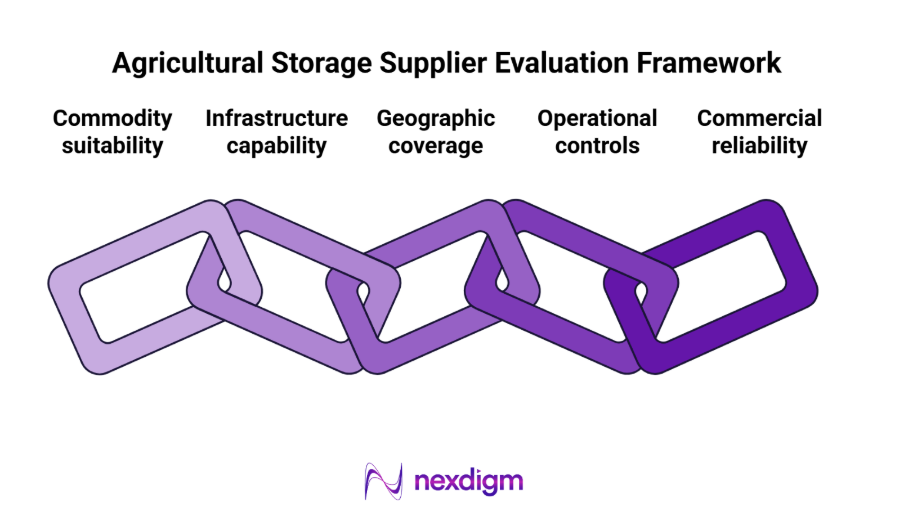
- Commodity suitability: Grain, horticulture, processed food or other product-specific storage requirements.
- Infrastructure capability: Warehouse design, silos, refrigeration, controlled atmosphere and handling equipment.
- Geographic coverage: Proximity to farms, procurement centres, processors and distribution markets.
- Operational controls: Quality monitoring, inventory management, pest control and compliance.
- Commercial reliability: Storage tariffs, service levels, insurance, contract terms and peak-season availability.
Nexdigm’s Case Study: Assessing Agricultural Storage Operators
Nexdigm assessed 38 storage providers across 7 agricultural markets, comparing facility types, usable capacity, commodity coverage and service capabilities. The research shortlisted 10 operators and identified regional gaps affecting grain and perishable storage access.
To take the next step, simply visit our Request a Consultation page and share your requirements with us.
Harsh Mittal
+91-8422857704