

Agribusinesses often measure supplier diversification by counting the number of vendors they purchase from. A business with several fertilizer distributors, multiple seed suppliers or a broad crop protection portfolio may appear to have a resilient procurement network. But this can be misleading. Different vendors may depend on the same manufacturer, raw material source, import market or distribution hub.
The real question is not how many suppliers an organisation has. It is how many independent sources of supply are available when a critical input becomes difficult to procure. Understanding this distinction is essential for businesses managing agricultural production, input distribution, processing and large-scale sourcing.
A Long Supplier List Can Conceal a Narrow Supply Base
Supplier concentration can exist at several levels. A company may purchase from multiple distributors that all source a product from one manufacturer. Different manufacturers may depend on the same imported technical ingredient. Domestic suppliers may also rely on common ports, processing facilities or raw material-producing regions.
These dependencies can remain invisible when procurement databases record only the immediate vendor. As a result, organisations may overestimate the number of alternatives available to them.
The problem becomes more serious when a product has few qualified substitutes. Seeds may require variety-specific performance and regulatory checks. Crop protection products may require technical and application validation. Fertilizer formulations can have different nutrient compositions, while machinery components may need to meet precise compatibility requirements.
Import Concentration Creates Exposure Beyond the Direct Supplier
India’s agricultural input supply chains have significant international connections. Fertilizer production depends partly on imported raw materials and finished products, while several agrochemical technical ingredients are sourced from overseas markets.
India’s fertilizer sector continues to depend on imports for important phosphorus and potassium inputs. In FY2024–25, the country’s fertilizer subsidy burden was reported at nearly ₹1.71 lakh crore, while external supply exposure remained significant for important nutrient categories.
Agrochemical imports also show concentration. China supplied approximately 60.8% of India’s pesticide import volume in FY2023–24. The United States, Taiwan and Israel were among the other major sources, with substantially smaller shares.
Such concentration does not mean supply will necessarily be disrupted. It does mean that buyers should understand how much of their procurement depends on a particular source market and whether alternatives can be activated quickly.
Switching Suppliers Is Not Always Immediate
Supplier replacement can involve more than negotiating a new purchase order. Buyers may need to validate product specifications, conduct quality testing, assess regulatory documentation, review manufacturing facilities and confirm logistics arrangements.
In agricultural operations, timing makes this especially important. An alternative seed supplier may not have the required variety available for the upcoming planting season. A new crop protection product may require technical assessment before adoption. A replacement fertilizer source may have different specifications or delivery constraints.
This creates a difference between a supplier being available in the market and being operationally qualified for a particular buyer.
Shared Infrastructure Can Increase Dependency
Supplier dependency can also arise through logistics and infrastructure. Several vendors may use the same port, warehouse, transport corridor, cold storage facility or regional distributor. A disruption at one of these shared points can affect multiple supply relationships at once.
The risk is particularly relevant for perishable agricultural products and inputs with specific storage requirements. A buyer may have several product suppliers but limited access to the infrastructure required to receive, store or distribute those products safely.
Dependency assessments should therefore extend beyond company ownership and purchasing records. They should examine the physical and commercial networks connecting suppliers to the buyer.
How Agribusinesses Can Measure and Reduce Supplier Dependency
A structured agricultural supplier dependency assessment should identify critical inputs, trace their upstream sources and evaluate the availability of qualified alternatives. The analysis should distinguish direct supplier concentration from deeper dependencies involving manufacturers, raw materials, countries of origin and logistics infrastructure.
Buyers should examine how much expenditure or volume is concentrated among their largest suppliers, but concentration alone is not enough. They should also assess the time and cost required to switch suppliers, the availability of substitute products and the operational impact of a supply interruption.
Nexdigm supports organisations through supplier intelligence, dependency mapping, market research and supply risk assessment. Its research can help procurement teams understand the structure of critical input markets, identify common upstream dependencies and evaluate diversification opportunities before disruptions affect operations.
Agricultural Supplier Dependency Assessment Framework
A detailed assessment should examine seven dimensions:
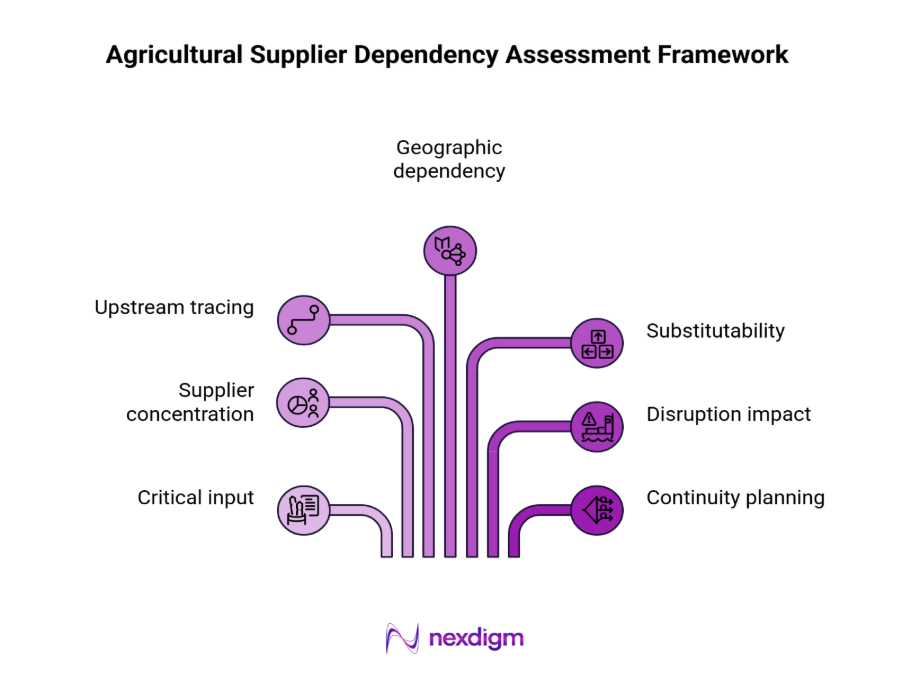
- Critical input identification and materiality: Identify seeds, fertilizers, crop protection products, machinery components, feed ingredients and other inputs essential to operations. Rank them by spend, volume, production criticality, substitution difficulty and the consequences of non-availability.
- Direct supplier concentration: Measure purchasing and volume concentration across vendors. Review the share of expenditure assigned to the largest suppliers, contract commitments, order frequency and dependence on individual distributors or manufacturers.
- Upstream source tracing: Identify the manufacturers, raw material producers, importers, processing facilities and countries of origin behind direct suppliers. Record common ownership, shared production facilities and overlapping source markets.
- Geographic and infrastructure dependency: Map exposure to specific agricultural regions, ports, warehouses, transport corridors and distribution hubs. Determine whether multiple suppliers depend on the same physical infrastructure or regional operating conditions.
- Substitutability and switching assessment: Identify technically acceptable alternative products and suppliers. Assess product validation, regulatory requirements, quality testing, compatibility, switching costs and the time required to qualify a replacement source.
- Disruption impact and exposure scoring: Evaluate the likelihood and potential duration of supply interruption, financial consequences, production impact and available inventory cover. Distinguish between high-spend suppliers and suppliers whose failure could stop critical operations.
- Diversification and continuity planning: Develop secondary sourcing options, alternative origin markets, strategic inventory arrangements and supplier development priorities. Establish monitoring indicators for concentration, lead times, market conditions and changes in supplier capacity.
Nexdigm’s Case Study: Assessing Critical Agricultural Supplier Dependencies
Nexdigm evaluated 30 critical input suppliers across 6 agricultural categories, tracing upstream manufacturers, import origins and shared logistics dependencies. The assessment identified 8 high-dependency relationships and shortlisted 6 alternative sourcing options for further qualification.
To take the next step, simply visit our Request a Consultation page and share your requirements with us.
Harsh Mittal
+91-8422857704