

India can produce agricultural commodities at competitive farm-gate prices. The difficulty begins after production. Intermediaries, mandi charges, inland freight, processing losses, and inconsistent quality can progressively erode the cost advantage before a product reaches an overseas buyer.
Global competitiveness therefore depends on what happens between the farm and the final customer.
A low farm-gate price can become a high delivered price
Agricultural competitiveness is often assessed using production costs. That captures only part of the equation.
APMC-related costs can add approximately 6–10%, while agricultural products may travel 1,200–1,800 km to major ports such as JNPA or Mundra. Processing can introduce another 3–5% yield loss depending on the product.
The relevant metric is therefore landed cost:
Landed Cost = Farm-Gate Cost + Procurement Costs + Processing + Inland Logistics + Port Costs + Ocean Freight + Compliance Costs + Losses
Two suppliers with similar farm-gate prices can consequently have very different export economics.
Where Indian export costs accumulate
- Fragmented procurement: Multiple intermediaries increase transaction costs and reduce visibility into source quality.
- Inland movement: Long distances from production clusters to ports increase freight exposure.
- Processing inefficiency: Yield losses directly increase the effective cost of saleable output.
- Quality variation: Mixed grades and inconsistent specifications create sorting, rejection, and discounting costs.
- Compliance: Testing, documentation, traceability, and certification add cost but can also determine market access.
Logistics is a competitiveness variable
India’s logistics performance has improved, but agricultural competitiveness remains highly dependent on geography. A product sourced far from the nearest processing facility or port carries structural freight disadvantages.
For exporters, the relevant question is therefore not simply whether logistics costs are falling nationally. It is whether the specific production cluster, processing location, and destination corridor create an economically viable route.
Rail-linked aggregation, direct procurement, strategically located processing, and port selection can materially change the delivered cost.
Quality reliability determines whether cost advantages survive
International buyers purchase against specifications, not averages. Moisture, residue levels, grade, size, protein content, contamination, and processing consistency can affect the price actually realized.
A low-cost shipment that requires additional sorting or generates quality disputes may provide less economic value than a slightly higher-cost shipment with predictable specifications.
Reliability therefore has a measurable commercial dimension: rejection rates, claims, lead times, specification variance, and repeat-order rates.
The competitiveness equation differs by commodity
Rice, oilseeds, spices, marine products, and processed foods face different cost structures.
For some products, procurement efficiency dominates. For others, freight or processing yield is the decisive variable. Perishables introduce cold-chain and shelf-life constraints, while processed products add packaging and manufacturing costs.
A meaningful competitiveness assessment therefore needs to identify where the margin is actually being lost, rather than applying a single national cost benchmark.
Nexdigm’s Agricultural Trade Competitiveness Assessment: From Farm-Gate Cost to Landed Margin
Nexdigm’s Agricultural trade competitiveness assessment can map the complete cost chain from production to destination market:
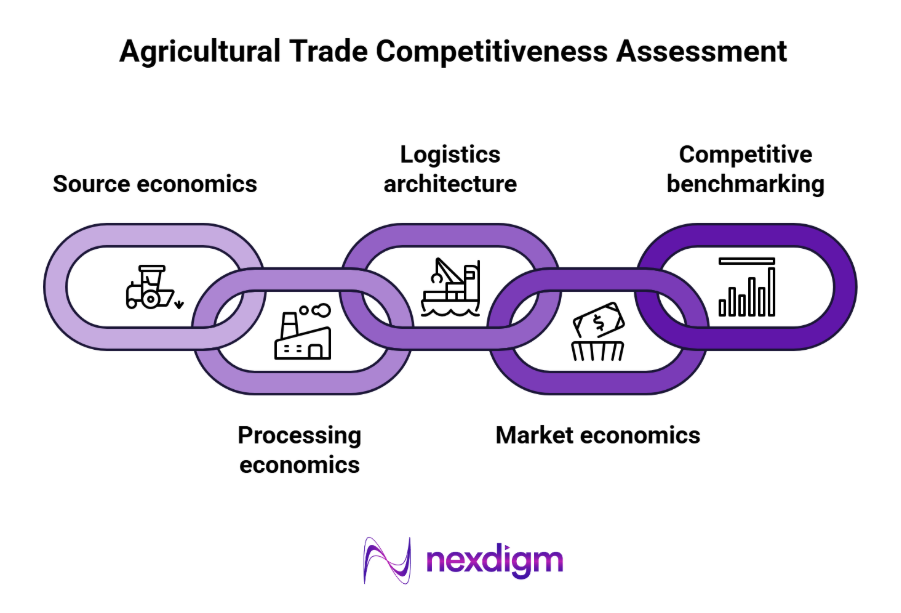
- Source economics: farm-gate prices, yields, procurement structures, and intermediary costs.
- Processing economics: conversion yields, operating costs, capacity utilization, and quality losses.
- Logistics architecture: origin-destination distances, transport modes, ports, freight rates, and handling.
- Market economics: destination prices, tariffs, distributor margins, and buyer specifications.
- Competitive benchmarking: comparable suppliers, delivered prices, quality positioning, and structural cost differences.
This can help businesses identify the exact cost levers required to improve export competitiveness and determine whether the answer lies in procurement, processing, logistics, product positioning, or market selection.
Nexdigm Case: Removing the Cost Penalty
Nexdigm’s assessment for a MP-based oilseed and spice processor found a 12% freight and intermediary disadvantage against competing suppliers in EU tenders. Direct procurement from 14 Farmer Producer Companies eliminated 5.5% in mandi taxes and commissions, while rail-linked movement to JNPA reduced inland logistics costs by $24/MT, restoring tender competitiveness.
To take the next step, simply visit our Request a Consultation page and share your requirements with us.
Harsh Mittal
+91-8422857704