

Agricultural willingness to pay analysis helps agribusinesses determine how much farmers will invest in premium seeds, advanced inputs, machinery, and digital technologies. Through structured Pricing Analysis Services, companies can evaluate perceived value, expected yield gains, affordability, farm income, risk reduction, financing access, and regional purchasing behavior.
These insights reveal acceptable price ranges, premium thresholds, adoption barriers, and segment-specific opportunities. Effective analysis supports value-based pricing, product positioning, portfolio design, promotional planning, and demand forecasting. By aligning prices with measurable farmer benefits and economic returns, businesses can increase adoption, strengthen competitiveness, protect margins, and support sustainable agricultural innovation across diverse markets.
An illustrative 7% improvement in willingness-to-pay accuracy can strengthen premium product adoption. Pricing Analysis Services identify acceptable price ranges, value perceptions, and adoption barriers, helping agribusinesses improve conversion rates, optimize premium pricing, protect margins, and accelerate technology uptake.
Pricing Analysis for Farmer Willingness to Pay and Premium Adoption
Pricing analysis measures farmer willingness to invest in premium agricultural solutions, helping businesses align prices with perceived value, affordability, expected returns, and adoption potential across diverse market segments and regions. Core elements in focus of pricing analysis are:
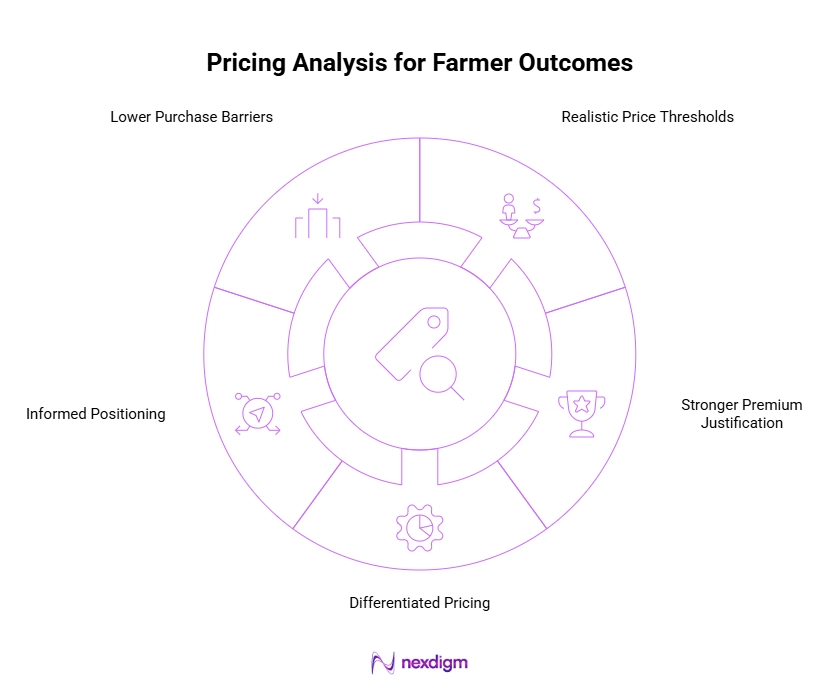
- Farmer Affordability Assessment: Evaluate farm income, crop returns, landholding size, credit availability, and seasonal cash flow. Benefits include realistic price thresholds, improved accessibility, and stronger adoption.
- Perceived Value Measurement: Assess expected yield gains, quality, convenience, risk reduction, and productivity improvements. Benefits include stronger premium justification, clearer value communication, and increased purchase confidence.
- Segment-Specific Willingness Analysis: Group farmers by region, crop, farm size, income, and technology readiness. Benefits include differentiated pricing, targeted promotions, higher conversions, and improved portfolio relevance.
- Competitive Premium Benchmarking: Compare competitor prices, features, performance claims, warranties, and support services. Benefits include informed positioning, reduced substitution risk, stronger differentiation, and protected market competitiveness.
- Financing and Incentive Evaluation: Analyze subsidies, credit schemes, payment terms, bundled offers, and leasing options. Benefits include lower purchase barriers, wider market reach, accelerated adoption, and improved retention.
Nexdigm’s Pricing Analysis Services for Premium Seeds, Inputs, and Technologies
Nexdigm’s Pricing Analysis Services empower agribusinesses to optimize pricing for premium seeds, agricultural inputs, and advanced farming technologies through agricultural willingness to pay analysis, competitive pricing analysis, market price benchmarking, value-based pricing, pricing intelligence, and farmer demand analysis. By evaluating affordability, perceived value, adoption thresholds, and competitor positioning, Nexdigm helps organizations maximize premium product adoption, improve price realization, strengthen market competitiveness, protect margins, and drive sustainable business growth.
Nexdigm’s Premium Agricultural Pricing Roadmap for Farmer Adoption
Nexdigm’s premium agricultural pricing roadmap combines farmer value perception, affordability, market intelligence, competitive benchmarks, and adoption insights to optimize prices, strengthen product positioning, improve margins, and support sustainable growth. Data Driven steps followed by Nexdigm’s experts are:
Step 1: Farmer Segment Assessment
Nexdigm groups farmers by crop, region, farm size, income, and technology readiness to identify distinct affordability levels and premium adoption potential.
Step 2: Willingness-to-Pay Analysis
Farmer responses to price, expected returns, product quality, yield gains, and risk reduction are evaluated to establish acceptable premium pricing thresholds.
Step 3: Competitive Value Benchmarking
Premium seeds, inputs, and technologies are compared against competitor prices, performance claims, warranties, and support services to strengthen differentiated market positioning.
Step 4: Pricing and Offer Design
Nexdigm develops segment-specific prices, bundles, financing options, discounts, and value propositions that balance farmer affordability with profitability and premium product adoption.
Step 5: Adoption Monitoring and Optimization
Sales conversions, farmer feedback, repeat purchases, margins, and competitor movements are tracked to refine pricing and sustain long-term market growth.
Nexdigm’s Case
In an illustrative engagement, Nexdigm helped an agribusiness refine premium agricultural pricing. The initiative increased farmer adoption by 15%, improved price realization by 10%, and strengthened contribution margins by 8%, supporting wider technology uptake and sustainable portfolio growth.
To take the next step, simply visit our Request a Consultation page and share your requirements with us.
Harsh Mittal
+91-8422857704