

Agriculture affordability pricing analysis helps agribusinesses understand how rising production, labor, energy, logistics, and input costs affect farmer purchasing capacity and product adoption. Through structured Pricing Analysis Services, companies can evaluate farm income, crop returns, seasonal cash flow, credit availability, regional cost pressures, and competitor pricing.
These insights identify affordability thresholds, demand risks, suitable pack sizes, financing needs, and segment-specific pricing opportunities. Effective affordability analysis supports value-based pricing, portfolio planning, subsidy assessment, and margin protection. By balancing producer cost recovery with farmer economics, businesses can maintain market access, strengthen competitiveness, improve adoption, and sustain profitable agricultural growth.
An illustrative 7% improvement in affordability assessment can strengthen agricultural adoption. Pricing Analysis Services evaluate farm income, production costs, credit access, and price sensitivity, helping businesses optimize price points, improve demand forecasting, protect margins, and maintain accessibility across cost-pressured markets.
Agricultural Price Optimization for Affordability and Margin Protection
Agricultural price optimization balances farmer affordability, production costs, market demand, and product value, helping agribusinesses improve adoption, recover expenses, protect margins, strengthen competitiveness, and sustain profitable growth across markets. Core benefits of pricing analysis are:
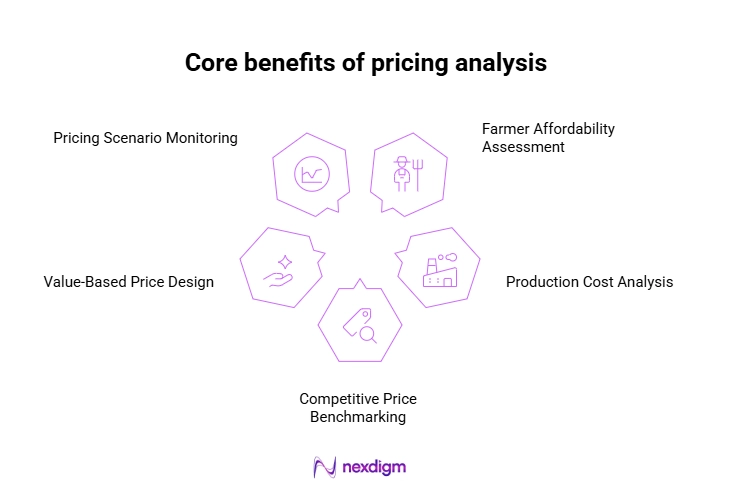
- Farmer Affordability Assessment: Evaluate farm income, crop returns, seasonal cash flow, credit availability, and purchasing capacity. Benefits include realistic price thresholds, broader accessibility, stronger adoption, and improved customer retention.
- Production Cost Analysis: Assess raw materials, manufacturing, energy, labor, logistics, and distribution expenses. Benefits include accurate cost recovery, protected margins, improved financial visibility, and disciplined pricing decisions.
- Competitive Price Benchmarking: Compare competitor prices, pack sizes, discounts, product performance, and channel offers. Benefits include stronger positioning, reduced substitution risk, informed adjustments, and improved market competitiveness.
- Value-Based Price Design: Link prices with productivity gains, quality, reliability, efficiency, and farmer returns. Benefits include premium justification, clearer value communication, stronger purchase confidence, and improved price realization.
- Pricing Scenario Monitoring: Model demand, cost inflation, price changes, margins, and adoption outcomes across customer segments. Benefits include faster decisions, reduced revenue risk, portfolio resilience, and sustainable profitability.
Nexdigm’s Role in Balancing Farmer Affordability and Cost Recovery
Nexdigm’s Pricing Analysis Services help agribusinesses balance farmer affordability with sustainable cost recovery through agriculture affordability pricing analysis, competitive pricing analysis, market price benchmarking, pricing intelligence, cost-to-serve analysis, and value-based pricing. By evaluating production costs, farmer purchasing capacity, regional demand, and competitor pricing, Nexdigm enables organizations to optimize pricing decisions, improve market accessibility, protect profit margins, strengthen competitiveness, and achieve sustainable growth across agricultural markets.
Nexdigm’s Integrated Pricing Analysis Plan for Affordability and Profitability
Nexdigm’s integrated pricing plan combines farmer affordability, cost recovery, competitive intelligence, and value assessment to optimize agricultural prices, protect margins, strengthen adoption, and support sustainable profitability across diverse markets. Data Driven types followed by Nexdigm’s experts are:
Type 1: Affordability-Based Pricing
Prices reflect farmer income, crop returns, seasonal cash flow, and credit access, improving market accessibility while maintaining commercially sustainable revenue levels.
Type 2: Cost-Plus Pricing
Production, logistics, distribution, and service costs are calculated with appropriate margins, ensuring systematic cost recovery and greater financial stability across portfolios.
Type 3: Value-Based Pricing
Pricing aligns with measurable productivity gains, quality, reliability, efficiency, and farmer returns, supporting premium justification and stronger customer value perception.
Type 4: Competitive Benchmark Pricing
Nexdigm compares competitor prices, product features, discounts, pack sizes, and channel offers to strengthen positioning and support informed market-responsive pricing decisions.
Type 5: Segment-Specific Pricing
Farmers and markets are segmented by geography, crop, purchasing power, and demand sensitivity, enabling differentiated prices that balance adoption and profitability.
Nexdigm’s Case
In an illustrative engagement, Nexdigm helped an agribusiness balance farmer affordability with cost recovery. The initiative increased product adoption by 13%, improved price realization by 9%, and strengthened contribution margins by 8%, supporting accessible pricing and sustainable profitability.
To take the next step, simply visit our Request a Consultation page and share your requirements with us.
Harsh Mittal
+91-8422857704