

Agribusinesses must manage sourcing across input categories with different supplier structures, cost drivers, and availability patterns. The USDA’s November 2026 World Agricultural Supply and Demand Estimates projected US corn production at 15.9 billion bushels, down from October’s estimate, while soybean production increased to approximately 4.6 billion bushels.
These contrasting revisions demonstrate how quickly agricultural market conditions can change across commodities. Through agriculture category sourcing strategy, it helps agribusinesses understand category-specific markets, evaluate supplier options, and develop procurement priorities that reflect changing supply conditions, commercial requirements, and operational needs.
Why Input Categories Should Not Share the Same Sourcing Strategy
Each farm input has distinct sourcing considerations. Seed procurement depends on variety selection, quality, and planting schedules; fertilizers involve nutrient requirements, production capacity, and price volatility. Crop protection sourcing requires attention to product registrations and technical suitability, while equipment procurement involves machinery specifications, servicing, and lifecycle costs. Category-specific planning helps organizations address these differences.
Questions to Ask Before Structuring Category Procurement
A category-level sourcing model should be developed around three practical decisions:
- What Should Be Sourced? Prioritize input categories based on operational criticality, expenditure, seasonal requirements, and potential consequences of supply interruptions.
- Where Should It Be Sourced From? Compare domestic and international markets, supplier concentration, regional availability, and distribution capabilities to identify suitable sourcing locations.
- How Should Suppliers Be Engaged? Determine appropriate supplier combinations, purchasing arrangements, and alternative sourcing channels according to category requirements.
Answering these questions helps agribusinesses establish procurement priorities before evaluating individual suppliers and commercial arrangements.
Nexdigm’s Category Intelligence: Understanding What Each Market Demands
Our industry-led expertise helps agribusinesses examine the market characteristics that influence sourcing decisions across critical farm inputs. Our experts research supplier ecosystems, product portfolios, regional market conditions, pricing indicators, and competitive positioning. This provides organizations with a clearer understanding of how individual categories operate and where sourcing approaches may need to be adjusted.
Conducting Category-Wise Analysis of Critical Farm Inputs with Nexdigm
Rather than treating agricultural inputs as a single procurement group, our experts conduct agriculture category sourcing strategy analysis that can help organizations examine the specific sourcing requirements of each category. These categories are:
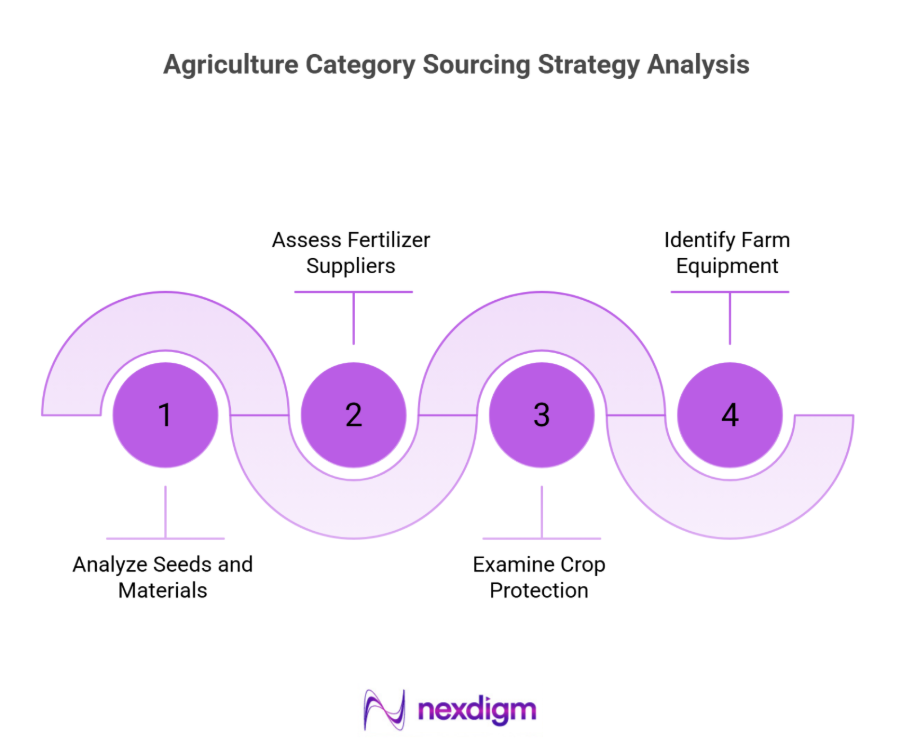
- Seeds and Planting Materials: Research seed developers, variety portfolios, product characteristics, certifications, and regional distribution networks.
- Fertilizers and Soil Nutrients: Assess nitrogen, phosphate, potash, and specialty fertilizer suppliers, production capabilities, import dependencies, and market pricing.
- Crop Protection Products: Examine herbicide, insecticide, and fungicide providers, product registrations, technical portfolios, and geographic availability.
- Farm Machinery and Equipment: Identify equipment manufacturers, product capabilities, distribution partners, maintenance networks, and after-sales service coverage.
This segmentation helps procurement teams understand category-specific supplier options and establish more relevant evaluation criteria.
Where Nexdigm’s Strategy Can Strengthen Category Sourcing Decisions
Our experts translate market findings into practical procurement intelligence through several areas of support:
- Supplier Landscape Development: Identify relevant manufacturers, distributors, regional providers, and emerging participants across selected input categories.
- Market and Cost Comparison: Examine supplier positioning, pricing indicators, commercial conditions, and regional cost differences.
- Sourcing Opportunity Assessment: Identify alternative suppliers, underserved markets, and potential opportunities to diversify existing sourcing arrangements.
- Category-Level Benchmarking: Compare supplier capabilities and market conditions against defined procurement and operational requirements.
These insights help organizations develop a more structured view of sourcing opportunities and determine where further supplier evaluation may be required.
Nexdigm’s Case
An agribusiness sought to improve sourcing decisions across fertilizers, seeds, crop protection products, and farm equipment. Nexdigm assessed 24 suppliers based on pricing, product portfolios, manufacturing capabilities, geographic coverage, and distribution networks. The analysis found that 27% had limited regional supply coverage, while 22% showed significant pricing variations across markets. Based on these findings, the organization identified alternative suppliers, evaluated regional sourcing opportunities, and prioritized categories requiring further procurement assessment.
To take the next step, simply visit our Request a Consultation page and share your requirements with us.
Harsh Mittal
+91-8422857704