

In increasingly competitive agricultural markets, pricing decisions directly influence profitability, customer perception, and market share. Agriculture competitor pricing analysis enables agribusinesses to compare rival prices, product specifications, discount structures, distribution margins, and regional variations. Through systematic pricing analysis, companies can identify price gaps and respond effectively to changing input costs.
Competitor price benchmarking also supports informed decisions on product launches, promotional strategies, and channel pricing. By combining market intelligence and cost analysis, agribusinesses can develop competitive pricing strategies that protect margins and improve their overall position across target markets.
Pricing Analysis Services can strengthen commercial outcomes by translating competitor benchmarks into actionable price corridors. Agribusinesses applying structured pricing reviews have 12% higher channel conversion, and 15% faster pricing decisions across priority markets globally.
How Pricing Analysis Improves Agribusiness Competitiveness
Pricing analysis helps agribusinesses understand competitor moves, customer expectations, channel margins, and regional price variations, enabling smarter decisions that improve profitability, market relevance, and long-term competitiveness across agricultural markets. Key strategic steps for the analytical process are:
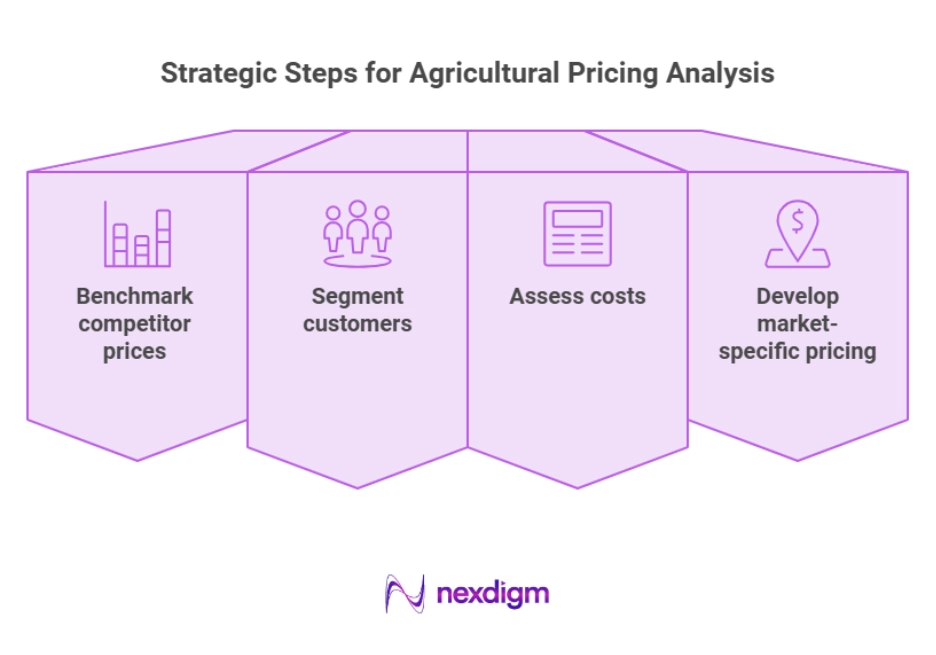
- Benchmark Competitor Prices: Comparing competitor prices, pack sizes, product features, discounts, and channel margins across regions to identify pricing gaps, premium opportunities, and areas where current positioning requires adjustment.
- Segment Customers by Value: Analyzing purchase behaviour, price sensitivity, farm size, application needs, and service expectations to create customer segments and establish differentiated prices that reflect perceived value and affordability.
- Assess Costs and Margin Thresholds: Evaluation of production, logistics, distribution, promotional, and regulatory costs to determine minimum viable prices, protect margins, and identify where operational efficiencies can support more competitive market offers.
- Develop Market-Specific Pricing: Adapting to pricing by geography, crop cycle, demand conditions, channel structure, and competitor intensity, ensuring each market receives a commercially viable and locally relevant pricing approach.
Nexdigm’s Pricing Analysis Expertise to Improve Agribusiness Market Positioning
Nexdigm helps agribusinesses make informed pricing decisions through comprehensive pricing analysis services, competitor pricing analysis, price benchmarking, and market intelligence. By evaluating competitor strategies, customer demand, channel dynamics, and cost structures, Nexdigm develops data-driven pricing strategies that strengthen market positioning, improve profitability, optimize product pricing, and enable sustainable growth in increasingly competitive agricultural markets
Nexdigm’s Agribusiness Pricing Analysis Framework for Competitive Growth
Nexdigm’s agribusiness pricing framework combines market intelligence, competitor benchmarking, customer insights, and financial modelling to build responsive pricing strategies that strengthen margins, positioning, and sustainable competitive growth. Some of the pricing analysis framework models used by Nexdigm’s experts are:
- Cost-Plus Pricing Model: Evaluates production, logistics, distribution, regulatory, and promotional costs to establish sustainable price floors while protecting targeted margins across products and markets.
- Conjoint Analysis Model: Measures how customers value product attributes, service levels, and price points, helping agribusinesses design stronger offerings and optimise willingness to pay.
- Discount Effectiveness Framework: Assesses promotional discounts, seasonal offers, and volume incentives to determine which programmes generate incremental sales without creating unnecessary margin erosion.
- Geographic Pricing Model: Adjusts prices according to regional demand, transportation costs, crop economics, competitor presence, and channel structures to support locally relevant market strategies.
Nexdigm’s Case
Nexdigm partnered with a leading agribusiness to redesign its pricing strategy using competitor benchmarking, price elasticity, and channel-margin analysis. The engagement improved gross margins by 11%, increased market share by 9%, and reduced pricing response time by 35%, enabling faster, data-driven commercial decisions across multiple regions.
To take the next step, simply visit our Request a Consultation page and share your requirements with us.
Harsh Mittal
+91-8422857704