

Cooperatives can strengthen farmer participation by designing transparent, market-linked pricing models that balance member returns, buyer competitiveness, and operational sustainability. Effective agriculture cooperative pricing strategy consulting combines cost analysis, quality premiums and seasonal demands to create fair, defensible price structures.
With Strategic Pricing Analysis, cooperatives can identify margin leakages, set differentiated rates, and communicate value more clearly to farmers. This improves trust, encourages higher supply volumes, supports better crop planning, and enables the cooperative to form a stronger commercial position.
Government data shows that sales through Farmer Producer Companies increased members’ price realization by 22%, while marketing costs were lower than alternative channels. Members purchasing inputs collectively also achieved average savings of ₹1,384 per acre, demonstrating the measurable value of cooperative pricing analysis.
Strategic Pricing Analysis for Sustainable Agricultural Cooperatives
Strategic pricing analysis enables agricultural cooperatives to improve farmer returns, remain competitive, and sustain operations by converting cost, demand, quality, and seasonal data into transparent, practical pricing strategies. Some major strategies used are:
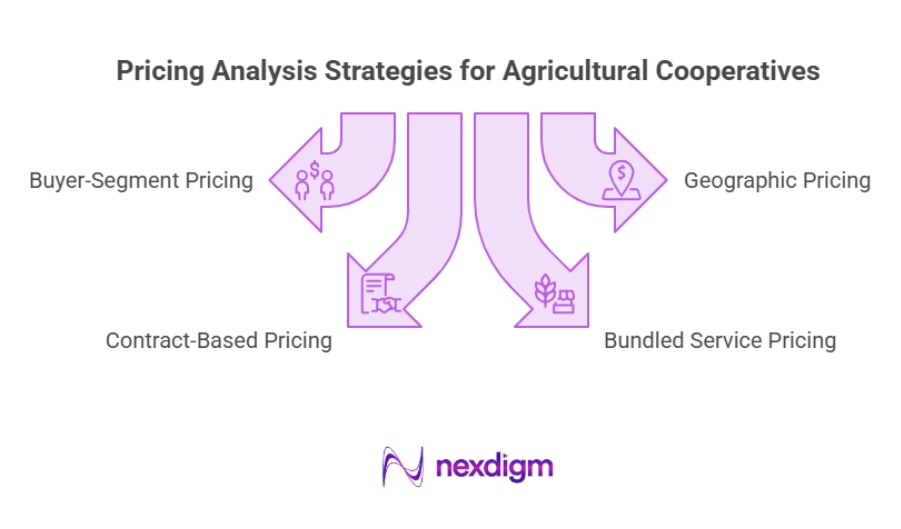
- Buyer-Segment Pricing Strategy: Differentiates prices for processors, retailers, exporters, and institutional buyers based on volume, quality requirements, payment terms, logistics complexity, and expected contribution margins.
- Geographic Pricing Strategy: Adjusts procurement or selling prices across regions to reflect transport costs, local competition, crop availability, market access, and differences in regional demand conditions.
- Contract-Based Pricing Strategy: Uses pre-agreed price bands, minimum guarantees, and adjustment clauses to reduce volatility, secure supply commitments, and provide farmers with greater income predictability.
- Bundled Service Pricing Strategy: Combines procurement prices with benefits such as seeds, fertilizers, advisory services, credit support, storage, or transport to improve overall farmer value and retention.
Nexdigm’s Approach to Pricing Analysis and Farmer-Centric Growth
Nexdigm combines market intelligence, cost benchmarking, demand assessment, and competitor analysis to develop farmer-centric pricing strategies for agricultural cooperatives. Its pricing analysis services support transparent procurement rates, quality premiums, sustainable margins, and improved member participation. Through strategic pricing consulting, agricultural pricing analysis, and cooperative pricing strategy, Nexdigm helps cooperatives strengthen farmer returns, market competitiveness, financial resilience, and long-term growth.
Nexdigm’s Strategic Pricing Analysis Playbook for Farmer-Centric Growth
Nexdigm’s strategic pricing playbook helps agricultural cooperatives align farmer value, market competitiveness, and financial sustainability through structured analysis and disciplined execution across markets. Major playbook elements in focus include:
- Crop and Member Segmentation: Differentiate pricing by crop variety, farmer profile, supply volume, production practices, and service needs to create equitable incentives and improve cooperative participation across member segments.
- Buyer and Channel Analysis: Assess profitability across wholesalers, processors, retailers, exporters, and institutional buyers to prioritize channels offering stronger realization, reliable demand, and sustainable payment terms for cooperatives.
- Digital Price Discovery: Integrate mandi feeds, commodity benchmarks, buyer quotations, weather indicators, and transaction data into dashboards that support faster, evidence-based procurement and selling decisions across regions.
- Price Risk Management: Use floor prices, indexed contracts, hedging mechanisms, contingency reserves, and scenario planning to reduce exposure to commodity volatility and protect farmer incomes during market disruptions.
Nexdigm’s Case
In an agricultural cooperative engagement, Nexdigm applied real-time market benchmarks, cost analysis, and quality-linked pricing models. Within two procurement cycles, farmer participation increased 23%, supply volumes grew 18%, average price realization improved 12%, and pricing disputes declined, strengthening member trust and cooperative profitability.
To take the next step, simply visit our Request a Consultation page and share your requirements with us.
Harsh Mittal
+91-8422857704