

Agricultural equipment procurement involves substantial financial commitments, but buyers often compare machines using headline prices and basic technical specifications. A tractor with a particular horsepower rating, a harvester with a stated capacity or an irrigation pump with a specified output may appear comparable across suppliers. In practice, the final purchase cost can differ because of configuration, attachments, technology, warranty, dealer margins, financing and after-sales support.
For agribusinesses, equipment distributors, farm operators and agricultural service providers, these differences can affect capital expenditure and long-term operating costs. A poor comparison can lead to overpaying for features that are not required or selecting a lower-priced machine that becomes expensive to maintain.
A Large Market with Multiple Pricing Structures
India is one of the world’s largest tractor markets. Domestic tractor sales exceeded 1.01 million units in calendar year 2023. Demand is influenced by agricultural cycles, rural purchasing conditions, financing availability and government support programmes.
However, tractor prices represent only one part of agricultural equipment expenditure. Buyers also procure power tillers, seed drills, planters, sprayers, harvesters, threshers, irrigation pumps, post-harvest machinery and specialised implements. Each category has a different supplier structure and pricing model.
The market includes large original equipment manufacturers, specialised implement producers, regional fabricators, importers, dealers and equipment rental operators. Their cost structures and service capabilities vary considerably.
Specifications Can Create Misleading Price Comparisons
Equipment with similar headline specifications may differ in engine configuration, transmission, hydraulic capacity, fuel efficiency, operating width, material quality and technology features. Implements may also require compatibility checks with the tractor or power unit being used.
A buyer comparing only horsepower or rated capacity may overlook features that affect productivity and maintenance. The same issue applies to harvesting machinery, where field conditions, crop type, operating speed and grain loss performance can influence the actual value of the equipment.
Optional attachments and accessories add another layer. A base quotation may exclude components that are necessary for the intended application, making the final purchase price substantially different from the initial offer.
Regional Markets Influence the Final Purchase Price
Equipment prices can vary between states and districts because of freight, dealer margins, inventory levels, local competition and after-sales arrangements. Rural financing conditions and seasonal demand can also affect promotional offers and delivery terms.
A supplier may offer a competitive base price but have limited service coverage in the buyer’s operating region. Another may charge more while providing faster spare parts access, technician availability and a stronger warranty network.
The commercial comparison must therefore account for the full delivered and supported cost of the machine, not simply the price printed in a catalogue.
Ownership Costs Extend Beyond the Initial Purchase
Agricultural equipment is a long-term asset. Fuel or energy consumption, maintenance, spare parts, downtime, operator training and replacement cycles influence the total cost of ownership.
A machine that is used only during a short harvest window may have a different economic profile from one deployed throughout the year. For seasonal operations, hiring or custom-hiring arrangements may be more economical than outright ownership.
Mechanisation also varies considerably across agricultural operations. Ploughing, sowing, irrigation, harvesting and transportation do not necessarily use the same equipment or operating model. This makes crop- and operation-specific evaluation important.
How Buyers Can Build a Reliable Equipment Price Benchmark
A structured agriculture equipment price intelligence exercise should compare equipment by application, technical specification, supplier, geography and purchase terms. Buyers should collect quotations for equivalent configurations and record what is included in each offer, including attachments, installation, training, warranty and delivery.
The analysis should then separate acquisition price from lifecycle expenditure. Maintenance schedules, spare parts pricing, service response, fuel consumption and expected utilisation can reveal whether a higher-priced machine offers better long-term economics.
Regional dealer research is equally important. Procurement teams should examine stock availability, service territories, authorised dealerships and the supplier’s ability to support equipment after delivery.
Nexdigm supports organisations through equipment market research, supplier benchmarking, pricing intelligence and commercial analysis. Its work can help buyers compare manufacturers and dealer networks, assess regional price variation and evaluate sourcing decisions against operating requirements.
Agricultural Equipment Price Intelligence Framework
A comprehensive assessment should include six stages:
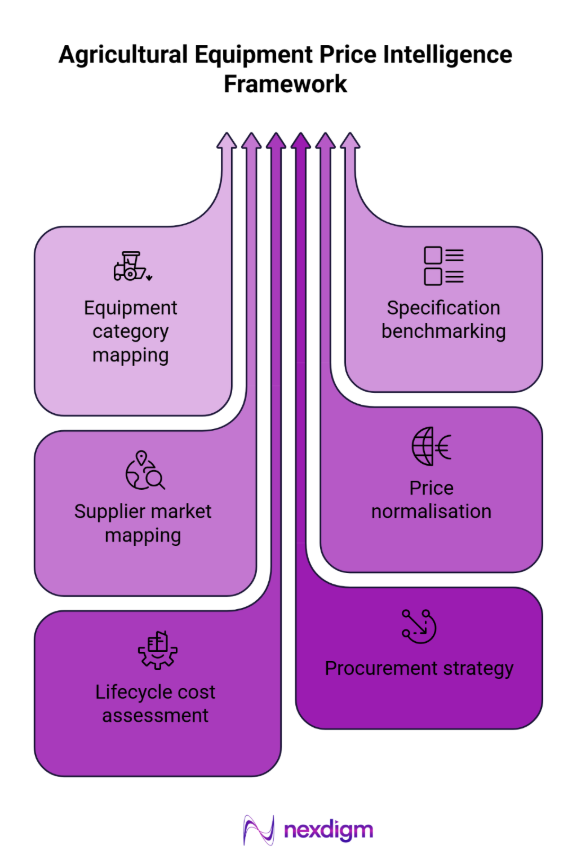
- Equipment category and application mapping: Define the machinery required for land preparation, planting, crop maintenance, irrigation, harvesting, threshing, transportation or post-harvest handling. Record operating conditions, expected utilisation and compatibility with existing assets.
- Specification and configuration benchmarking: Compare horsepower, capacity, engine type, operating width, output, technology features, materials, attachments and safety requirements. Identify which features are essential and which are optional.
- Supplier and market mapping: Identify OEMs, regional manufacturers, importers, authorised dealers and equipment rental providers. Map manufacturing locations, dealer coverage, service infrastructure and regional market presence.
- Price and quotation normalisation: Compare base prices, taxes, freight, installation, accessories, financing, discounts and delivery terms. Ensure that quotations refer to equivalent machine configurations and quantities.
- Lifecycle cost and service assessment: Estimate fuel or energy use, scheduled maintenance, spare parts, warranty coverage, downtime, operator training and expected asset life. Include service availability and replacement equipment arrangements.
- Procurement strategy and negotiation: Compare ownership with leasing or custom hiring, identify suitable volume negotiations, establish acceptable price ranges and define post-sale service commitments. Track actual expenditure against the benchmark after procurement.
Nexdigm’s Case Study: Comparing Agricultural Machinery Prices
Nexdigm benchmarked 28 equipment suppliers across 7 machinery categories, comparing technical configurations, regional quotations, warranty terms and service networks. The analysis identified 8 competitive sourcing options and 5 areas where lifecycle costs warranted closer review.
To take the next step, simply visit our Request a Consultation page and share your requirements with us.
Harsh Mittal
+91-8422857704