

India’s agricultural export opportunity is large, but export growth is not evenly distributed across products or destinations. The relevant question for an exporter is not simply which commodities India produces at scale. It is where price realization, compliance requirements, supply reliability, and destination demand combine to create a commercially viable opportunity.
The export basket is broad, but opportunity is uneven
India’s agricultural and processed food exports exceed $51.9 billion, with products ranging from Basmati and non-Basmati rice to marine products, spices, de-oiled oil meals, buffalo meat, fruits, and processed foods. APEDA has set an ambition of taking agricultural exports toward $100 billion by 2030.
Yet volume alone does not determine attractiveness. A product can have strong global demand while offering limited margins once freight, certification, processing, rejection risk, and distributor margins are considered.
Products with greater differentiation can command materially different realizations. Aged Basmati rice, for example, can achieve around $950–1,250 per MT, while specialty spices and oleoresins can reach $3,500–6,000 per MT.
Destination markets change the value equation
The same product can have very different economics across markets. European markets may support higher realizations for traceable, compliant products, while other destinations may compete primarily on landed cost.
For exporters, destination screening therefore needs to examine:
- Import demand and historical growth
- Realized prices and premium segments
- Tariff and non-tariff barriers
- Sanitary and phytosanitary requirements
- Maximum residue limits
- Certification and traceability requirements
- Freight and port connectivity
- Competitive suppliers from other producing countries
A market with a high import price is not automatically attractive if compliance costs or rejection risks absorb the premium.
Five signals that separate export opportunity from export volume
- Price realization: Products with differentiated quality, processing, provenance, or specifications can create better margins than undifferentiated commodities.
- Regulatory fit: SPS requirements, pesticide residue limits, veterinary requirements, and documentation can determine whether a product is commercially exportable.
- Supply concentration: Established production clusters can provide more predictable procurement and quality control.
- Logistics economics: Perishable products require a very different export model from dry commodities. Cold-chain availability can determine the feasible destination radius.
- Repeatability: A market opportunity becomes commercially meaningful when an exporter can meet specifications consistently across multiple shipments.
Clusters matter as much as commodities
India’s agricultural production is geographically concentrated. This creates opportunities to build export strategies around specific sourcing clusters rather than treating the country as one procurement market.
Rice, grapes, spices, marine products, and horticulture each require different combinations of farmer networks, aggregation, processing, quality testing, storage, and logistics.
The commercial opportunity therefore sits at the intersection of product-market fit and supply-chain readiness.
Compliance can erase an attractive export opportunity
Regulatory volatility is one of the largest risks in agricultural exports. Changes in residue limits, import standards, documentation, or inspection requirements can disrupt shipments even when underlying consumer demand remains strong.
For exporters entering higher-value markets, traceability and pre-export quality control increasingly become part of the commercial proposition rather than administrative overhead.
How Nexdigm Converts Export Potential Into an Actionable Market Map
Nexdigm’s Agriculture export opportunity analysis can assess an export opportunity across four connected dimensions:
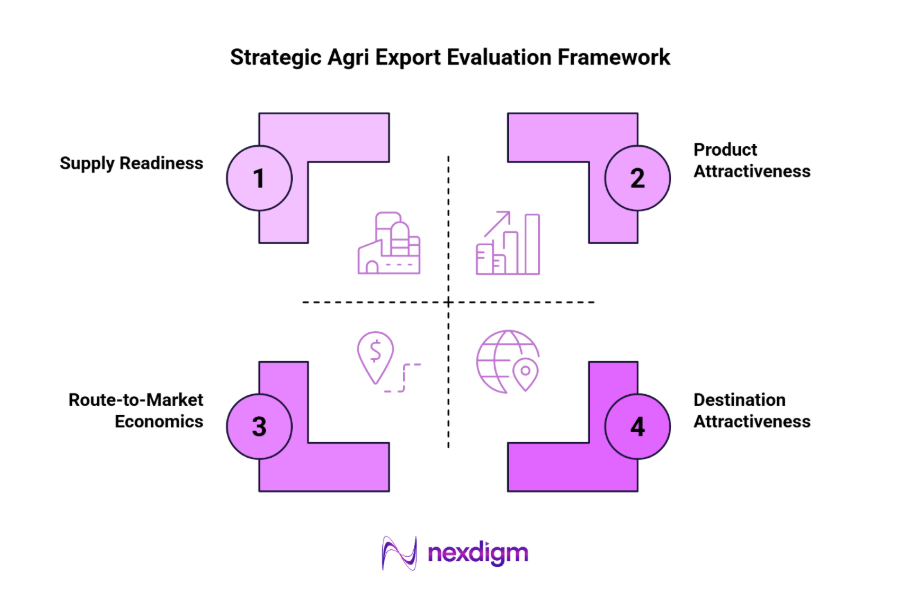
- Product attractiveness: demand growth, price realization, differentiation, processing potential, and competitive intensity.
- Destination attractiveness: import volumes, market growth, buyer requirements, tariffs, regulatory barriers, and price pools.
- Supply readiness: production clusters, procurement availability, processing capacity, quality consistency, and traceability infrastructure.
- Route-to-market economics: freight, cold chain, port connectivity, distributor structures, working capital, and landed margins.
The resulting assessment can help identify priority product-market combinations, quantify addressable opportunity, and determine where investment in sourcing, processing, compliance, or distribution is required.
Nexdigm Case: Turning Compliance Into Export Value
An assessment of a North Indian rice exporter identified tricyclazole compliance as a critical barrier in European markets. A traceability system covering 4,500 contracted hectares was introduced alongside field-level agronomy controls. Rejections fell to zero over two seasons, while realized prices increased by 14% and clearance time declined from 21 days to 4 days.
To take the next step, simply visit our Request a Consultation page and share your requirements with us.
Harsh Mittal
+91-8422857704