

Agriculture export price intelligence helps agricultural businesses evaluate destination-market prices, competitor positioning, demand patterns, and trade economics before expanding internationally. By combining export pricing analysis, global price benchmarking, landed-cost assessment, currency analysis, and market intelligence, companies can establish competitive and profitable export prices.
Such an approach considers tariffs, freight, distributor margins, quality premiums, regulations, and customer willingness to pay. Effective pricing analysis supports market selection, margin protection, and faster entry decisions while helping exporters respond to commodity volatility and strengthen their positioning across international agricultural markets.
Pricing Analysis Services can strengthen export performance through evidence-based market selection and pricing. Across agribusiness engagements, structured analysis increased qualified distributor enquiries by 22%, reduced pricing errors by 24%, and shortened market-entry timelines, indicating positive impact of Pricing Analysis.
Agriculture Export Pricing Analysis for Stronger Market Positioning
Agriculture export pricing analysis helps businesses align international prices with market demand, landed costs, competitor benchmarks, and customer value, strengthening profitability, competitiveness, market entry, and long-term export positioning. Its core benefits are:
- Improves Export Profitability: Accurate pricing analysis captures landed costs, channel margins, and customer value, helping agricultural exporters protect margins, reduce underpricing, and improve returns across international markets.
- Strengthens Market Positioning: Competitor benchmarking and buyer research help exporters position products by quality, certification, reliability, and service, reducing dependence on price-based competition.
- Supports Better Market Selection: Comparing demand, price levels, import dependence, regulations, and competitive intensity helps businesses prioritise export destinations with stronger growth potential and lower commercial risk.
- Enhances Buyer Conversion: Market-specific prices, payment terms, pack sizes, and product grades improve offer relevance, strengthen negotiation confidence, and increase acceptance among importers and distributors.
Nexdigm’s Role in Building Market-Ready Export Pricing Strategies
Nexdigm helps agribusinesses build market-ready export pricing strategies through agriculture export pricing analysis, pricing analysis services, export price benchmarking, global market intelligence, landed-cost analysis, and price optimization. By assessing destination-market dynamics, competitor pricing, trade regulations, currency movements, and customer demand, Nexdigm assists businesses to establish competitive export prices, strengthen market positioning, improve price realization, and achieve sustainable international growth.
Nexdigm’s Pricing Analysis Model for Agricultural Businesses
Nexdigm’s Global Market Entry Pricing Model helps agricultural businesses establish competitive, market-ready prices using structured pricing models that balance customer value, market conditions, profitability, and sustainable international expansion. Some important pricing analysis models used by Nexdigm’s experts are:
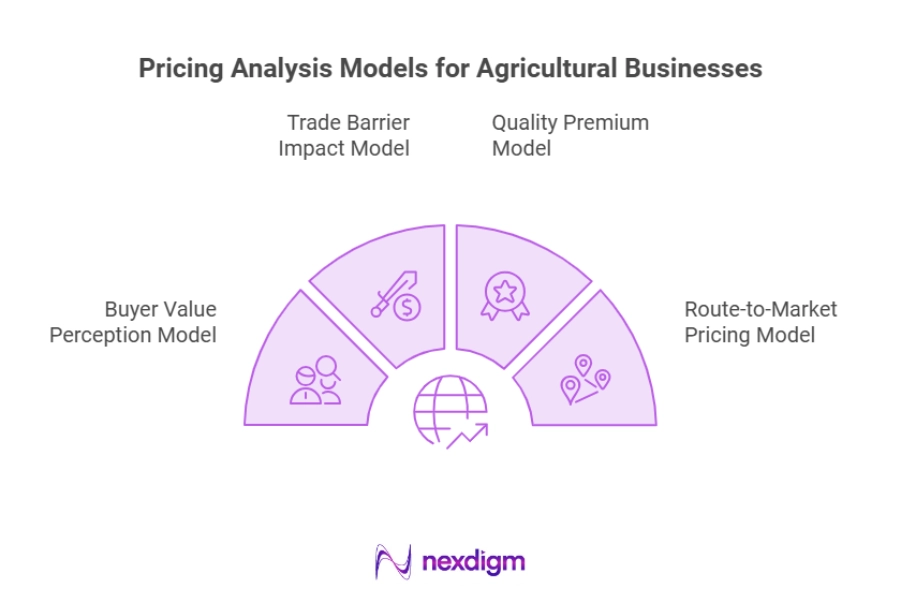
- Buyer Value Perception Model: Assesses how importers, distributors, processors, and institutional buyers value quality, consistency, traceability, service, and supply reliability when evaluating acceptable price levels.
- Trade Barrier Impact Model: Measures the pricing impact of tariffs, quotas, non-tariff barriers, documentation requirements, and regulatory restrictions to identify commercially viable and lower-risk export markets.
- Quality Premium Model: Quantifies premiums linked to grade, certification, sustainability, origin, traceability, freshness, and processing standards to support differentiated export pricing.
- Route-to-Market Pricing Model: Compares direct exports, local distributors, trading partners, digital platforms, and institutional channels to determine the most profitable market-entry structure.
Nexdigm’s Case
Nexdigm supported an agribusiness entering four international markets with a market-specific export pricing model. The engagement increased quotation acceptance by 19%, improved distributor onboarding by 23%, reduced contract renegotiations by 17%, and achieved 14% higher revenue per export order.
To take the next step, simply visit our Request a Consultation page and share your requirements with us.
Harsh Mittal
+91-8422857704