

India’s agricultural production base is expanding faster than parts of the infrastructure required to move, store, cool, process, and preserve that output.
Horticulture output has reached approximately 362 million metric tonnes, exceeding foodgrain production of 357.73 million tonnes. Yet large infrastructure gaps remain across packhouses, refrigerated transportation, multi-commodity cold storage, and modern grain handling.
The commercial opportunity is therefore increasingly defined by where production is growing faster than infrastructure capacity.
Cold Storage Capacity Does Not Equal Cold-Chain Capability
India has approximately 37.4 million metric tonnes of cold-storage capacity, but around 70% is concentrated in single-commodity potato storage, particularly across Uttar Pradesh and West Bengal.
This creates a structural mismatch.
A warehouse may have substantial installed capacity while still providing limited value for fruits, vegetables, dairy, seafood, or processed foods requiring different temperature and handling conditions.
The next infrastructure opportunity is therefore not necessarily more cold storage. It is infrastructure that can handle multiple commodities, seasons, and temperature requirements.
The First Mile Remains the Weakest Link
Post-harvest losses often begin before produce reaches a formal storage facility.
Modern integrated packhouses remain limited relative to estimated requirements, particularly facilities combining sorting, grading, washing, rapid pre-cooling, and packing.
This matters most for high-value perishables. Without rapid cooling and appropriate handling at or near the farm gate, downstream cold storage cannot fully protect quality.
Infrastructure investment therefore needs to follow the product’s journey rather than focus on isolated assets.
Reefer Shortages Are Creating a Mobility Gap
Temperature-controlled transport represents another major constraint.
The country has fewer than 15,000 active reefer vehicles against an estimated requirement exceeding 50,000 units. This gap creates temperature-control failures between farms, packhouses, processing plants, distribution centres, and ports.
The commercial consequence extends beyond spoilage. Export-oriented producers can lose quality premiums, processors face inconsistent raw-material quality, and retailers bear higher rejection and inventory risks.
A cold-chain investment strategy therefore needs to consider transport density alongside fixed infrastructure.
Grain Infrastructure Has a Different Problem
Foodgrain storage faces a different structural challenge.
Traditional storage systems rely heavily on jute bags, conventional warehouses, and Cover and Plinth facilities. Modern steel silos can improve handling efficiency and reduce exposure to pest, moisture, and spillage losses, but deployment can be slowed by land acquisition and inadequate rail connectivity.
This creates an infrastructure-location problem. A silo can be technically efficient yet commercially unattractive if it lacks access to major procurement centres or dedicated rail infrastructure.
Utilization Will Determine Which Assets Actually Work
Agricultural infrastructure is particularly sensitive to seasonality.
Single-commodity cold stores may operate close to full capacity for several months after harvest and remain substantially underutilized for the rest of the year. Debt servicing continues regardless.
Multi-commodity facilities can spread utilization across crops and seasons, potentially improving asset economics.
For investors, therefore, the relevant question is not simply whether a region has an infrastructure deficit. It is whether the deficit can support an asset with sufficiently high year-round utilization.
Where Production Meets Infrastructure, the Investment Opportunity Emerges
An agriculture infrastructure investment study should identify mismatches between production density and available storage, processing, transportation, and handling capacity.
The analysis should then translate those gaps into investable infrastructure configurations.
Nexdigm’s Agri-Infrastructure Gap Assessment Framework
Nexdigm evaluates agricultural infrastructure opportunities through five lenses:
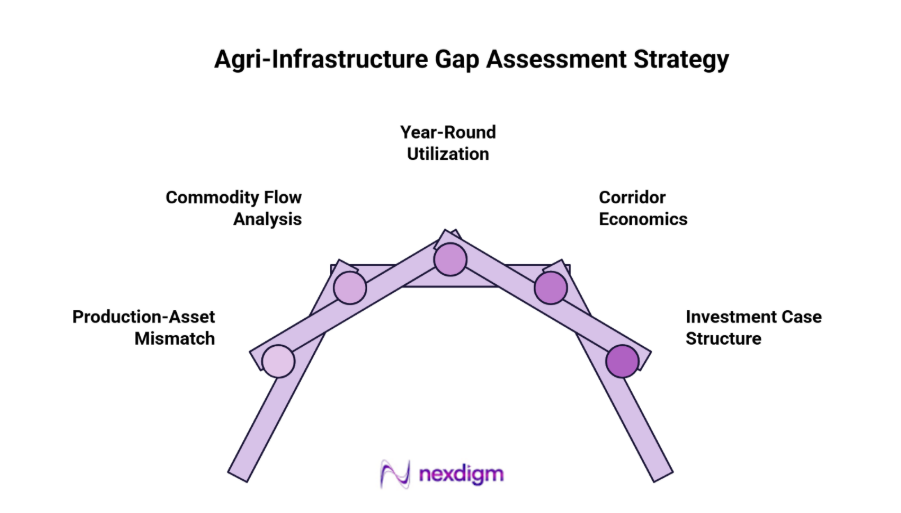
- Locate the Production-Asset Mismatch: Map crop production, growth rates, seasonality, and commodity concentration against existing storage, packhouse, processing, and logistics capacity to identify structural gaps.
- Follow the Commodity Beyond the Farm Gate: Trace each product through collection, grading, pre-cooling, storage, transportation, processing, and final markets to identify where infrastructure failure creates the greatest value leakage.
- Design for Year-Round Utilization: Model commodity seasonality and temperature requirements to test whether multi-commodity, multi-temperature, or flexible infrastructure can improve asset utilization.
- Build the Corridor Economics: Assess road, rail, port, airport, and market connectivity alongside freight costs and transit requirements to identify locations where infrastructure can serve multiple demand centres.
- Structure the Investment Case: Evaluate CapEx, financing support, subsidies, utilization, operating costs, contracted demand, and revenue potential to determine commercially viable asset configurations.
Case Study: Nexdigm’s Multi-Commodity Cold-Chain Development
A third-party cold-chain logistics operator evaluating a new facility in the Nashik horticultural belt projected an 8.5% IRR for a conventional 5,000 MT single-commodity cold store because of seasonal utilization constraints.
Nexdigm redesigned the project as a multi-commodity, four-temperature-zone Controlled Atmosphere facility with integrated pre-cooling chambers and an Individual Quick Freezing line. The project secured a 3% interest subvention on a ₹12 crore debt facility through the Agriculture Infrastructure Fund and a 35% capital subsidy under the MoFPI PMKSY framework. By rotating export grapes, pomegranates, and off-season vegetable pulps through the facility, projected year-round utilization reached 78%, increasing the asset’s equity IRR to 19.4%.
To take the next step, simply visit our Request a Consultation page and share your requirements with us.
Harsh Mittal
+91-8422857704