

Agricultural input expenditure can vary substantially across regions, suppliers, product grades and purchasing periods. For agribusinesses, distributors, agricultural service companies and large farming operations, these differences influence operating margins and the cost of production.
Yet procurement teams often evaluate seeds, fertilizers, crop protection products and other inputs through separate purchasing processes, making it difficult to understand the total cost of agricultural operations.
A supplier may offer a competitive price in one category while charging more for another. Regional distributors may apply different margins, while packaging, freight, seasonal availability and credit terms alter the final purchase cost. Without a common benchmarking approach, organisations may struggle to identify where their spending is genuinely competitive.
Input Price Variation Is Driven by More Than Supplier Margins
Agricultural input prices are influenced by raw material costs, manufacturing processes, imports, energy, packaging, logistics, regulatory requirements and distribution margins. These factors vary across product categories.
Fertilizer procurement, for example, is exposed to international prices and import availability. India’s fertilizer supply data for FY 2024–25 shows that domestic production did not fully meet demand across several major fertilizer categories.
MOP was entirely import-dependent, while DAP imports were higher than domestic production. This creates exposure to international markets, shipping and currency movements
Seeds have a different cost structure. Hybrid characteristics, breeding and multiplication costs, treatment, certification, packaging and distribution can influence prices. Crop protection products are affected by active ingredient costs, formulation, registration and product positioning. Comparing these categories using a single price metric would therefore produce little meaningful insight.
Regional Differences Can Distort Procurement Budgets
The same input may be sold at different prices across states, districts and distribution channels. Freight, local dealer margins, taxes where applicable, order volumes and seasonal demand all contribute to these differences.
Procurement teams managing multiple agricultural locations may therefore face inconsistent pricing even when purchasing similar products. In some cases, regional variation reflects legitimate differences in delivery and service costs. In others, it may indicate fragmented purchasing, weak negotiation leverage or limited visibility into alternative suppliers.
The problem becomes more serious when organisations compare invoice prices without normalising pack sizes, product concentrations, grades or delivery terms. A lower price per pack may not represent better value if the pack contains a smaller quantity or a different formulation.
Seasonal Purchasing Can Increase Cost Exposure
Agricultural input demand is closely linked to sowing and crop protection calendars. Suppliers may face concentrated demand before planting seasons, while buyers may have limited flexibility to delay purchases.
This creates a procurement disadvantage for organisations that do not forecast requirements or negotiate early. Last-minute orders can increase dependence on local availability, reduce supplier choice and create pressure to accept less favourable commercial terms.
Inventory decisions also affect total cost. Purchasing too early can increase storage and financing expenses, while purchasing too late may expose buyers to shortages and higher prices. The optimal approach depends on the product’s shelf life, demand predictability and market conditions.
Inconsistent Specifications Make Cost Comparisons Misleading
A comparison of two fertilizer prices is incomplete without accounting for nutrient composition. Similarly, seed prices need to be assessed against variety, germination, purity, treatment and pack size. Crop protection products require comparison by active ingredient concentration, formulation and recommended application rate.
The same issue applies to equipment, irrigation supplies and other farm inputs. Procurement teams need consistent specifications before they can determine whether suppliers are offering comparable products.
What Buyers Should Do to Establish a Meaningful Cost Benchmark
A comprehensive agriculture input cost benchmarking exercise should consolidate expenditure across major input categories and compare prices on a like-for-like basis. It should examine supplier quotations, historical purchase data, regional market prices, product specifications, distribution margins and logistics costs.
The analysis should separate product price from the wider cost of procurement. Freight, handling, storage, credit periods, minimum order quantities and quality-related losses can all change the economic outcome. For inputs with different concentrations or application rates, prices should be normalised to a comparable unit, such as cost per nutrient unit, treated area or application.
Nexdigm supports organisations through procurement benchmarking, supplier intelligence, market pricing research and commercial analysis. Its research can help buyers identify price variation, understand cost drivers, compare supplier offers and develop negotiation strategies across agricultural input categories.
Agriculture Input Cost Benchmarking Framework
A useful benchmarking programme should be built around six stages:
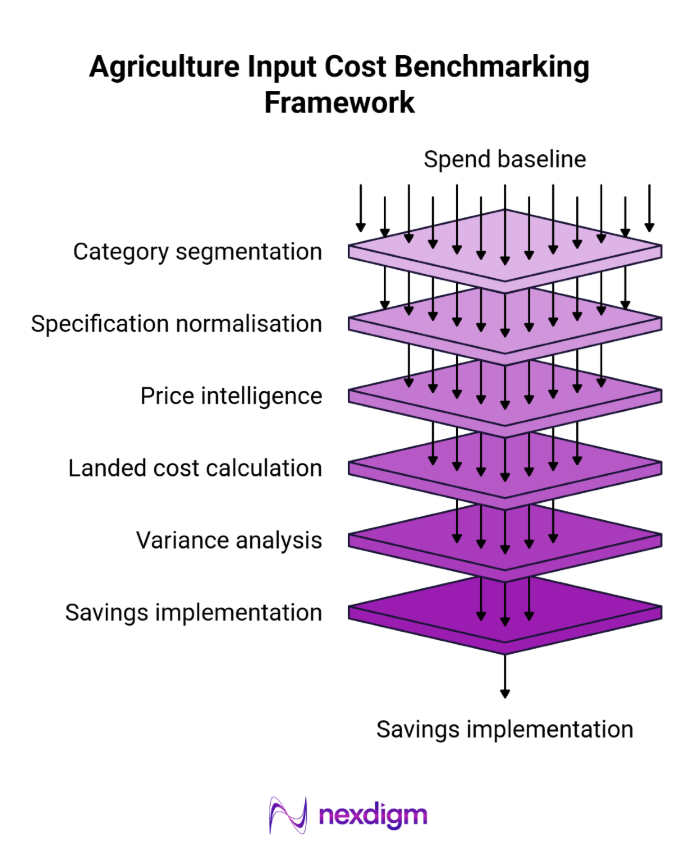
- Spend baseline and category segmentation: Consolidate expenditure across seeds, fertilizers, crop protection products, micronutrients, irrigation materials and other relevant inputs. Segment purchases by region, crop, supplier, product and season.
- Specification normalisation: Establish comparable product definitions. Account for seed variety and pack size, fertilizer nutrient composition, pesticide active ingredient and concentration, formulation, application rate and quality grade.
- Market and supplier price intelligence: Collect current and historical supplier quotations, distributor prices, market references and available procurement data. Distinguish manufacturer pricing from distributor and retail pricing.
- Total landed cost calculation: Include freight, handling, storage, insurance, financing, credit terms, packaging and other procurement-related expenses. For selected products, calculate cost per usable unit or treated hectare.
- Variance and cost-driver analysis: Identify differences by region, supplier, purchase volume, season and contract structure. Separate justified cost differences from potential inefficiencies, fragmented purchasing or weak negotiation outcomes.
- Negotiation and savings implementation: Prioritise categories with the greatest addressable spend and price variance. Develop target price ranges, volume consolidation opportunities, alternative supplier options and contract improvements. Track realised savings against a defined baseline.
Nexdigm’s Case Study: Benchmarking Multi-Category Agricultural Input Spend
Nexdigm analysed procurement expenditure across 5 agricultural input categories and 9 sourcing regions, identifying price variances, specification gaps and logistics cost drivers. The study prioritised 7 procurement opportunities for supplier negotiations and category-level cost optimisation.
To take the next step, simply visit our Request a Consultation page and share your requirements with us.
Harsh Mittal
+91-8422857704