

Agriculture is attracting capital across a value chain that looks increasingly different from the traditional farm investment story. Seeds, crop protection, cold storage, food processing, logistics, and branded foods can offer very different combinations of growth, margins, capital intensity, and regulatory exposure.
For investors, the challenge is therefore allocation. A rapidly growing agricultural market does not automatically translate into an attractive investment. Capital has to be matched with the economics and structural constraints of each segment.
The Highest-Growth Segment May Not Be the Best Asset
Upstream agricultural inputs can offer attractive economics because technical capabilities, intellectual property, and distribution relationships create barriers to entry. Specialty agrochemicals and hybrid seeds, for example, can support stronger margins than commodity-oriented agricultural businesses.
But these businesses also carry significant working-capital requirements. Seed businesses can hold inventory for extended seasonal periods, while agrochemical companies may extend substantial credit through distribution networks.
At the other end of the value chain, basic staples processing can generate high asset turnover but operate on much thinner margins. Commodity exposure, procurement cycles, inventory requirements, and government intervention can constrain the return available to investors despite large underlying volumes.
The investment equation therefore needs to distinguish market scale from value creation.
Infrastructure Offers a Different Route Into Agricultural Growth
Midstream infrastructure sits between production and consumption, making its economics dependent on utilization rather than simply commodity prices.
Cold storage, modern silos, packhouses, and logistics networks can benefit from increasing agricultural output and organized food distribution. However, asset utilization becomes critical. A facility built around a single commodity can remain underutilized for significant portions of the year.
This makes multi-commodity infrastructure increasingly relevant. Facilities capable of handling different products, temperatures, and seasonal cycles can potentially spread fixed costs across a wider revenue base.
For infrastructure investors, location and utilization can matter as much as headline market growth.
Primary Farming Has Scale Constraints That Other Segments Avoid
Direct investment in agricultural production presents a different set of challenges.
Land fragmentation, state-level land regulations, weather exposure, input-price volatility, and harvest cycles make primary agriculture operationally intensive. Farm-level margins can also remain relatively thin compared with downstream branded products.
This does not eliminate the opportunity. Contract farming, integrated livestock production, aggregation, and technology-enabled farm management can create scalable models without relying entirely on direct land ownership.
The more important question is how much operating control and value-chain integration an investment can establish around the farm.
Processing Can Capture Value Beyond the Commodity
Downstream processing changes the economics by moving the business closer to the consumer.
Value-added packaged foods, functional products, ready-to-eat categories, and value-added dairy can combine agricultural inputs with processing, branding, packaging, and distribution. These businesses can generate higher realization and reduce direct dependence on commodity pricing.
Government support also matters. The Production Linked Incentive Scheme for Food Processing Industry carries an outlay of ₹10,900 crore, creating an additional policy lever for eligible investments.
The opportunity is consequently moving toward businesses that can convert agricultural volume into differentiated products.
Five Questions Before Agricultural Capital Moves
An agriculture investment opportunity analysis needs to go beyond market growth and examine the characteristics that determine whether growth can actually translate into investor returns.
- How scalable is the business? Assess whether growth depends on adding proportionate physical assets, expanding distribution, increasing processing throughput, or developing proprietary capabilities.
- How much capital does growth consume? Compare initial CapEx, asset turnover, maintenance requirements, and incremental capital required for each additional unit of revenue.
- How stable are margins? Separate businesses with pricing power and differentiated products from those exposed to commodity prices, procurement volatility, or government intervention.
- Where does working capital get trapped? Examine inventory cycles, farmer payments, distributor credit, seasonal procurement, and receivables to determine how much cash must remain inside the operating model.
- What can change the investment thesis? Stress-test regulatory changes, export restrictions, subsidy changes, commodity prices, climate exposure, and competitive entry before committing capital.
Nexdigm’s 5-Vector Agri-Capital Investment Framework
Nexdigm evaluates agricultural investment opportunities across five interconnected dimensions:
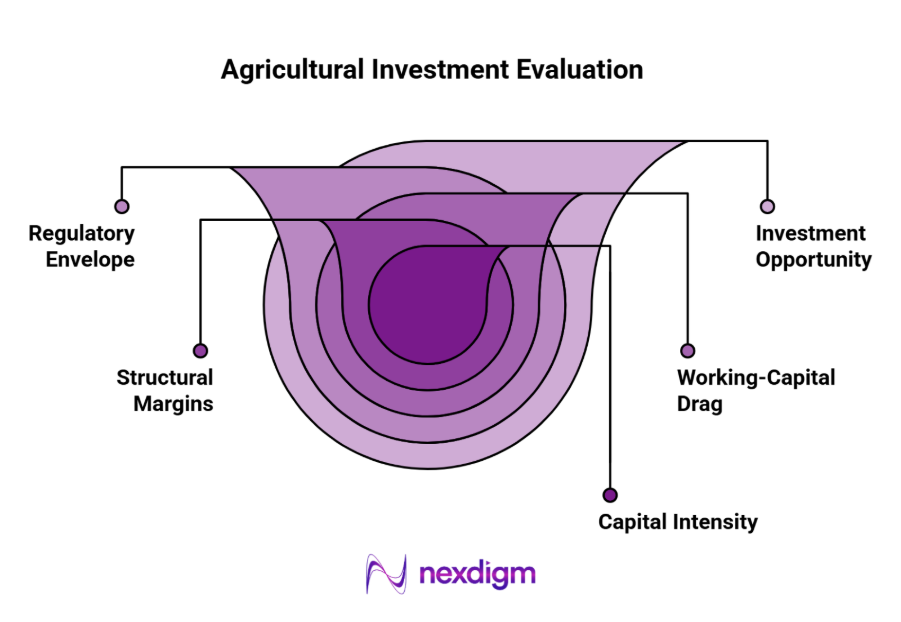
- Growth Without Blind Expansion: Assess category growth, addressable demand, competitive intensity, and scalability to determine whether projected expansion can support an investable growth trajectory.
- Capital Intensity Before Capital Commitment: Model asset requirements, asset turnover, maintenance CapEx, and incremental investment need to identify businesses where growth does not consume disproportionate capital.
- Separate Structural Margins from Commodity Margins: Analyse pricing power, product differentiation, procurement exposure, and margin volatility to understand the durability of operating returns.
- Expose the Working-Capital Drag: Map inventory, seasonal procurement, distributor credit, receivables, and payment cycles to quantify the cash required to sustain operations.
- Stress-Test the Regulatory Envelope: Evaluate land restrictions, food regulations, environmental requirements, subsidies, procurement policies, and trade interventions to identify potential downside scenarios.
Case Study: Nexdigm’s Pre-Acquisition Value Chain Re-Allocation
A private equity firm evaluating an investment in a commodity basmati rice processing plant in Punjab identified working-capital cycles exceeding 150 days and EBITDA margins capped at 4.2%, alongside exposure to export restrictions.
Nexdigm assessed alternative agricultural value-chain opportunities and recommended reallocating capital toward a specialty food ingredients processor in Gujarat producing customized spice oleoresins and extruded pea-protein isolates for export.
The alternative asset operated with a 60-day working-capital cycle and contracted EBITDA margins of 17.5%. Including applicable fiscal incentives, the investment model projected a five-year IRR of 24%, compared with 11% for the rice-processing asset.
To take the next step, simply visit our Request a Consultation page and share your requirements with us.
Harsh Mittal
+91-8422857704