

Agricultural logistics plays a critical role in connecting farms, processors, distributors, and end markets. However, supplier selection involves more than comparing freight rates or transportation capacity. Businesses must understand whether logistics partners can manage commodity-specific handling requirements, maintain product condition, serve relevant production and consumption regions, and deliver consistently.
India’s logistics cost was estimated at 8% of GDP in 2023–24, highlighting the commercial importance of logistics efficiency. Meanwhile, government data indicates that 301 integrated cold-chain projects were operational by December 2025, adding storage, processing, and refrigerated transport capacity. Against this backdrop, agriculture logistics supplier analysis can help businesses assess logistics providers beyond their stated service offerings and identify partners aligned with their supply-chain requirements.
Why Agricultural Logistics Requires a Network-Level Assessment
Agricultural products move through multiple stages, from farm-gate collection and aggregation to storage, processing, transportation, and distribution. Each stage introduces different handling and coordination requirements. Perishable commodities require temperature management, while grains and other bulk products depend on suitable storage, loading, and transport infrastructure. Logistics providers therefore need to be assessed in the context of the complete supply chain, rather than on individual service capabilities alone.
Factors That Shape Agricultural Logistics Partner Selection
Businesses evaluating logistics providers should consider how well their networks and operating models support the movement of agricultural commodities.
- Geographic Reach: Assess coverage across production clusters, procurement centres, warehouses, processing facilities, consumption markets, and key transportation corridors.
- Commodity Handling Capability: Examine infrastructure and processes for bulk storage, temperature-controlled transport, loading, unloading, packaging, and product-specific handling requirements.
- Service Reliability and Economics: Compare delivery consistency, transit times, shipment visibility, service flexibility, pricing structures, and additional charges across providers.
Together, these factors help businesses distinguish between providers with broad service portfolios and those capable of meeting specific agricultural logistics requirements.
Nexdigm’s Approach to Understanding the Agricultural Logistics Supplier Landscape
A logistics provider’s stated coverage does not always reflect its operational reach or suitability for a particular commodity. Our agriculture logistics supplier analysis helps businesses develop a structured view of the agricultural logistics market by examining:
- Transportation and Freight Providers: Road transport operators, rail freight participants, bulk cargo handlers, and multimodal logistics providers involved in moving agricultural commodities.
- Storage and Warehousing Companies: Operators offering grain warehouses, silos, cold-storage facilities, distribution centres, and other agricultural storage infrastructure.
- Integrated Logistics Providers: Businesses combining transportation, warehousing, inventory management, freight coordination, and distribution services.
- Specialized Cold-Chain Operators: Providers managing refrigerated vehicles, pre-cooling, temperature-controlled storage, and handling of perishable agricultural products.
This segmentation helps procurement and supply-chain teams understand the composition of the market before evaluating individual providers.
How Nexdigm Assesses Operational Capability of Agriculture Logistics Partner
A large fleet or extensive warehouse portfolio does not necessarily indicate that a provider can support every agricultural commodity or route. Our analysis examines the operating capabilities behind each supplier’s service proposition.
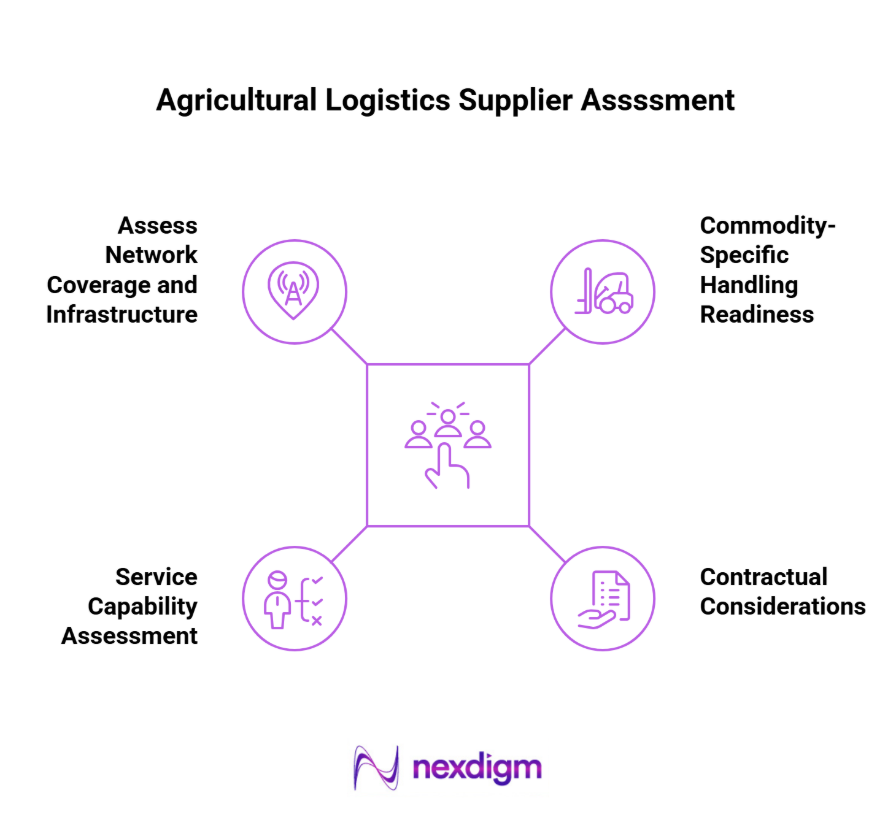
- Network Coverage and Infrastructure: Our research examines provider locations, serviceable regions, warehouse networks, transport routes, fleet presence, and connectivity with agricultural production and consumption centres. This helps businesses understand the practical reach of potential partners.
- Commodity-Specific Handling Readiness: We assess whether providers have relevant infrastructure and operating processes for different product categories. This can include bulk handling equipment, loading systems, and specialized transportation arrangements.
- Execution and Service Capabilities: Our assessment considers shipment tracking, delivery coordination, documentation processes, operational flexibility, and the ability to manage varying shipment volumes. These indicators provide a broader view of service readiness.
- Commercial and Contractual Considerations: We examine available information on freight rates, storage charges, pricing models and other commercial parameters. This supports a more informed comparison of providers beyond headline pricing.
By evaluating these dimensions together, our assessment helps businesses distinguish between providers with a broad service offering and those with the operational capabilities to support specific agricultural logistics requirements
Business Impact of Nexdigm’s Agricultural Logistics Supplier Analysis
A structured understanding of logistics providers can help businesses make more informed supply-chain and procurement decisions. Our supplier analysis supports several practical outcomes:
- Improved Supplier Selection: Identify logistics partners whose network coverage, handling capabilities, and service offerings align with business requirements.
- Greater Supply-Chain Visibility: Understand provider infrastructure, operating locations, and service capabilities across different stages of agricultural movement.
- Better Handling and Quality Alignment: Evaluate whether logistics partners can support commodity-specific storage, transportation, and handling requirements.
- More Informed Cost Evaluation: Compare freight charges, storage costs, service terms, and commercial models to understand overall logistics suitability.
- Stronger Operational Planning: Identify capability gaps and prioritize providers for further evaluation, due diligence, and commercial negotiations.
These insights help businesses build a logistics partner network that better reflects their operational priorities, commodity requirements, and distribution objectives.
Nexdigm’s Case
An agricultural commodities distributor sought to improve logistics coverage across multiple procurement regions. Nexdigm assessed 26 providers across transportation, warehousing, and handling capabilities. The analysis found that 27% had limited coverage in key sourcing regions, while 19% lacked adequate commodity-specific handling information. The distributor used these findings to prioritize seven providers for further operational and commercial evaluation.
To take the next step, simply visit our Request a Consultation page and share your requirements with us.
Harsh Mittal
+91-8422857704