

A large agricultural market can produce a surprisingly small addressable opportunity. Headline acreage, farmer population, and input spending often conceal the factors that determine whether a new entrant can actually sell, collect payments, obtain approvals, and build a viable distribution network.
For agricultural businesses entering India, the commercial question therefore moves from “How large is the market?” to “Which part of that market can the business realistically reach and serve?”
Why Headline TAM Can Mislead Agricultural Entrants
India has approximately 140 million hectares of net sown area, according to the source material. Yet the commercially serviceable portion can be substantially smaller once irrigation, farmer adoption, credit availability, road connectivity, and purchasing power are considered.
The source estimates that effective SAM may represent only 15%–25% of headline TAM after these filters are applied.
Distribution economics create another constraint. Agricultural dealers commonly operate on 60–90-day credit terms linked to kharif and rabi cycles. A new entrant therefore has to fund inventory and receivables before meaningful cash conversion occurs. Indicative channel margins also accumulate across the route to market, from C&F agents and distributors to retail agro-dealers.
Regulatory Complexity Can Determine the Entry Timeline
Agricultural products cannot always be commercialised through a uniform national launch model. Seeds, fertilizers, and crop protection products can involve state-level registration, testing, licensing, and administrative requirements.
The source estimates that obtaining relevant approvals across multiple major agricultural states can involve 12–24 months of bio-efficacy trials, laboratory testing, and regulatory filings, depending on the product category.
That timeline changes the economics of market entry. Working capital, launch sequencing, local partnerships, and product prioritisation need to be planned around regulatory readiness rather than treated as post-launch execution issues.
Entry Mode Changes the Risk Profile
Four broad routes create different combinations of control, speed, capital requirements, and margin retention:
- Direct Rollout: Provides greater control over branding and distribution but requires substantial time and investment to establish dealer networks and regulatory approvals.
- Contract Manufacturing or White-Labeling: Can accelerate commercialisation, with the source estimating a 6–9-month route to market, although margins are shared and brand ownership at the rural retail level is weaker.
- Strategic Distribution Alliances: Established distribution networks can provide immediate geographic reach, although the entrant trades part of its margin for access and execution speed.
- Regional Acquisition: Acquiring a local player can provide existing approvals, facilities, distributors, and market relationships, but requires careful commercial, regulatory, and operational due diligence.
Nexdigm’s Agriculture Market Entry Assessment Framework
Nexdigm can structure an agriculture market entry advisory firm engagement around five analytical dimensions:
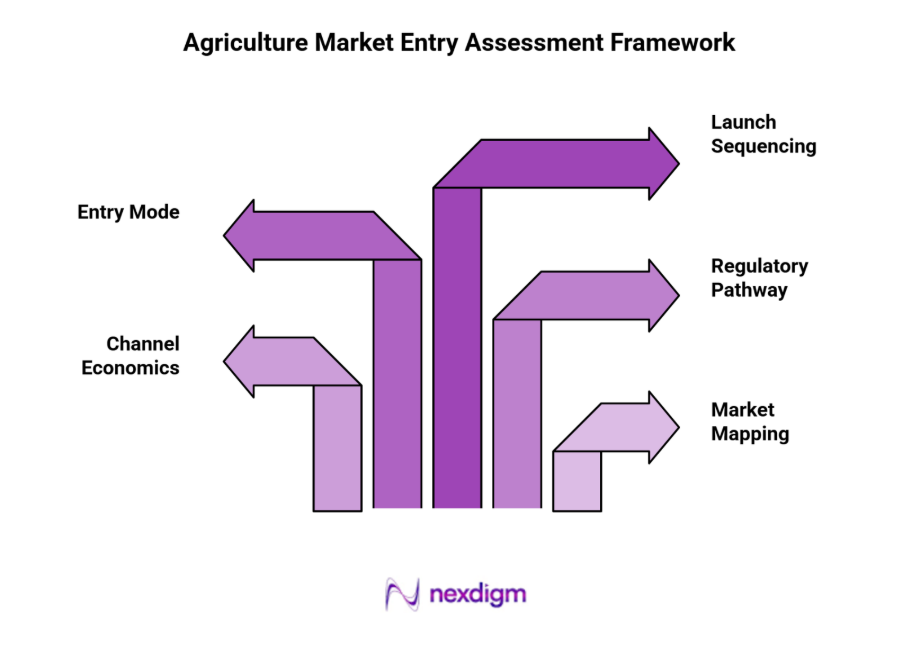
- Effective Addressable Market Mapping: Target states and districts are segmented by crop mix, irrigation, farmer profiles, purchasing power, logistics access, and adoption readiness to identify the portion of the market that is realistically serviceable.
- Channel Economics and Credit Exposure: Distributor margins, dealer credit periods, inventory requirements, collection cycles, working-capital exposure, and bad-debt risks are modelled to determine the financing required to support market entry.
- Regulatory Pathway Mapping: Product-specific approvals, state registrations, testing requirements, documentation, and expected timelines are mapped to identify regulatory bottlenecks before commercial launch.
- Entry Mode Evaluation: Direct investment, contract manufacturing, distribution partnerships, acquisitions, and other routes are compared against capital requirements, speed to market, control, margin retention, and execution risk.
- Launch Sequencing and Market Prioritisation: States and product categories are sequenced according to addressable demand, regulatory readiness, channel availability, competitive intensity, and expected return on investment.
Nexdigm’s Case Study
Nexdigm guided a Japanese farm-equipment maker entering India. Across Maharashtra, Haryana, and Tamil Nadu, analysis compressed 140M-hectare TAM into a viable 15%–25% SAM, optimized 60–90-day channel credit, cut 12–24-month regulatory delays, and delivered a 9–12-month commercialization roadmap.
To take the next step, simply visit our Request a Consultation page and share your requirements with us.
Harsh Mittal
+91-8422857704